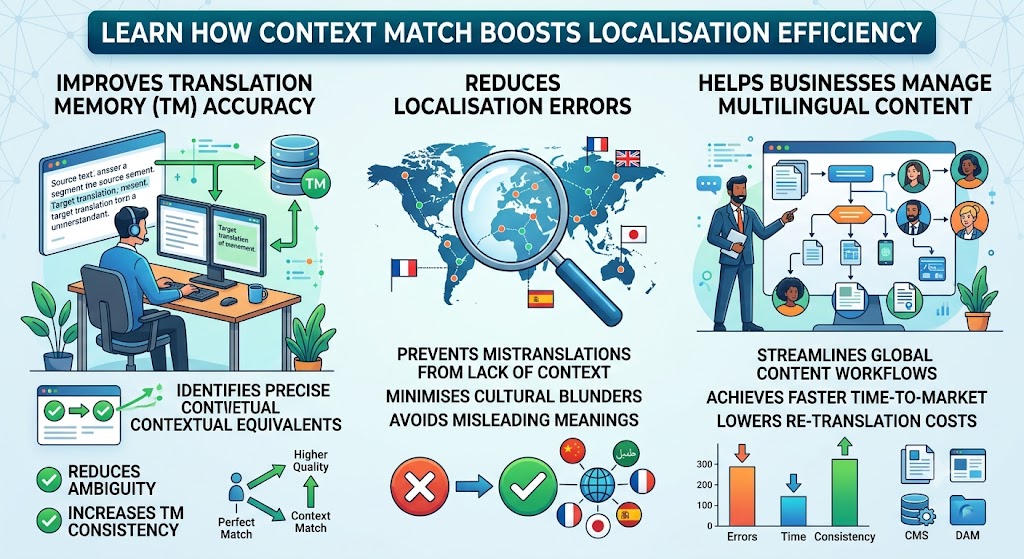
A context match is a translation memory feature that helps translators identify when a new source sentence exactly matches a previously translated sentence in the same context. Unlike a simple 100% translation memory match, this approach also checks surrounding information, such as neighbouring segments, document structure, or metadata, to confirm that the translation remains appropriate.
For global businesses managing thousands of product descriptions, legal documents, software interfaces, and marketing materials, this distinction matters. A sentence may have been translated correctly in one project but become unsuitable when used in another situation. Context match reduces this risk by examining more than the words alone.
Modern localisation platforms rely heavily on translation memory systems because they improve productivity, maintain brand consistency, and reduce unnecessary translation costs. However, organisations must understand how these systems work, where they provide value, and where human expertise remains essential.
Understanding How Context Match Works
Translation memory (TM) technology stores previously approved translations in databases called translation memories. Each stored entry contains:
- The original source text.
- The approved translated version.
- Additional information about where and when it was used.
When translators receive new content, the system compares incoming sentences against stored material. If it discovers a complete match, it can suggest the previous translation.
A standard exact match checks whether the sentence itself is identical. A context match goes further by verifying whether the surrounding conditions are also identical.
For example, a software company may have previously translated:
“Download your account statement”
for a banking application. The same phrase appearing in a financial report may require the same translation, but the surrounding content confirms whether the meaning remains unchanged.
Context Match vs Traditional Translation Memory Matches
Translation technology commonly categorises matches according to confidence levels.
| Match Type | How It Works | Accuracy Level | Typical Use |
| No Match | No previous translation exists | Low | New translation required |
| Fuzzy Match | Similar wording found | Medium | Translator review required |
| 100% Match | Exact sentence previously translated | High | Reuse possible |
| Context Match | Exact sentence plus identical context | Very high | Usually approved automatically |
The advantage of a context match is reduced uncertainty. A translator is not simply trusting that words are identical; the system confirms that the phrase appears in the same environment.
Why Context Matters in Translation
Language is highly dependent on situation. Words often change meaning depending on industry, audience, and placement.
Consider the word “charge”. It could refer to:
- A financial payment.
- An electrical process.
- A legal accusation.
- A responsibility or duty.
A translation memory database may contain multiple translations for the same term. Without context information, automated suggestions can introduce mistakes.
Context match helps solve this problem by analysing factors such as:
- Previous and following sentences.
- Document type.
- Project information.
- Segment identifiers.
- Translation history.
This makes it particularly valuable for industries where terminology must remain precise.
Business Benefits of Using Context Match Systems
Companies operating internationally often produce large volumes of multilingual content. Translation memory technology allows them to improve speed while maintaining quality.
Faster Translation Cycles
Repeated content does not need to be translated from scratch. Product updates, technical manuals, and compliance documents can reuse previously approved language.
Better Brand Consistency
A company’s terminology should remain stable across markets. Context match helps ensure that product names, technical phrases, and brand messaging remain consistent.
Lower Localisation Costs
Professional translation requires skilled human expertise. By reducing repetitive tasks, businesses can focus translator time on complex and creative content.
Improved Quality Control
Previously reviewed translations provide a foundation of approved terminology. This creates a controlled language environment.
Practical Applications Across Industries
Context match technology is used across many sectors where translation accuracy has commercial or regulatory importance.
| Industry | Example Content | Value of Context Matching |
| Software | User interfaces and help documentation | Maintains consistent commands and labels |
| Healthcare | Patient information and medical documents | Reduces terminology variation |
| Legal | Contracts and compliance materials | Supports precise wording |
| Retail | Product descriptions | Maintains global brand voice |
| Finance | Reports and customer communications | Improves accuracy of specialised language |
A software company releasing updates every month may translate thousands of interface strings repeatedly. Context matching reduces unnecessary work while ensuring users receive familiar terminology.
Strategic Implications for Global Organisations
Translation is no longer only a language function. It has become part of international business operations.
Companies expanding into new markets need scalable localisation systems. Context match supports this by creating a structured knowledge base of approved translations.
However, organisations should treat translation memories as managed assets rather than passive databases. Poorly maintained translation memories can create problems.
Old translations may contain:
- Previous branding.
- Outdated legal terminology.
- Incorrect product information.
- Regional language preferences that have changed.
A strong translation management strategy requires regular database cleaning and human oversight.
Risks and Limitations of Context Match Technology
Although context match improves translation efficiency, it does not eliminate the need for professional review.
Outdated Translation Memory
A previous translation may be grammatically correct but commercially outdated. For example, a company rebranding a product may still have old terminology stored in its database.
Cultural Differences
A translation that works in one market may not work elsewhere. Context matching can confirm consistency but cannot fully understand cultural sensitivity.
Over-Reliance on Automation
Automation can accelerate workflows, but complex content still requires linguistic judgement. Creative marketing campaigns, legal interpretations, and sensitive communications often require expert translators.
Data Insights: The Role of Translation Technology
| Insight Area | Observation |
| Repetition Reduction | Large organisations often reuse significant amounts of previously translated material |
| Quality Control | Translation memories create searchable records of approved terminology |
| Workflow Impact | Automation allows translators to spend more time on high-value language tasks |
| Main Challenge | Poor database management can spread outdated translations |
The Future of Context Match in 2027
By 2027, context-aware translation systems are expected to become more integrated with artificial intelligence, machine learning, and automated quality assurance tools.
Future systems will likely analyse:
- Larger linguistic datasets.
- User behaviour patterns.
- Industry-specific terminology.
- Real-time translation feedback.
Regulatory requirements will also influence development. Organisations handling personal information will need stronger controls around language data storage and processing, particularly under privacy frameworks such as the UK General Data Protection Regulation (UK GDPR).
However, artificial intelligence will not remove the need for human translators. Instead, the strongest workflows will combine machine efficiency with human judgement.
The key challenge will be maintaining reliable translation memories while ensuring automated recommendations remain accurate and relevant.
Key Takeaways
- Context match improves translation memory by considering surrounding information, not only identical sentences.
- It helps organisations reduce translation costs while maintaining terminology consistency.
- Translation databases require regular maintenance to prevent outdated suggestions.
- Human review remains essential for cultural accuracy and complex content.
- Businesses benefit most when translation technology is combined with professional localisation processes.
Conclusion
Context match represents an important advancement in translation memory technology because it addresses one of the biggest challenges in automated language workflows: understanding meaning beyond individual sentences.
By checking previous translations alongside their surrounding context, these systems provide more reliable suggestions than basic matching methods. For organisations managing international content, this improves efficiency, consistency, and quality control.
However, technology alone cannot replace linguistic expertise. Translation involves cultural understanding, industry knowledge, and strategic communication decisions that require human involvement.
The future of localisation will depend on collaboration between translators and intelligent systems. Context match provides the foundation for faster workflows, but successful global communication still relies on careful review, accurate terminology management, and a clear understanding of audience needs.
Frequently Asked Questions
What is a context match in translation?
A context match identifies a previously translated sentence that is identical to the new source text and confirms that the surrounding information is also the same.
How is context match different from a 100% translation memory match?
A 100% match checks the sentence only, while a context match also verifies surrounding segments and related information.
Why do businesses use translation memory systems?
Businesses use translation memory systems to improve consistency, reduce costs, and speed up multilingual content production.
Can context match replace human translators?
No. It supports translators by reducing repetitive work but cannot replace human judgement for cultural or complex language decisions.
What industries benefit most from context-aware translation?
Industries such as software, healthcare, finance, legal services, and retail benefit because they require accurate and consistent terminology.
Does translation memory improve localisation quality?
Yes, when properly maintained. Translation memory helps preserve approved terminology, but outdated databases can create errors.
Methodology
This article was prepared using established translation technology concepts, terminology used by professional localisation providers, and publicly available information about translation memory workflows.
Sources were reviewed for general accuracy regarding translation memory systems, localisation practices, and industry standards. The analysis focuses on explaining the practical role of context matching rather than evaluating a specific software provider.
Limitations include differences between translation platforms, as individual systems may use different algorithms and naming conventions for contextual matching features.
AI-assisted drafting was used during preparation. Final publication should include human editorial verification of technical claims, references, and terminology.
References
SDL Trados. (2023). Translation memory and computer-assisted translation technology overview.
European Language Industry Association. (2024). Language technology and localisation industry trends.
Association of Language Companies. (2023). Professional translation and localisation practices.
International Organization for Standardization. (2015). ISO 17100: Translation services — Requirements for translation services.
Editorial Disclosure:
This article was drafted with AI assistance and should be reviewed and verified by the RubbleMagazine.co.uk editorial team before publication. All technical claims, references, and terminology should be independently confirmed.