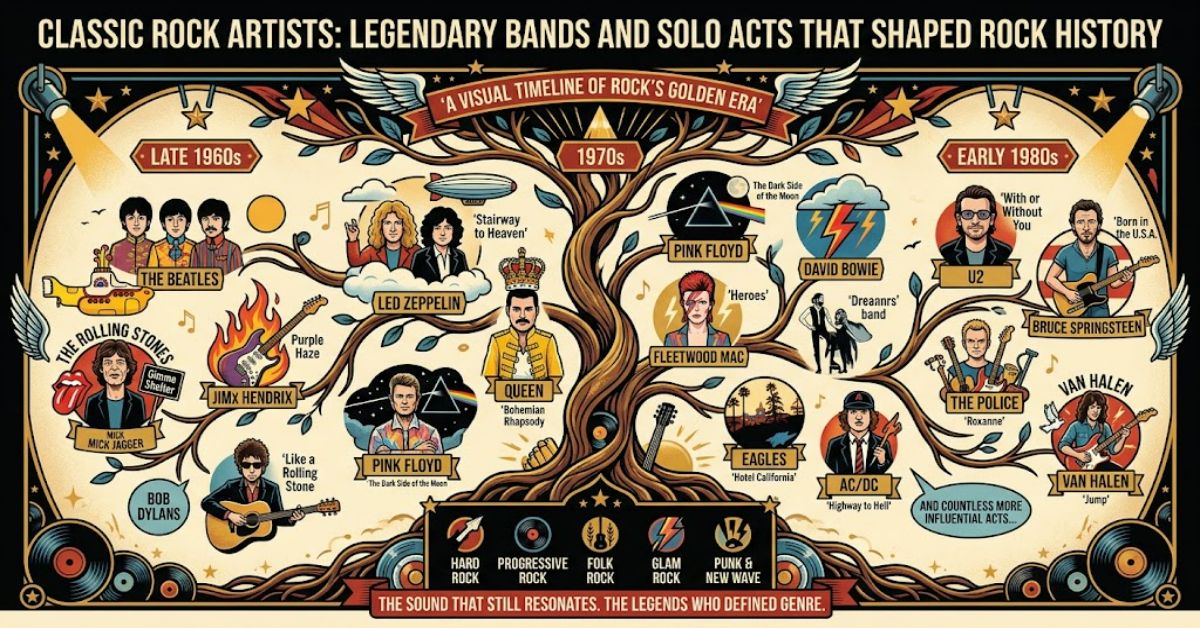
Classic rock artists represent one of the most influential groups of musicians in modern popular music. Although “classic rock” is not a strict genre with a single starting or ending date, the term is generally associated with major rock acts whose work emerged from the 1960s through the 1980s, with some artists remaining culturally important into the 1990s and beyond.
The period produced an extraordinary range of sounds. The Beatles expanded the possibilities of songwriting and studio production. The Rolling Stones carried blues and rhythm and blues into a harder rock setting. Led Zeppelin helped establish the foundations of heavy metal, while Pink Floyd pushed psychedelic and progressive rock towards ambitious album-length works. Queen combined theatrical performance with sophisticated arrangements, and Bruce Springsteen developed a powerful form of storytelling-driven arena rock.
The Rock & Roll Hall of Fame’s archives illustrate the breadth of this period. Its induction records include The Beatles, Bob Dylan, The Beach Boys, The Rolling Stones, The Who, Led Zeppelin, Pink Floyd, Queen, Fleetwood Mac and many other artists associated with rock’s development.
Rather than treating classic rock as one sound, it is more useful to see it as a broad cultural period in which musicians continually expanded what a rock band or solo performer could achieve.
The Defining Eras of Classic Rock
Classic rock developed through several overlapping movements rather than one uninterrupted style.
| Period | Dominant developments | Representative artists |
| 1960s | British Invasion, psychedelia, blues rock | The Beatles, The Rolling Stones, The Who |
| Late 1960s–1970s | Heavy rock, progressive rock, album culture | Led Zeppelin, Pink Floyd, Black Sabbath |
| 1970s | Arena rock, folk rock, Southern rock | Queen, Fleetwood Mac, Eagles |
| 1980s | Stadium rock, MTV, polished production | Bon Jovi, Def Leppard, Bruce Springsteen |
| 1990s | Alternative influence and legacy acts | R.E.M., Pearl Jam, Guns N’ Roses |
The boundaries overlap considerably. An artist might begin in blues rock, move into progressive music and later produce commercial arena anthems.
That flexibility is one reason the term remains useful.
The Beatles and the British Invasion
Few bands changed popular music as dramatically as The Beatles.
John Lennon, Paul McCartney, George Harrison and Ringo Starr became central figures in the British Invasion that transformed the American music market during the 1960s. The Rock & Roll Hall of Fame credits the group with helping usher rock into an era of experimentation and musical transformation. The Beatles were inducted into the Hall in 1988.
Their importance goes beyond individual hit songs. They demonstrated how a successful band could develop its own songwriting identity while using the recording studio as a creative instrument.
Their influence extended into psychedelia, progressive rock and later alternative music.
The Rolling Stones and Blues-Based Rock
The Rolling Stones developed a different relationship with rock.
Where The Beatles frequently pursued melodic experimentation, the Stones maintained a strong connection to blues and American R&B. Their music incorporated psychedelic rock, country, garage rock and other influences over several decades.
Their 1989 induction into the Rock & Roll Hall of Fame recognised a career that had already transformed the idea of the rock band into a long-term touring institution.
Their cultural impact also came from performance. Mick Jagger’s stage presence and Keith Richards’ guitar style helped create a visual language for rock that influenced generations of performers.
Led Zeppelin and the Birth of Heavy Rock
Led Zeppelin took blues-based rock towards greater volume, complexity and theatrical scale.
The band’s combination of blues, folk, soul, heavy riffs and elaborate studio production helped establish a template for heavy metal and stadium rock. The Rock & Roll Hall of Fame describes the group as important to the development of heavy metal, progressive rock and theatrical large-scale concerts.
Albums such as Led Zeppelin IV demonstrated another major shift: the album itself could become the central artistic statement rather than simply a collection of singles.
Pink Floyd and Progressive Rock
Pink Floyd occupied a very different part of the classic-rock spectrum.
The group became associated with psychedelic and progressive rock, using extended compositions, conceptual themes, studio experimentation and elaborate live production. The Rock & Roll Hall of Fame notes the significance of The Dark Side of the Moon from 1973 and The Wall from 1979.
Pink Floyd’s influence also shows why classic rock cannot be reduced to guitar riffs and loud concerts. Their work connected rock with visual art, sound engineering, political commentary and album-oriented storytelling.
Queen, Fleetwood Mac and Arena Rock
The 1970s expanded the commercial possibilities of rock.
Queen combined progressive influences, classical arrangements, layered harmonies and theatrical performance. Their ability to move between heavy rock, pop, disco and other styles helped them reach audiences beyond traditional rock fans. They were inducted into the Rock & Roll Hall of Fame in 2001.
Fleetwood Mac followed a different route. Beginning as a British blues group, the band evolved towards polished, emotionally detailed rock and pop. Their 1977 album Rumours became one of the defining records of the period, while the band’s internal relationships became part of its cultural mythology. The group entered the Hall of Fame in 1998.
Together, these examples show how rock could become both commercially accessible and musically ambitious.
Heavy Metal and the Harder Edge
Another major branch of classic rock developed through heavy blues and hard rock.
Black Sabbath became particularly important. Their dark guitar sound, heavy rhythms and bleak lyrical themes helped establish heavy metal as a distinct musical force. The Rock & Roll Hall of Fame describes the group as pioneers who helped deliver heavy metal to a worldwide audience. They were inducted in 2006.
This is one of the clearest examples of classic rock’s long-term influence. Later metal bands did not simply imitate Sabbath; they developed its core ideas into faster, heavier and more technically demanding styles.
Solo Artists Who Defined the Era
Classic rock was never exclusively a band phenomenon.
| Artist | Key contribution | Representative period |
| Bob Dylan | Folk-rock songwriting and lyrical influence | 1960s onward |
| Jimi Hendrix | Guitar innovation and psychedelia | Late 1960s |
| David Bowie | Glam, art rock and reinvention | 1970s–1980s |
| Elton John | Piano-led rock and pop | 1970s onward |
| Neil Young | Folk, country and electric rock | 1970s onward |
| Bruce Springsteen | Storytelling and arena rock | 1970s–1990s |
| Eric Clapton | Blues guitar and rock crossover | 1960s onward |
Bruce Springsteen, for example, combined folk, soul and rock with detailed stories about ordinary American life. His 1999 Hall of Fame induction recognised a career that moved from 1970s singer-songwriter work to enormous arena performances in the 1980s.
Eric Clapton represents another important thread. His blues-driven guitar work shaped The Yardbirds, Cream, Blind Faith and his solo career, making him one of the era’s most influential guitarists.
Why Classic Rock Still Matters
The enduring importance of these musicians is not simply nostalgia.
Their influence can be seen in three areas.
Songwriting: Rock artists demonstrated that albums could carry recurring themes, personal narratives and ambitious compositions.
Production: Studio technology became part of the creative process, particularly for artists such as The Beatles and Pink Floyd.
Live performance: Large-scale tours established the arena and stadium as major spaces for popular music.
A less obvious point is that classic rock’s influence survives partly because it became a flexible framework. Later musicians could borrow from its blues structures, guitar vocabulary, album culture or theatrical performance without reproducing the original sound.
The Future of Classic Rock Artists in 2027
By 2027, the classic-rock audience will increasingly include listeners discovering these artists through streaming services, films, social media and algorithmic recommendations rather than traditional radio.
The Rock & Roll Hall of Fame continues to expand its historical framework, recognising artists across rock, R&B, punk, metal and related traditions. Its current inductee database demonstrates how broad the accepted history of rock has become.
The challenge is preservation. Original recordings remain available, but the cultural context surrounding them can become less familiar to younger listeners.
That makes archival work, documentaries, remastered releases and music education increasingly important. The music is likely to remain relevant, but the reasons behind its importance will need continued explanation.
Key Takeaways
- Classic rock is a broad historical category rather than one tightly defined genre.
- The Beatles transformed songwriting, recording and popular culture.
- The Rolling Stones preserved and expanded the blues-rock tradition.
- Led Zeppelin and Black Sabbath helped establish heavy rock and metal.
- Pink Floyd expanded the possibilities of progressive and conceptual rock.
- Queen and Fleetwood Mac demonstrated the commercial power of sophisticated arena music.
- Solo artists such as Dylan, Hendrix, Bowie, Clapton and Springsteen broadened rock’s artistic vocabulary.
Conclusion
The story of classic rock artists is ultimately a story about expansion. Musicians took blues, rhythm and blues, folk, country, psychedelia and emerging studio technology and turned them into an enormous range of new musical forms.
The Beatles showed how a band could transform songwriting and recording. The Rolling Stones kept blues at the heart of rock. Led Zeppelin and Black Sabbath pushed heavier sounds into the mainstream, while Pink Floyd demonstrated the power of conceptual albums. Queen brought theatricality to stadiums, Fleetwood Mac refined emotionally complex rock, and artists such as Bruce Springsteen proved that rock could also function as detailed social storytelling.
Their influence remains visible in contemporary rock, metal, alternative music and popular culture. The most lasting legacy of classic rock is therefore not a particular guitar sound or decade. It is the idea that rock can continually change while retaining a recognisable connection to its roots.
Frequently Asked Questions
Who are considered the most famous classic rock artists?
The Beatles, Rolling Stones, Led Zeppelin, Pink Floyd, Queen, Fleetwood Mac, The Who, Bob Dylan, Jimi Hendrix and Bruce Springsteen are among the most widely recognised names associated with classic rock.
What years are considered classic rock?
There is no universal boundary, but the term commonly focuses on music from the 1960s through the 1980s, with many important artists continuing into the 1990s and beyond.
Which classic rock artists influenced heavy metal?
Led Zeppelin, Black Sabbath and Deep Purple are particularly important. Their heavy guitar riffs, amplified sound and blues-based structures influenced generations of metal musicians.
Are The Beatles classic rock?
Yes. Although their music also belongs to pop and other categories, The Beatles are central to the history of rock and are commonly included in classic-rock discussions.
Which classic rock artists are known for progressive rock?
Pink Floyd, Yes, Genesis, King Crimson and Emerson, Lake & Palmer are strongly associated with progressive rock, although each developed a distinct sound.
Methodology
This article was researched using authoritative music-history material, particularly Rock & Roll Hall of Fame artist profiles and induction records. These sources were used to verify induction dates, musical descriptions and documented influence.
No fabricated interviews, personal concert experiences or invented firsthand observations have been included. The analysis focuses on documented historical impact rather than claiming personal experience.
Because “classic rock” has no universally fixed genre boundary, artist selection is necessarily interpretive. Some musicians included here are also commonly classified as blues rock, progressive rock, folk rock, hard rock, metal or pop rock.
Editorial disclosure: This article was drafted with AI assistance and should be independently reviewed and fact-checked by the RubbleMagazine.co.uk editorial team before publication.
References
Rock & Roll Hall of Fame. (n.d.). The Beatles. Rock & Roll Hall of Fame.
Rock & Roll Hall of Fame. (n.d.). The Rolling Stones. Rock & Roll Hall of Fame.
Rock & Roll Hall of Fame. (n.d.). Led Zeppelin. Rock & Roll Hall of Fame.
Rock & Roll Hall of Fame. (n.d.). Pink Floyd. Rock & Roll Hall of Fame.
Rock & Roll Hall of Fame. (n.d.). Queen. Rock & Roll Hall of Fame.
Rock & Roll Hall of Fame. (n.d.). Fleetwood Mac. Rock & Roll Hall of Fame.
Rock & Roll Hall of Fame. (n.d.). Bruce Springsteen. Rock & Roll Hall of Fame.
Rock & Roll Hall of Fame. (n.d.). Eric Clapton. Rock & Roll Hall of Fame.
Rock & Roll Hall of Fame. (n.d.). Black Sabbath. Rock & Roll Hall of Fame.
Publication Quality-Control Note
No RubbleMagazine.co.uk internal links have been inserted because verified, directly relevant pages from the publication were not established during research. Unrelated or unverified links would conflict with the supplied editorial rules.
The article also does not claim fabricated firsthand reporting, interviews or personal concert observations. Those E-E-A-T signals require genuine editorial evidence and should be added only after human verification.