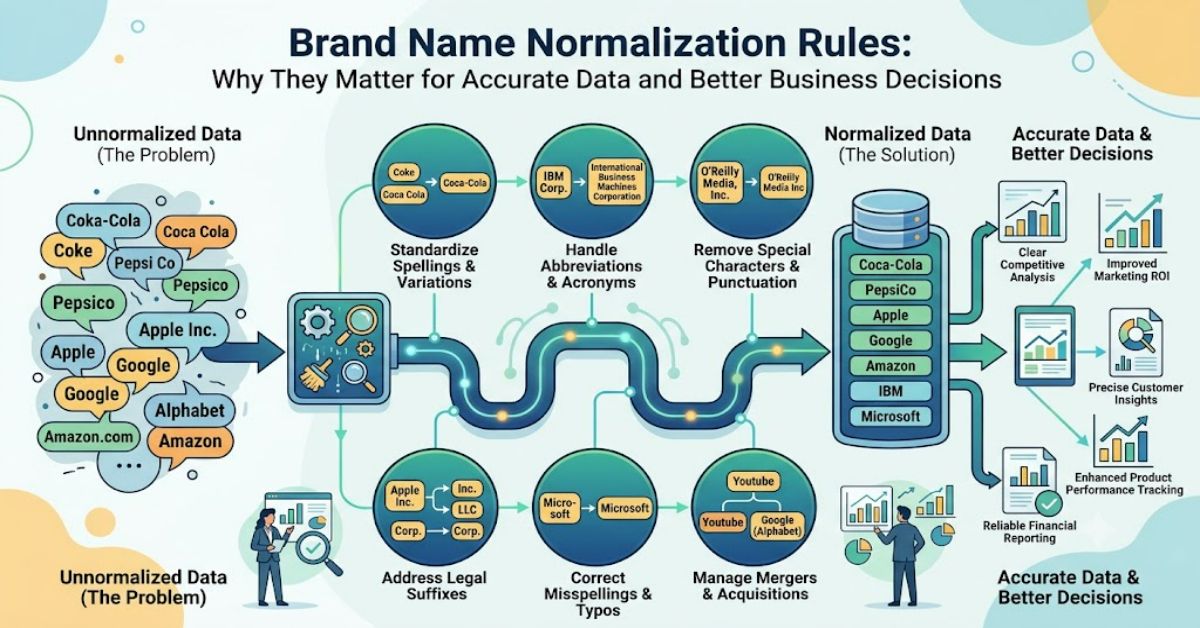
Every organisation collects brand-related data from multiple sources, including customer forms, CRM platforms, supplier databases, invoices, and online submissions. Unfortunately, these records are rarely entered consistently. One employee may write “IBM,” another “I.B.M.,” while someone else enters “International Business Machines.” Similar inconsistencies occur with legal suffixes such as Ltd., LLC, Inc., or Plc, spelling mistakes, abbreviations, punctuation differences, and formatting variations. Brand name normalization rules solve this problem by automatically converting different versions of the same company or brand into a single, standardised—or canonical—name.
This process significantly improves data quality, prevents duplicate records, and increases matching accuracy across business systems. Rather than treating multiple versions of the same organisation as separate entities, normalization ensures they are recognised as one trusted record.
As organisations increasingly rely on analytics, artificial intelligence, and customer relationship management, maintaining clean and consistent data has become essential rather than optional.
What Are Brand Name Normalization Rules?
Brand name normalization rules are predefined instructions that identify variations of a company or brand name and convert them into one approved format.
For example:
| Raw Input | Normalized Output |
| Apple Inc. | Apple |
| APPLE | Apple |
| Apple Incorporated | Apple |
| Microsoft Corp. | Microsoft |
| Microsoft Corporation | Microsoft |
These rules recognise common inconsistencies while preserving the identity of the business.
Why Inconsistent Brand Data Creates Problems
Poor-quality brand data affects nearly every business process.
Common issues include:
- Duplicate customer accounts
- Inaccurate sales reports
- Incorrect supplier records
- Poor search results
- Inefficient marketing campaigns
- Reduced customer satisfaction
When duplicate records exist, teams may contact the same customer multiple times or generate inaccurate performance reports. Over time, these problems become increasingly expensive to fix.
Common Normalization Techniques
Several methods are commonly used when building normalization systems.
Removing Legal Suffixes
Many organisations remove legal identifiers that don’t change the brand itself.
Examples include:
- Inc.
- LLC
- Ltd.
- PLC
- GmbH
- S.A.
- Co.
For instance:
“Tesla Inc.” becomes “Tesla.”
Correcting Spelling Errors
Misspellings frequently occur during manual data entry.
Examples include:
- Amazn → Amazon
- Googl → Google
- Microsfot → Microsoft
Spell correction algorithms help detect and standardise these errors.
Expanding Abbreviations
Some brands appear in abbreviated forms.
Examples include:
- P&G → Procter & Gamble
- GE → General Electric
Normalization rules translate these abbreviations into the preferred canonical format.
Standardising Capitalisation
Differences in uppercase and lowercase letters create unnecessary inconsistencies.
Examples:
- nike
- NIKE
- Nike
All become:
Nike
Benefits of Brand Name Normalization
Businesses experience measurable improvements after implementing normalization rules.
| Benefit | Business Impact |
| Better matching accuracy | Fewer duplicate records |
| Cleaner databases | Higher data quality |
| Improved reporting | More reliable analytics |
| Better customer experience | Consistent customer profiles |
| Operational efficiency | Less manual data cleaning |
These advantages help organisations make more confident business decisions.
Applications Across Industries
Brand normalization is valuable across many sectors.
Customer Relationship Management (CRM)
Sales teams maintain cleaner customer records and avoid duplicate contacts.
Financial Services
Banks use normalized company names to improve fraud detection and compliance screening.
E-commerce
Online marketplaces standardise merchant names for consistent search results and reporting.
Healthcare
Healthcare providers match supplier and pharmaceutical records more accurately.
Supply Chain Management
Manufacturers maintain consistent vendor databases across multiple countries and systems.
Challenges of Brand Name Normalization
Although normalization delivers significant benefits, it also presents several challenges.
Some brands intentionally share similar names, making automated matching difficult.
For example:
- ABC Electronics
- ABC Solutions
- ABC Industries
These should not always be merged.
International businesses also introduce language differences, local naming conventions, and regional abbreviations that require carefully designed rules.
Human review remains important for ambiguous cases where automation cannot confidently determine the correct match.
Best Practices for Effective Normalization
Successful organisations typically follow several best practices.
- Create a master list of approved brand names.
- Continuously update normalization rules.
- Review uncertain matches manually.
- Combine rule-based systems with machine learning.
- Monitor data quality using regular audits.
- Document every normalization rule for transparency.
These practices improve consistency while reducing long-term maintenance costs.
The Future of Brand Name Normalization in 2027
As artificial intelligence continues to evolve, normalization systems are becoming increasingly intelligent.
Future solutions are expected to combine natural language processing, machine learning, and knowledge graphs to recognise brand variations with greater accuracy. Cloud-based master data management platforms will automate more of the normalization process while supporting multilingual datasets and global business operations.
Rather than relying solely on static rules, future systems will learn from user feedback and historical corrections, making them more adaptive over time. However, human oversight will continue to play an important role in validating complex or ambiguous cases.
Key Takeaways
- Clean brand data improves reporting accuracy.
- Normalization reduces duplicate records.
- Canonical names simplify customer matching.
- Automated rules improve operational efficiency.
- Human validation remains essential for complex cases.
- AI will continue enhancing normalization accuracy.
Conclusion
Brand name normalization rules are a fundamental part of modern data management. By transforming inconsistent brand names into a single standard format, organisations create cleaner databases, improve matching accuracy, and support more reliable analytics. The process reduces duplicate records, strengthens customer relationship management, and enables better decision-making across departments.
While automation can handle many common inconsistencies, successful normalization requires thoughtful rule design, continuous maintenance, and occasional human review. As businesses increasingly depend on data-driven insights, investing in effective normalization strategies will remain a practical way to improve data quality and operational performance. Organisations that prioritise clean, standardised brand information will be better positioned to support growth, efficiency, and long-term digital transformation.
Frequently Asked Questions
What is brand name normalization?
It is the process of converting multiple variations of a brand or company name into one standardised version for consistent data management.
Why is brand name normalization important?
It improves data quality, reduces duplicate records, and supports more accurate analytics and reporting.
Can normalization fix spelling mistakes?
Yes. Many normalization systems detect common spelling errors and automatically replace them with the correct brand name.
Does normalization remove legal company suffixes?
Often, yes. Terms such as Inc., Ltd., LLC, and Plc are commonly removed when creating canonical brand names.
Is machine learning used in brand normalization?
Modern solutions increasingly combine rule-based logic with machine learning to improve matching accuracy while reducing manual effort.