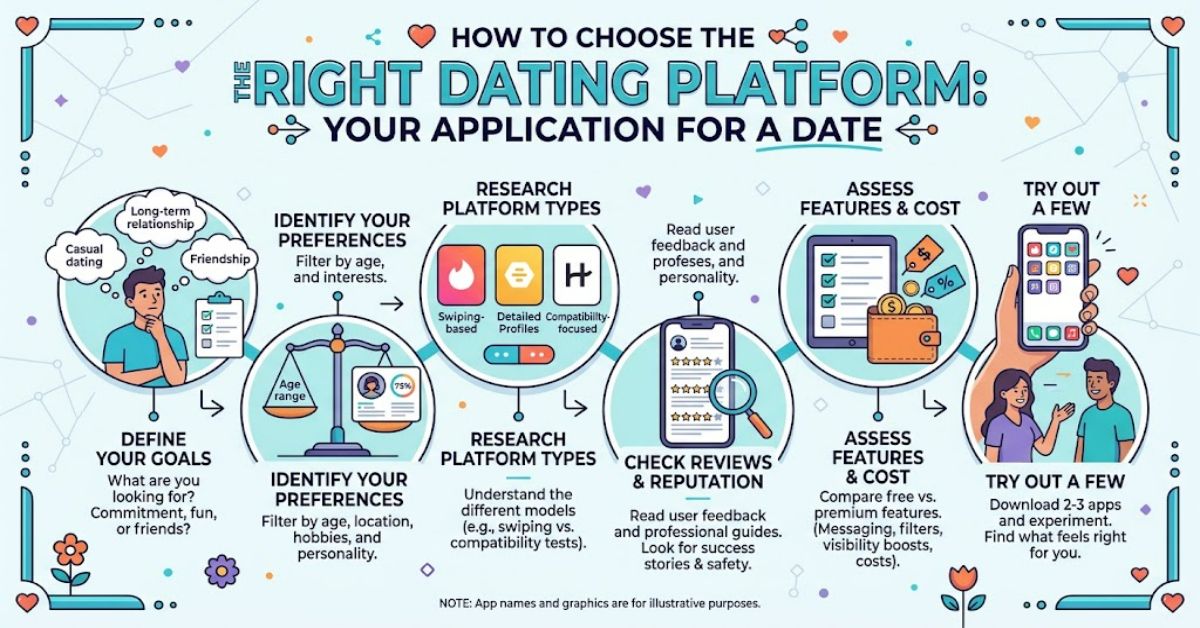
The phrase application for date is commonly used when discussing tools that help people find potential romantic partners. In practice, it can describe two different things: a dating application installed on a smartphone or a custom dating questionnaire created to learn more about someone’s personality, interests and expectations.
Dating applications have changed how people meet. Instead of relying only on social circles, workplaces or introductions from friends, users can create profiles and communicate with people they may never have encountered otherwise.
The basic process is simple. A person creates a profile, adds photographs and information about their interests, and then searches for compatible people. Depending on the platform, matching can be based on location, age, interests, preferences and other profile information.
A questionnaire takes a different approach. Rather than presenting hundreds of profiles, it can ask questions about communication style, hobbies, relationship expectations, lifestyle and values.
This distinction matters because not every person wants the same dating experience. Some prefer a large pool of potential matches, while others prefer a slower and more structured process.
Dating Apps vs Compatibility Forms
| Feature | Dating Application | Compatibility Form |
| Main purpose | Discover potential matches | Understand compatibility |
| Typical format | Mobile or web platform | Questionnaire |
| Matching | Algorithm or user selection | Answers and preferences |
| Number of people | Usually large | Usually smaller |
| Communication | Built-in messaging | Often arranged separately |
| Personalisation | Depends on platform | Can be highly customised |
The biggest difference is scale. A conventional dating application can introduce users to many people quickly, whereas a questionnaire can encourage deeper reflection before contact begins.
Neither model guarantees compatibility. A matching system can identify shared interests, but it cannot accurately predict how two people will behave together in real life.
Features to Look For
A useful dating platform should make basic functions easy to understand. Profile creation, search, matching and messaging should not require unnecessary complexity.
Profile controls: Users should be able to decide what information appears publicly.
Communication tools: Blocking and reporting features are important when interactions become uncomfortable.
Privacy controls: Users should understand what personal information is collected and how it is used.
Age assurance: Dating services need effective measures to prevent inappropriate access by children. Ofcom reported in 2025 that major dating services had introduced age checks as part of broader online-safety requirements.
Reporting systems: A platform should provide a clear way to report suspicious accounts, harassment or abusive behaviour.
These features are not merely technical extras. They influence whether people can use a service with reasonable confidence.
Privacy Should Be Part of the Selection Process
One of the less obvious issues with choosing an application for date is the amount of personal information involved.
Dating profiles may reveal photographs, approximate location, age, employment information, interests and relationship preferences. Some services may collect additional information through device permissions, analytics or account activity.
The UK’s Information Commissioner’s Office advises people to consider who is collecting their information, why it is needed and what will happen to it before providing personal data.
The ICO also advised app users in 2024 to examine privacy notices and consider questions such as whether data will be deleted when an account is no longer required and who information may be shared with.
| Privacy Question | Why It Matters |
| What information is collected? | Reveals the platform’s data requirements |
| Why is it collected? | Helps identify unnecessary data processing |
| Who receives it? | Shows potential third-party exposure |
| How long is it retained? | Indicates what happens after account closure |
| Can preferences be changed? | Gives users greater control |
A useful rule is simple: do not provide information merely because a form asks for it. Consider whether the information is actually necessary.
Safety When Meeting Someone
Online communication can create a sense of familiarity before two people have met. That can make it easy to trust someone too quickly.
A sensible approach is to keep early conversations within the platform where possible. Avoid immediately sharing your home address, financial details, workplace location or other sensitive information.
The first meeting should take place in a public setting. Tell a trusted person where you are going and consider arranging your own transport.
Online safety also has a regulatory dimension. Ofcom’s guidance on dating and social-discovery services explains that the UK’s Online Safety Act applies to certain online services that allow users to interact or share content.
This does not remove personal responsibility. Platform regulation and individual caution work together.
Three Practical Insights
A larger dating pool is not automatically better. More profiles create more choice, but excessive choice can also make the process tiring and encourage people to judge profiles too quickly.
Compatibility questions work best when they are specific. Asking someone about favourite films may reveal a common interest, but questions about communication preferences, lifestyle and relationship expectations can provide more useful information.
Privacy is part of compatibility. Someone’s attitude towards boundaries, personal information and online communication can itself reveal useful information about whether their approach to relationships matches yours.
These points are particularly relevant when choosing between a broad dating application and a more structured compatibility form.
The Future of Application for Date in 2027
By 2027, dating services are likely to place greater emphasis on safety, age assurance, privacy and automated moderation.
Ofcom’s continuing work under the Online Safety Act suggests that user-to-user services will face stronger expectations around preventing illegal and harmful activity. In June 2026, Ofcom announced strengthened protections against cyberflashing for dating, messaging and social-media services.
The technology behind matching is also likely to become more sophisticated. However, better algorithms will not eliminate uncertainty. A system can compare data points, but attraction, trust, communication and long-term compatibility remain human experiences.
The more useful development may therefore be a balance between personalisation and user control rather than simply more automated matching.
Key Takeaways
- Dating applications provide broad access to potential partners.
- Compatibility forms offer a more structured way to explore relationship preferences.
- Privacy policies should be reviewed before creating an account.
- Age assurance is becoming a more important feature of dating platforms.
- Blocking and reporting tools should be treated as essential features.
- A digital match should not be treated as proof of real-world compatibility.
Conclusion
An application for date can be much more than a simple tool for finding someone nearby. It can be a large-scale dating platform, a carefully designed questionnaire or a combination of both approaches.
The right option depends on the user’s priorities. People who enjoy browsing and discovering new connections may prefer a conventional dating application. Those who value reflection and structured compatibility may prefer questionnaires or services that use detailed preferences.
Regardless of the format, privacy and safety should remain central considerations. Personal information should be shared carefully, and online familiarity should not replace sensible precautions when meeting someone in person.
Dating technology can make introductions easier, but it cannot guarantee a successful relationship. The strongest outcome still depends on communication, shared expectations, mutual respect and what happens beyond the screen.
FAQ
What is an application for date?
It generally refers to a digital dating application used to discover and communicate with potential romantic partners. It can also describe a questionnaire designed to assess compatibility between potential partners.
What should I look for in a dating application?
Look for clear privacy controls, useful profile settings, blocking and reporting tools, age assurance, secure communication and transparent information about how personal data is handled.
Are dating applications safe?
They can be used safely when users combine platform safety features with sensible personal precautions. Avoid sharing sensitive information too early and arrange first meetings in public places.
Can a compatibility questionnaire replace a dating app?
Not necessarily. A questionnaire can help identify shared preferences and expectations, but it cannot replace real communication or determine whether two people will work well together.
Why is privacy important on dating applications?
Dating profiles can contain personal information such as photographs, interests, location details and relationship preferences. Understanding how this information is collected and used helps reduce unnecessary exposure.
Are dating apps required to improve online safety in the UK?
Certain dating and user-to-user services are subject to duties under the UK’s Online Safety Act. Ofcom is responsible for implementing and enforcing relevant online-safety requirements.
Methodology
This article uses publicly available guidance from UK regulators, particularly Ofcom and the Information Commissioner’s Office, alongside general analysis of dating-platform functionality. No firsthand testing of a specific dating service was conducted, so no personal testing claims or invented performance figures are presented. Regulatory requirements can change, and individual platforms may have different policies.
References
Information Commissioner’s Office. (2024, 9 July). Do I really need to read the privacy notice?
Information Commissioner’s Office. (2026). Online safety and personal information guidance.
Ofcom. (2025, 4 December). Online Safety in 2025: Summary of the technology sector’s response to online safety rules.
Ofcom. (2026, 18 May). Dating and social discovery: Know the online safety risks, rules and how to comply.
Ofcom. (2026, 25 June). Tech firms must do more to block unwanted sexual images, under strengthened Ofcom protections.
Editorial disclosure: This article application for date was drafted with AI assistance and should be reviewed and independently verified by the publication’s editorial team before publication.