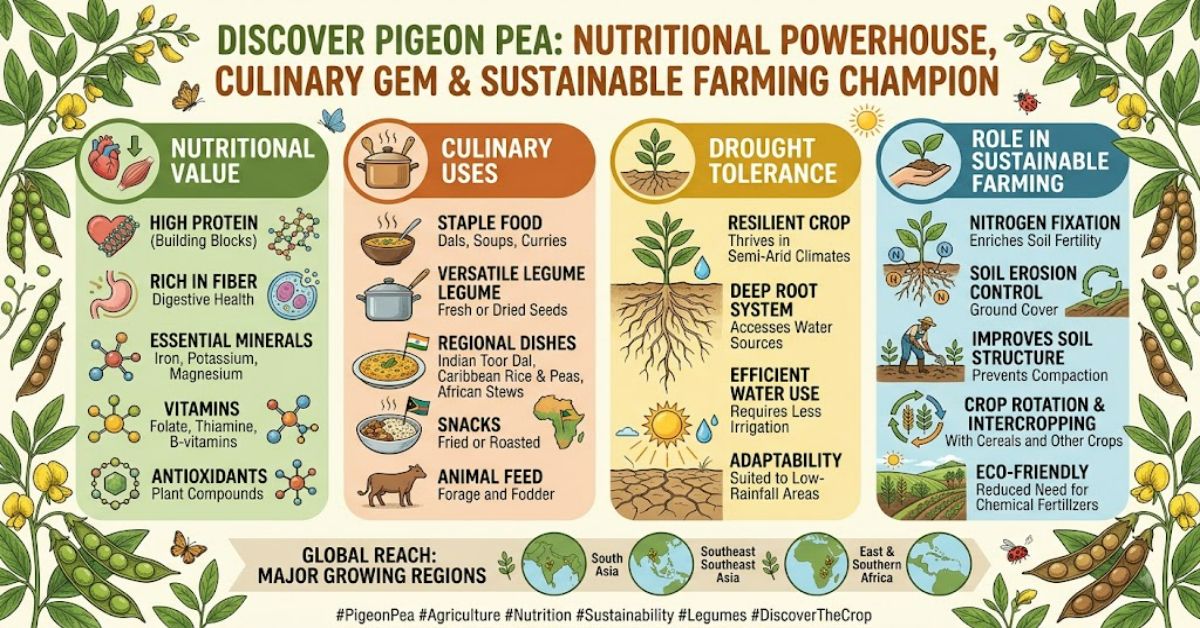
Pigeon pea is a versatile legume that has been cultivated for thousands of years and remains an important food and agricultural crop across tropical and subtropical regions. Scientifically known as Cajanus cajan, it belongs to the Fabaceae family and is closely associated with food traditions in South Asia, Africa, Southeast Asia, the Caribbean and parts of Latin America. Kew identifies the Indian Subcontinent as its native range and describes the species as a perennial shrub that is particularly suited to seasonally dry tropical environments.
The crop is valued for more than its edible seeds. Its ability to tolerate dry conditions gives farmers an option where rainfall can be unreliable. Its roots can also form associations with nitrogen-fixing bacteria, helping add biologically available nitrogen to agricultural soils. Kew notes that the plant can grow with annual rainfall around 600–1,000 mm and can tolerate areas receiving less than 600 mm.
For consumers, the attraction is equally practical. The dried seeds provide protein and are traditionally prepared in a wide range of dishes. In India, split pigeon pea is commonly used for dal, while other regions use whole seeds in soups, sauces, porridges and vegetable dishes.
Modern research is also examining its nutritional composition, bioactive compounds and potential food applications. A 2024 review describes the crop as a significant tropical and subtropical grain legume with protein, minerals and several vitamins.
What Is Pigeon Pea?
The plant is an erect shrub that can reach around four metres in height under suitable conditions. It has a strong central stem, branching growth and distinctive trifoliate leaves, meaning each leaf is divided into three leaflets. Its root system can extend deeply into the soil, an important characteristic in areas where surface moisture is limited.
The seeds vary considerably in colour, flavour and size. Kew records varieties ranging from creamy white to darker colours, with flavours ranging from sweet to bitter. This diversity helps explain why the crop has been adapted to many regional food cultures.
| Feature | Description |
| Scientific name | Cajanus cajan |
| Family | Fabaceae |
| Growth habit | Perennial shrub or cultivated annual |
| Native range | Indian Subcontinent |
| Main climate | Tropical and subtropical |
| Key food product | Dried or immature seeds |
| Major agricultural trait | Drought tolerance |
| Soil contribution | Biological nitrogen fixation |
Why the Crop Matters
One of the strongest characteristics of pigeon pea is its adaptability. Many grain crops perform best when water is reliably available, whereas this legume has characteristics that allow it to remain productive under relatively dry conditions.
That does not mean it is immune to drought. Severe water stress can still reduce flowering, seed formation and overall yield. The important distinction is that its deep-rooting habit and physiological adaptations can make it better suited to dry farming environments than some alternative crops.
A second advantage is its relationship with soil microorganisms. Like other legumes, it can host nitrogen-fixing bacteria in root nodules. This process converts atmospheric nitrogen into forms that can contribute to soil fertility. As a result, pigeon pea can play a useful role in crop rotations and mixed farming systems.
Nutritional Value and Food Uses
The seeds are particularly valued as a source of plant protein. A 2024 review reported that pigeon pea contains protein, essential amino acids, minerals and water-soluble vitamins, while also containing a range of bioactive compounds.
However, nutrition should not be separated from preparation. Another 2024 review highlighted practical barriers to wider consumption, including hard texture, characteristic flavour and anti-nutritional compounds. Processing methods such as soaking, cooking, sprouting and fermentation can influence these characteristics.
| Use | Typical application |
| Dried seeds | Dal, soups and stews |
| Fresh immature seeds | Vegetable dishes |
| Ground or processed seeds | Flour and food products |
| Livestock feed | Seeds, leaves and pods |
| Fermented products | Traditional and developing food applications |
| Agricultural use | Cover crop, rotation and green manure |
In South Asian cuisine, split seeds are particularly important. The familiar dal preparation turns the dried pulse into a soft, protein-containing dish that can be combined with rice, flatbreads, vegetables and spices.
Across Africa, dried seeds are commonly incorporated into sauces served with staple foods. In Central America and the Caribbean, pigeon pea may be canned, frozen or prepared alongside rice and other ingredients. Kew records this broad geographical range of culinary applications.
Pigeon Pea in Sustainable Agriculture
The crop’s agricultural value extends beyond the harvested grain. Farmers can use pigeon pea as part of diversified production systems, particularly where rainfall is seasonal.
Its nitrogen-fixing capacity is one important advantage. Instead of viewing the crop only as a source of food, farmers can consider how it fits within a rotation. The plant can contribute organic matter and biological activity while providing a harvestable product.
Its stems and branches also have practical uses. Kew documents applications including fencing, basketry, thatching and fuel. The plant can also function as a living fence, windbreak or shade crop.
This creates a useful multi-output model: food for people, feed for livestock and material for farm use can come from the same crop.
Three Important Insights for Farmers and Consumers
1. Drought tolerance is not the same as drought immunity.
The crop can tolerate relatively dry conditions, but water stress still affects reproductive development. Good crop management remains important.
2. Processing affects food quality.
The nutritional potential of the seed does not automatically make every preparation equally desirable. Soaking, cooking, sprouting and fermentation can alter texture and anti-nutritional factors.
3. Its value is broader than the seed harvest.
Livestock feed, fencing, fuel, shade and soil fertility can all contribute to the economic usefulness of the plant.
The Future of Pigeon Pea in 2027
By 2027, pigeon pea is likely to remain relevant to discussions about climate-resilient agriculture and diversified diets. The strongest case is not that it will replace major staple crops, but that it can complement them in regions where heat, seasonal rainfall and soil constraints make farming difficult.
Research is also moving towards improved food processing. The 2024 literature identifies thermal processing, extrusion, sprouting and fermentation as possible ways to improve food applications and reduce some anti-nutritional limitations.
Crop diversity will also matter. Kew and the Global Crop Diversity Trust have highlighted work to conserve wild relatives of important food crops, including pigeon pea, so genetic resources remain available for future breeding programmes.
The likely opportunity is therefore practical rather than speculative: better varieties, improved processing and wider integration into resilient farming systems.
Key Takeaways
- Pigeon pea originated in the Indian Subcontinent and is now cultivated widely across tropical and subtropical regions.
- The crop combines food production with agricultural and environmental uses.
- Its seeds provide plant protein and several micronutrients.
- Preparation and processing can affect texture, flavour and anti-nutritional compounds.
- Drought tolerance makes it useful in seasonally dry farming areas.
- Nitrogen fixation gives the crop value beyond its harvested grain.
Conclusion
Pigeon pea is an unusually versatile crop because its importance extends from the kitchen to the wider farming system. Its protein-rich seeds have supported traditional diets across several continents, while the plant itself can provide livestock feed, fuel, fencing material and other useful resources.
Its drought tolerance is particularly significant as farmers manage increasingly uncertain growing conditions, although it should not be treated as a crop that can withstand every form of water stress. Its ability to participate in biological nitrogen fixation also gives it a role in diversified rotations and soil-management strategies.
Modern research is adding another dimension. Scientists are examining its nutritional compounds and exploring processing techniques that could make the crop more appealing in new food products.
The result is a crop with both deep agricultural history and continuing relevance. Its strongest advantage may be its combination of food, environmental and practical farm uses rather than any single characteristic.
Frequently Asked Questions
What is pigeon pea?
Pigeon pea is a legume scientifically known as Cajanus cajan. It originated in the Indian Subcontinent and is now cultivated throughout many tropical and subtropical regions.
Is pigeon pea healthy?
Pigeon pea can be a nutritious part of a balanced diet. Research identifies it as a source of protein, minerals and several vitamins. Preparation methods can affect its nutritional characteristics.
What is pigeon pea used for?
The seeds are used in dal, soups, sauces, porridges and vegetable dishes. The plant can also provide livestock feed, fuel, fencing material and other agricultural resources.
Can pigeon pea tolerate drought?
It has notable drought tolerance and can grow in relatively dry environments. Kew reports that it can tolerate areas receiving less than 600 mm of annual rainfall, although severe drought can still affect productivity.
Does pigeon pea improve soil?
As a legume, pigeon pea can form root nodules containing nitrogen-fixing bacteria. This makes it useful in rotations and other farming systems where biological nitrogen inputs are valuable.
Where is pigeon pea commonly eaten?
It is especially important in South Asia, Africa, Southeast Asia, the Caribbean and parts of Latin America. Preparation methods vary widely between regions.
Methodology
This article was prepared using botanical and research information from the Royal Botanic Gardens, Kew and recent peer-reviewed literature indexed through the Food and Agriculture Organization’s AGRIS system. Kew was used to validate taxonomy, origin, distribution, ecology and documented uses, while 2024 research reviews were used for nutritional and food-processing context.
No personal field testing or laboratory analysis was conducted for this article, so no firsthand observations or original measurements are presented as independent testing. Nutritional and agricultural claims should be checked against the cited primary research before publication.
Editorial disclosure: This article was drafted with AI assistance and should be reviewed and verified by a human editor before publication. All data, citations and named claims should be independently confirmed against the original sources.
References
Haji, A., Teka, T. A., Bereka, T. Y., Andersa, K. N., Nekera, K. D., Abdi, G. G., Abelti, A. L., & Makiso, M. (2024). Nutritional composition, bioactive compounds, food applications, and health benefits of pigeon pea (Cajanus cajan L. Millsp.): A review.
Kew Science. (2026). Cajanus cajan (L.) Huth. Plants of the World Online, Royal Botanic Gardens, Kew.
Wu, J., Zhou, Q., Zhou, C., Cheng, K.-W., & Wang, M. (2024). Strategies to promote the dietary use of pigeon pea (Cajanus cajan L.) for human nutrition and health.