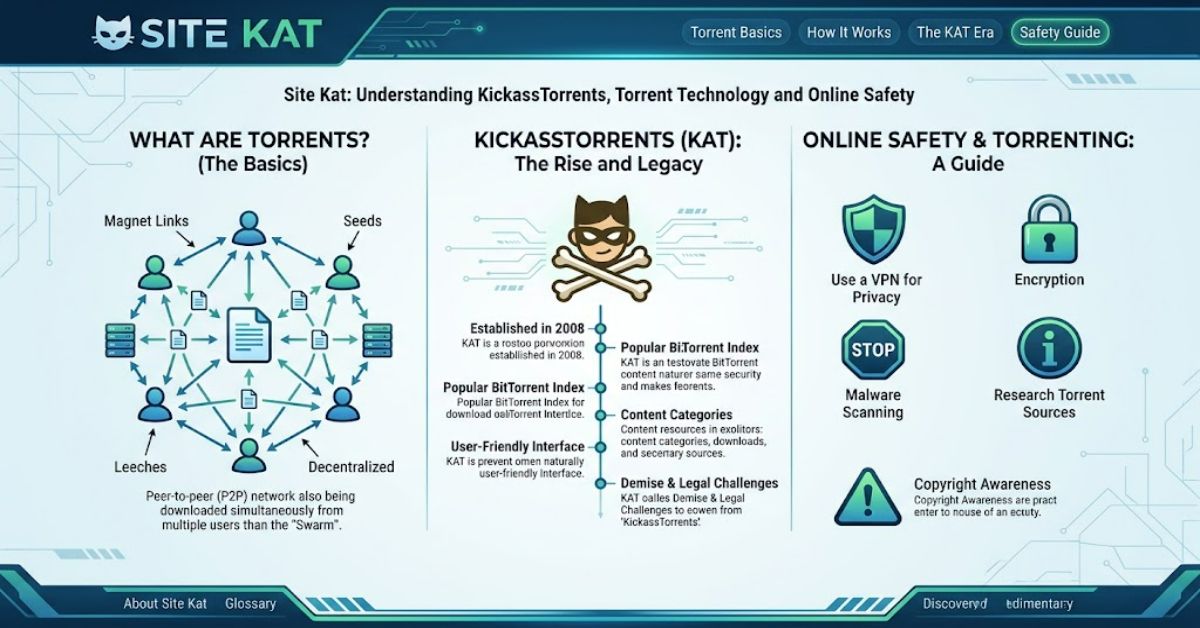
Site Kat is a search phrase commonly associated with KickassTorrents, often abbreviated as KAT. The original website became widely recognised for helping users find torrent files and magnet links used in peer-to-peer (P2P) file sharing. Although the original service is no longer operating in its former capacity, its name continues to appear in online searches because people remain interested in torrent technology, digital distribution and alternatives to traditional downloads.
KickassTorrents did not host every file listed in its directory in the same way a conventional download server would. Instead, it helped users discover torrent metadata and connect with other participants sharing the same content. This distinction is important because torrent directories, torrent clients and the computers distributing files perform different roles within the process.
The site’s history also illustrates the challenges surrounding online copyright enforcement. A service can attract a large international audience while facing legal pressure over material shared through its platform. When the original operation disappeared, its name continued to circulate across unofficial websites, creating uncertainty about which services, if any, were authentic.
Anyone researching Site Kat today should understand three things: the history of KickassTorrents, the technical principles behind BitTorrent, and the risks associated with unofficial copies of familiar websites. These subjects help explain why the name remains relevant and how people can access digital content more safely and lawfully.
What Was KickassTorrents?
KickassTorrents was a torrent directory that grew into one of the best-known names in online file sharing. Launched in 2008, it attracted users looking for digital media, software, games and other downloadable content. Its popularity reflected the demand for a central place to discover files distributed through peer-to-peer networks.
The website’s role was primarily discovery. It organised torrent listings and provided information that helped users locate content and connect with other participants. This made the directory easier to navigate than searching through scattered file-sharing communities.
However, popularity also brought legal scrutiny. On 20 July 2016, the United States Department of Justice announced criminal copyright infringement charges against the alleged operator, Artem Vaulin, and the seizure of domain names associated with the service. The department’s announcement described allegations concerning large-scale distribution of copyrighted works. These were allegations at the time, not proof of guilt by themselves.
The enforcement action marked a major turning point for the original platform. Its disappearance did not eliminate BitTorrent, because the underlying technology operates independently of any single directory. Instead, it left a familiar name that other websites could use to attract visitors.
Why Did the Website Become So Popular?
Several factors helped KAT attract an international audience:
- Broad content discovery: Users could search listings covering different categories of digital media.
- Peer-to-peer distribution: Files could be shared between participants instead of relying entirely on one central download server.
- Community participation: Listings and user feedback helped visitors assess available content, although such signals were not guarantees of safety or authenticity.
- Convenience: A searchable directory made it easier to discover files than navigating multiple independent sources.
Its appeal demonstrated how internet users valued accessible distribution systems. Yet it also exposed a central weakness of public directories: a listing does not establish that a file is legal, safe or accurately described.
How BitTorrent Technology Works
Understanding Site Kat requires separating the website from the technology associated with it. BitTorrent is a protocol designed to distribute files across participating computers. Rather than requiring a single server to deliver every byte to every recipient, it allows peers to exchange pieces of the same file.
A typical process involves several elements.
- Torrent metadata: A torrent file or magnet link supplies information used to identify the content and locate participants.
- Peer discovery: A client finds other computers that possess the file or parts of it, using mechanisms such as trackers or a distributed hash table.
- Piece exchange: The client downloads available pieces from connected peers and may upload pieces to others.
- Integrity checking: The client checks downloaded pieces against expected cryptographic hashes where the torrent format provides them.
- Completion: Once all required pieces have been obtained and verified, the client can assemble the file.
The official BitTorrent protocol specification explains how peers exchange pieces and verify data integrity. These mechanisms improve distribution efficiency, but they do not establish whether the underlying material is lawful or trustworthy.
For example, an independent software developer might distribute a large, freely licensed operating-system image through BitTorrent. Many users can download it while sharing the transfer workload. The same technical mechanism can also be used to distribute copyrighted material without permission. The protocol itself is not the deciding factor; the content and rights governing its distribution matter.
Torrent Directory, Magnet Link and Torrent Client Compared
These terms are often used interchangeably, but each describes a different part of the process.
| Element | Main purpose | Important limitation |
| Torrent directory | Helps users discover listings | A listing may be misleading or unauthorised |
| Torrent file | Contains metadata used to initiate a transfer | It does not guarantee the file is safe |
| Magnet link | Identifies content and helps a client find peers | It still requires compatible software and available peers |
| Torrent client | Manages connections, downloads and uploads | It cannot independently verify copyright permission |
| Peer network | Distributes file pieces between participants | Availability depends on connected peers and network conditions |
This distinction is useful because a website can disappear while its associated protocol remains functional. It also explains why a new website using the KAT name is not automatically a continuation of the original service.
Risks of Unofficial Site Kat Websites
After a well-known website closes, its name can retain considerable search value. Unrelated operators may use familiar branding to attract visitors. Some mirrors may attempt to recreate the original experience, while others may exploit the name for advertising, deceptive downloads or other harmful activity.
A domain name, logo or familiar page layout is not sufficient proof of authenticity.
Malware and deceptive downloads: A download button may lead to an unwanted installer, browser extension or executable rather than the expected file. Untrusted files can expose devices to malware, credential theft or unwanted software.
Privacy exposure: Peer-to-peer connections can reveal network information, including a participant’s public IP address to other peers. A website may also use tracking technologies or collect information through advertisements and redirects.
False trust signals: Comments, ratings, file sizes and apparent download counts can be manipulated. Even a popular listing can contain misleading information.
Copyright concerns: Accessing a file does not mean that the uploader owns the rights or has permission to distribute it. Users may face legal or account-related consequences depending on their location, the material and the circumstances.
These risks are separate. A file may be lawful but unsafe, or technically safe but distributed without the required permission. Responsible assessment must consider both questions rather than treating them as one.
How to Recognise Risky Torrent Websites
A cautious approach can reduce avoidable problems when researching torrent services. No single security measure makes an untrusted website safe, but several checks can help users identify warning signs.
- Check the domain carefully: Similar spellings and unfamiliar domain endings may indicate an unrelated operator.
- Avoid unexpected software: A website should not require an unfamiliar browser extension or executable merely to display a listing.
- Use updated security software: Operating-system updates, browser protections and reputable antivirus tools can reduce exposure to known threats.
- Be careful with personal information: Do not provide passwords, payment details or account credentials to suspicious websites.
- Verify content permissions: Prefer official publishers, authorised platforms and clearly licensed repositories.
One important distinction is that HTTPS protects the connection between a browser and a website; it does not prove that the website is legitimate. Likewise, a security scanner’s clean result cannot guarantee that every download is harmless.
Legal Considerations for File Sharing
Copyright law varies by jurisdiction, so users should not assume that material available through a torrent directory is free to download or redistribute.
In the UK, the government explains that copyright-protected works generally require permission, a suitable licence or an applicable legal exception. Unauthorised distribution of films, music, software and other protected material can create legal exposure.
BitTorrent itself is not inherently illegal. Developers, researchers and organisations can use it to distribute permitted files, including open-source software and public-domain material. The important questions are whether the work is protected, what permissions apply and whether the intended use falls within those permissions.
The Future of Site Kat in 2027
By 2027, interest in the KAT name is likely to remain tied to its historical reputation and the continuing use of peer-to-peer distribution. However, the long-term status of websites claiming to revive KickassTorrents cannot be established simply from their branding or search rankings.
Three developments are particularly relevant.
First, legitimate digital distribution continues to offer multiple ways to access software, films, music and games. Official stores and publisher websites provide clearer information about licensing and support.
Second, online safety measures are increasingly important as deceptive websites imitate recognised services. Users benefit from checking domains, avoiding suspicious downloads and keeping devices updated.
Third, decentralised file distribution remains useful where large files must reach many recipients efficiently. Its continued use does not depend on the survival of any one torrent directory.
These are grounded expectations based on existing technology and security practices, not guarantees about a particular site’s future.
Key Takeaways
- KAT was a directory associated with BitTorrent file discovery, not the protocol itself.
- The original service faced major legal action in July 2016.
- Unofficial websites using familiar branding may have different operators and security standards.
- Torrent metadata and community feedback do not establish legality or safety.
- HTTPS and antivirus software are useful safeguards, but neither guarantees trustworthiness.
- Licensed sources offer a clearer route to accessing digital content lawfully.
Conclusion
Site Kat remains a useful search term for understanding the history of KickassTorrents and the wider development of peer-to-peer file sharing. The original directory became prominent because it simplified content discovery, but its 2016 shutdown demonstrated the legal pressures that can affect services associated with copyright infringement.
The underlying BitTorrent protocol continues to serve legitimate purposes, from distributing open-source software to sharing large files efficiently. Its technology should therefore be distinguished from the conduct of individual websites and the permissions attached to specific content.
For anyone researching KAT today, the most sensible approach is to treat claims about unofficial mirrors cautiously, verify the source of any download and check copyright permissions before sharing or accessing protected material. Familiar branding is not proof of authenticity, and technical accessibility does not establish legal permission.
Frequently Asked Questions
What does Site Kat mean?
Site Kat commonly refers to KickassTorrents, also known as KAT, a former torrent directory used to discover files and magnet links.
Is KickassTorrents still operating as the original website?
The original service was taken down following US enforcement action in July 2016. Websites using its name later appeared, but their ownership and authenticity must be assessed separately.
Why was KickassTorrents shut down?
US authorities announced criminal copyright infringement charges against its alleged operator and the seizure of associated domain names in July 2016.
Is BitTorrent illegal?
No. BitTorrent is a file-distribution protocol with legitimate uses. Legal concerns arise when protected content is distributed or accessed without the necessary permission.
Are KAT mirror websites safe?
Not necessarily. Some may be unrelated copies or deceptive sites. Branding, ratings and HTTPS alone cannot establish that a website or its downloads are trustworthy.
What are safer alternatives to torrent directories?
Use official software repositories, publisher websites, authorised streaming services and platforms that clearly identify licensing or distribution permissions.
Methodology
This article draws on the US Department of Justice’s July 2016 announcement, the published BitTorrent protocol specification and UK government copyright guidance. Historical claims are distinguished from allegations, while security advice reflects general digital-safety principles. No live KAT mirror was tested, and no claim is made that a particular unofficial site is authentic or safe.
References
- BitTorrent. (2017). The BitTorrent protocol specification (BEP 3). BitTorrent.org.
- UK Government. (n.d.). Using somebody else’s intellectual property: Copyright. GOV.UK.
- UK Government. (n.d.). Topical issues for businesses and consumers: File sharing, downloading and streaming. GOV.UK.
- United States Department of Justice. (2016, 20 July). Owner of most-visited illegal file-sharing website charged with criminal copyright infringement.