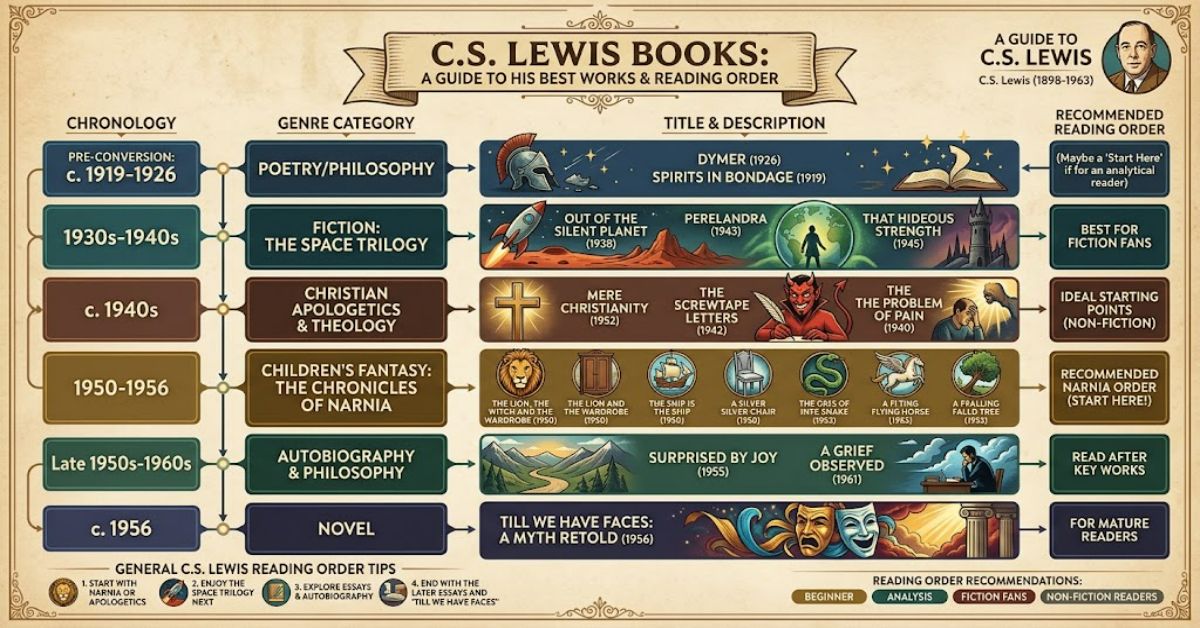
C.S. Lewis books continue to attract readers because they combine imaginative storytelling with questions about courage, morality, faith and the purpose of life. Clive Staples Lewis was a British writer and scholar who taught at Oxford and later Cambridge. Born on 29 November 1898, he became one of the twentieth century’s most recognised authors of fantasy and Christian apologetics.
His best-known works include The Chronicles of Narnia, a fantasy series featuring enchanted lands and memorable characters, and Mere Christianity, a non-fiction exploration of Christian belief. Other popular titles, such as The Screwtape Letters and The Great Divorce, examine human choices through unusual narrative perspectives.
Lewis’s writing reaches beyond a single audience. Younger readers can enjoy his adventures and magical settings, while adults may appreciate the ethical questions and philosophical arguments beneath the stories. His fiction often explores the conflict between selfishness and sacrifice, the responsibilities of leadership and the difficulty of distinguishing genuine goodness from appearances.
Choosing a starting point depends on what you want from a book. Readers who enjoy fantasy can begin with Narnia, while those interested in religion and philosophy may prefer his nonfiction. His shorter works also offer an accessible introduction before moving on to more demanding literary criticism.
This guide covers the most important titles, explains what makes each one distinctive and suggests a reading order for different interests.
The Best C.S. Lewis Books to Read
1. The Chronicles of Narnia
Fantasy · Seven-book series · First published between 1950 and 1956
The Chronicles of Narnia is the natural starting point for readers who enjoy fantasy, adventure and imaginative worlds. The series follows children who encounter Narnia, a land inhabited by talking animals, mythical creatures, rulers and supernatural forces.
The books include The Lion, the Witch and the Wardrobe, Prince Caspian, The Voyage of the Dawn Treader and four other stories. Each explores different themes, from bravery and loyalty to temptation, forgiveness and responsibility.
The Lion, the Witch and the Wardrobe is often the most familiar entry point. It introduces Lucy, Edmund, Susan and Peter Pevensie, whose experiences in Narnia lead them into a struggle against the White Witch.
Readers can enjoy the books as standalone adventures, although reading the series in publication order helps preserve the way the world and its characters unfold. Lewis also incorporated Christian symbolism into Narnia, particularly through the character of Aslan, but the stories can be appreciated for their fantasy and moral themes independently.
2. Mere Christianity
Christian apologetics · First published as a book in 1952
Mere Christianity presents Lewis’s arguments about morality, belief in God and the foundations of Christian faith. The book developed from radio talks broadcast during the Second World War.
Lewis begins with ideas about right and wrong, considering why people often appeal to moral standards even when their behaviour does not match them. He then develops his arguments about belief and discusses the Christian understanding of character and spiritual transformation.
This book is particularly suitable for readers who want to understand Lewis’s reasoning rather than explore a fictional world. It is also useful for readers interested in philosophy, ethics and religious debate.
However, it represents Lewis’s own Christian perspective, not a neutral account of every religious or philosophical position. Readers may agree with some arguments and question others. Approaching the book as an argument to examine, rather than a set of conclusions to accept automatically, makes it a more rewarding read.
3. The Screwtape Letters
Satire · First published in 1942
The Screwtape Letters presents moral and spiritual questions through a series of fictional letters from Screwtape, an experienced demon, to his inexperienced nephew, Wormwood.
The nephew’s task is to tempt a human being away from goodness. Through this unusual arrangement, Lewis explores pride, distraction, resentment, vanity and the small compromises that shape everyday decisions.
The satirical style makes the book distinctive. Instead of explaining human weaknesses through direct instruction, Lewis presents them from the perspective of characters who want people to fail.
The result encourages readers to examine habits that can appear harmless, such as constantly comparing themselves with others or allowing minor frustrations to control their behaviour.
Its short chapters make it suitable for readers who prefer to reflect on a few pages at a time.
4. The Great Divorce
Philosophical fantasy · First published in 1945
The Great Divorce imagines a journey from a bleak, grey town to a more vivid and beautiful destination. The travellers encounter figures who struggle to accept the changes required to move forward.
Lewis uses this imagined journey to explore freedom, pride, regret and the difficulty of letting go of destructive attachments. The characters illustrate how people may cling to familiar grievances or ambitions even when offered the possibility of something better.
The book is relatively short, but its ideas invite careful reflection. It is a strong choice for readers who enjoy symbolic fiction and philosophical questions about human nature.
5. The Problem of Pain
Theology and philosophy · First published in 1940
In The Problem of Pain, Lewis addresses one of the most challenging questions in religious philosophy: why suffering exists if God is good and powerful.
He considers human freedom, moral development, suffering and the limits of human understanding. Rather than presenting the subject as simple, Lewis develops an argument about the relationship between pain and the Christian conception of the world.
Readers interested in theology or the philosophy of religion may find this book valuable. It is worth approaching with an awareness that philosophical explanations of suffering do not remove the emotional reality of grief or answer every person’s experience.
6. The Space Trilogy
Science fiction · Three novels published between 1938 and 1945
Lewis’s Space Trilogy combines science fiction with philosophical and religious themes. The series begins with Out of the Silent Planet, continues with Perelandra and concludes with That Hideous Strength.
The first novel follows scholar Elwin Ransom on a journey to Mars. The later books expand the series into questions about temptation, power, scientific ambition and humanity’s place in the universe.
Unlike contemporary science fiction focused primarily on technology, Lewis uses interplanetary settings to explore moral and spiritual conflicts.
The trilogy suits readers who enjoy older speculative fiction and do not mind a style that places ideas and symbolism alongside adventure.
C.S. Lewis Books Compared
| Book | Main subject | Best for |
| The Chronicles of Narnia | Fantasy and moral choices | Adventure readers and families |
| Mere Christianity | Christian belief and ethics | Readers interested in religious philosophy |
| The Screwtape Letters | Satire and human behaviour | Readers who enjoy short, reflective chapters |
| The Great Divorce | Freedom and spiritual choices | Fans of symbolic fiction |
| The Problem of Pain | Suffering and religious philosophy | Readers exploring difficult theological questions |
| The Space Trilogy | Science fiction and philosophy | Fans of classic speculative fiction |
Reading Order: Where Should You Begin?
There is no single order that every reader must follow. The most useful approach is to select a book that matches your interests and then explore related titles.
| Reader’s interest | Suggested starting point | Next book |
| Fantasy and adventure | The Lion, the Witch and the Wardrobe | Prince Caspian |
| Christian apologetics | Mere Christianity | The Problem of Pain |
| Human behaviour and satire | The Screwtape Letters | The Great Divorce |
| Classic science fiction | Out of the Silent Planet | Perelandra |
| Short philosophical fiction | The Great Divorce | Mere Christianity |
For Narnia, publication order is a sensible choice for first-time readers because it follows the sequence in which the stories originally reached audiences. Some readers prefer the series’ internal chronological order, which begins with The Magician’s Nephew. Both approaches are possible, but publication order preserves the original reading experience.
Readers interested in Lewis’s ideas should also remember that his fictional works and nonfiction serve different purposes. A fantasy novel may express an ethical idea through a character’s choices, while an apologetic work presents arguments directly.
Why C.S. Lewis’s Books Remain Popular
Lewis’s continued appeal comes partly from his ability to make difficult ideas accessible through stories, analogies and memorable characters. He writes about familiar human experiences, including fear, ambition, friendship, loss and the desire to belong.
His work also crosses traditional genre boundaries. Narnia can be read as children’s fantasy, but its questions about sacrifice and responsibility can interest adults. Similarly, The Screwtape Letters uses comedy and satire to explore serious moral concerns.
There are limitations to consider. Some readers may find his theological assumptions unpersuasive, while others may find older language and cultural references less familiar. His arguments also reflect the intellectual and religious context in which he wrote.
These differences do not make the books irrelevant. They provide reasons to read them critically, considering both the ideas Lewis presents and the questions that readers may raise in response.
The Future of C.S. Lewis Books in 2027
C.S. Lewis’s books are likely to remain accessible to new readers in 2027 through print editions, digital books, audiobooks and library collections. His major works are established parts of modern literary and religious discussion, giving readers several ways to discover them.
Interest in fantasy adaptations may also introduce Narnia to audiences who have not read the original novels. However, screen adaptations and the books offer different experiences. A film can bring characters and settings to life visually, while reading allows more time to consider the narrative, symbolism and language.
For new readers, the most useful approach remains straightforward: begin with a title that matches your interests and explore the wider collection gradually. His works are varied enough to support different reading paths without requiring knowledge of his entire life or philosophy.
Key Takeaways
- Start with Narnia if you prefer imaginative storytelling and adventure.
- Choose Mere Christianity if you want to examine Lewis’s arguments about faith and morality.
- Read The Screwtape Letters for a satirical perspective on everyday behaviour.
- Explore The Great Divorce for symbolic storytelling about freedom and personal choices.
- Try the Space Trilogy if you enjoy science fiction with philosophical themes.
- Read critically and distinguish Lewis’s personal beliefs from arguments that all readers necessarily share.
Conclusion
C.S. Lewis wrote books that continue to appeal to readers across fantasy, philosophy, theology and science fiction. His best-known series, The Chronicles of Narnia, offers imaginative adventures with questions about courage, sacrifice and responsibility. His nonfiction works, including Mere Christianity and The Problem of Pain, examine belief and morality through direct argument, while The Screwtape Letters and The Great Divorce explore similar concerns through satire and symbolic fiction.
The best starting point depends on what you hope to gain from reading. Fantasy enthusiasts may prefer Narnia, while readers interested in religious ideas can begin with his apologetic works. Those who enjoy shorter philosophical stories may find his satirical fiction more accessible.
Lewis’s ideas will not persuade every reader, and some aspects of his writing reflect the period in which he lived. Yet his ability to connect abstract questions with recognisable human experiences gives his books lasting literary interest.
Frequently Asked Questions
1. What are the most popular C.S. Lewis books?
His best-known titles include The Lion, the Witch and the Wardrobe, Mere Christianity, The Screwtape Letters, The Great Divorce and The Problem of Pain.
2. Which C.S. Lewis books should beginners read first?
Readers who enjoy fantasy can begin with The Lion, the Witch and the Wardrobe. Those interested in Christian philosophy may prefer Mere Christianity, while readers who want a short, satirical work can start with The Screwtape Letters.
3. How many C.S. Lewis books are in The Chronicles of Narnia?
The series contains seven novels, first published between 1950 and 1956. They can be read in publication order or internal chronological order.
4. Are C.S. Lewis books only for Christians?
No. Although many works explore Christian beliefs, readers can also approach them for their storytelling, literary style, ethical questions and philosophical arguments.
5. What is The Screwtape Letters about?
It is a satirical work presented as letters from an experienced demon advising a younger demon on tempting a human being. It explores pride, distraction and moral weakness.
6. Did C.S. Lewis books write science fiction?
Yes. His Space Trilogy consists of Out of the Silent Planet, Perelandra and That Hideous Strength, combining speculative settings with philosophical and religious themes.
Methodology
This article C.S. Lewis books summarises C.S. Lewis’s major works, their genres, publication periods and principal themes. The descriptions are intended as a general reading guide rather than a comprehensive literary analysis. Publication dates and bibliographic details should be checked against authoritative editions before publication. Interpretations of religious symbolism and philosophical arguments can vary among readers, so the discussion distinguishes broad themes from claims that every reader must accept.
Editorial disclosure: This article was drafted with AI assistance and should be reviewed by a human editor before publication.