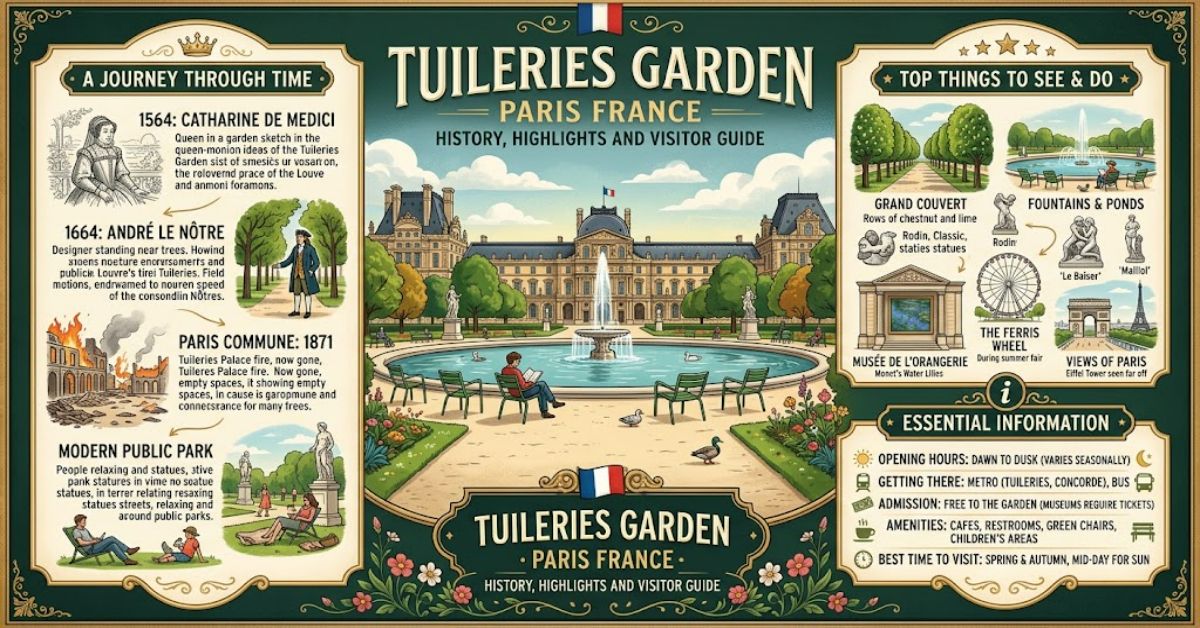
The Tuileries Garden Paris France is a historic public garden in the 1st arrondissement, stretching between the Louvre Museum and Place de la Concorde. Created for Catherine de’ Medici in 1564, it began as a royal landscape beside the Tuileries Palace. It opened to the public in 1667 and became a public park following the French Revolution. Today, it offers visitors an accessible way to experience Parisian history, landscape architecture and everyday outdoor life.
Unlike a secluded botanical garden, the Tuileries forms part of the city’s central public realm. Residents cross its paths, visitors rest beside its ponds, and sculptures transform its open spaces into an outdoor exhibition. Its carefully arranged avenues also reflect the French tradition of formal garden design, where symmetry, perspective and geometry shape the visitor’s experience.
The garden is especially convenient for travellers exploring the Louvre or walking towards the Champs-Élysées. It can be visited independently or included in a wider itinerary through central Paris. Families, photographers, art enthusiasts and visitors seeking a quieter break from museums can all find something of interest here.
However, understanding its historical development adds depth to a visit. The garden is not simply a surviving royal landscape. It has changed with French politics, public life and artistic taste over several centuries. Its present character combines historic planning, public recreation and contemporary cultural activity, making it an important part of Paris’s architectural and social heritage.
The history of the Tuileries Garden
The garden’s name comes from the tile-making workshops that occupied the area during the Middle Ages. In 1564, Catherine de’ Medici commissioned a palace and garden here, drawing inspiration from the Italian landscapes associated with her childhood in Florence.
Its design changed substantially during the reign of Louis XIV. From 1664, landscape architect André Le Nôtre reshaped the grounds, introducing stronger symmetry, long perspectives, carefully arranged flowerbeds and broad avenues. His approach established the formal French garden character that remains visible today.
The palace itself disappeared after the Paris Commune in 1871, when it was set on fire. Unlike the building, the garden survived and continued to serve the public. Restoration projects in the early 1990s, led by landscape architects Pascal Cribier and Louis Benech, helped renew its historic layout.
According to the Louvre’s historical account, the garden has evolved through royal, imperial and republican periods. Its landscape is therefore a record of changing ideas about power, leisure and public access, rather than a preserved scene from one historical moment. (Musée du Louvre, n.d.)
What to see in the garden
The garden rewards a slow walk rather than a rushed visit. Its main features combine architecture, art and practical spaces for relaxation.
- The central avenue: This broad route creates a strong visual connection towards the Champs-Élysées and provides a clear way to cross the garden.
- The ponds and fountains: Water features form natural gathering points where visitors can sit, rest and enjoy views across the formal landscape.
- Outdoor sculptures: Historic and contemporary works give the garden the character of an open-air museum. The Louvre manages the site and oversees the care of its sculpture collection.
- Tree-lined walks: Shaded paths offer a different atmosphere from the open lawns and formal flowerbeds.
- Garden chairs: The familiar movable chairs around the ponds support an enduring Parisian habit of enjoying public space without needing to buy anything.
The contrast between the garden’s strict geometry and its informal daily use is one of its defining qualities. Visitors can admire the landscape as a carefully composed work of art or simply use it as a place to pause between sightseeing stops.
Visitor information at a glance
| Detail | Information |
| Location | Between the Louvre and Place de la Concorde, Paris |
| District | 1st arrondissement |
| Entry fee | Free |
| Historical origin | 1564 |
| Landscape redesign | André Le Nôtre, beginning in 1664 |
| Best for | Walking, sculpture, photography and relaxation |
| Nearby attraction | Louvre Museum |
| Typical visit | Around 45–90 minutes |
Opening hours change with the seasons. The Louvre’s published schedule lists 07:30–19:30 for January, February, March, November and December; 07:00–21:00 for April, May, September and October; and 07:00–23:00 for June, July and August. Check the current schedule before travelling, particularly during special events or temporary closures. Entry is free, and visitors must leave before the official closing time. (Musée du Louvre, n.d.)
Practical tips for planning your visit
The best way to experience the Tuileries Garden Paris France is to combine it with nearby attractions without trying to fit everything into a single rushed walk.
Choose your timing carefully. Spring brings fresh planting and comfortable conditions for walking, while summer offers longer evenings. Autumn can be rewarding for tree colours and softer light. Winter visits are quieter, although some planting displays may be less prominent.
Plan a simple walking route. Start near the Louvre, follow the central paths towards Place de la Concorde, and stop at the ponds and sculptures along the way. Allow extra time if you enjoy photography or want to sit outdoors.
Consider accessibility and facilities. The garden has public entrances and toilets, including accessible facilities. However, large open spaces, long paths and busy entrances can affect how comfortable a visit feels for people with limited mobility. Check current access arrangements if you have specific requirements.
Respect the landscape. This is both a historic monument and a living public space. Follow signs about lawns, planting beds and temporary restrictions, and avoid touching sculptures.
The Future of Tuileries Garden Paris France in 2027
In 2027, the garden’s continuing challenge will be to balance heritage conservation with the needs of a heavily used urban green space. The Louvre has highlighted restoration, responsible landscape management and the protection of historic features as priorities for the site.
Climate pressures make this balance important. Trees, planted beds and shaded paths contribute to the experience of public space during hot weather, but maintaining them requires careful horticultural management. Any changes must also respect the historic geometry that defines the garden.
Cultural programming may continue to bring new audiences into the area, although specific exhibitions, festivals and opening arrangements should be confirmed through official announcements rather than assumed in advance. The garden’s long-term value rests on its ability to remain accessible while protecting its historic design and sculpture.
Key takeaways for visitors
- History: The garden began as a royal landscape in 1564 and reflects centuries of political and cultural change.
- Design: André Le Nôtre’s formal layout remains central to its identity.
- Art: Sculptures turn an ordinary walk into an outdoor cultural experience.
- Convenience: Its position between the Louvre and Place de la Concorde makes it easy to include in a central Paris itinerary.
- Budget: Free entry makes it an accessible option for travellers managing sightseeing costs.
- Preparation: Seasonal opening hours and temporary restrictions should be checked before arrival.
Conclusion
The Tuileries Garden is one of Paris’s most distinctive public spaces because it brings together history, landscape architecture and everyday urban life. Created for Catherine de’ Medici, redesigned under Louis XIV and preserved after the destruction of its palace in 1871, it has survived major changes in French society while retaining its essential formal character.
For visitors, its appeal lies in its flexibility. It can be a peaceful place to rest after visiting the Louvre, a setting for appreciating sculpture, or a scenic route towards Place de la Concorde. Its ponds, avenues and tree-lined paths provide a different perspective on Paris from the city’s museums and busy shopping streets.
A visit requires little planning and no admission fee, but checking seasonal opening times helps avoid disappointment. More importantly, taking time to understand the garden’s history reveals why it matters beyond its appearance. The Tuileries remains a living part of Parisian heritage, connecting the city’s royal past with its modern public life.
Frequently asked questions
1. Where is the Tuileries Garden in Paris, France?
It is in the 1st arrondissement, between the Louvre Museum and Place de la Concorde, close to the Seine and the Champs-Élysées.
2. Is the Tuileries Garden free to visit?
Yes. General entry is free throughout the year, although special events or temporary arrangements may affect access to particular areas.
3. What is the history of the Tuileries Garden?
Catherine de’ Medici commissioned it in 1564. André Le Nôtre redesigned it from 1664, and it became fully accessible to the public in 1871.
4. How long should I spend at the garden?
Allow around 45–90 minutes for a comfortable walk, photographs and time beside the ponds. You may need longer if you plan to explore nearby attractions.
5. What is the best time to visit the Tuileries Garden?
Spring and early autumn are appealing for walking and photography. Summer offers longer opening hours, while winter can provide a quieter experience.
6. Can I visit the garden after the Louvre Museum?
Yes. The garden is immediately west of the Louvre and works well as a relaxing stop before continuing towards Place de la Concorde.
Methodology
This article Tuileries Garden Paris France draws on the Musée du Louvre’s official historical account, visitor information and material about the garden’s landscape and sculpture collection. Historical dates and practical details have been cross-checked against those institutional sources. Opening hours are seasonal and may change, while future cultural events and conservation projects remain subject to official announcements.
The article does not claim personal visits, original field observations or independent testing. Its visitor recommendations are practical guidance based on the garden’s location, documented history and published facilities. Opening hours should be reconfirmed before publication and before travel.
Editorial disclosure: This article was drafted with AI assistance and should be reviewed by a human editor before publication. Historical claims, current visitor information, references and author credentials should be independently verified.
References
Musée du Louvre. (n.d.). From royal garden to public park: The Tuileries Garden. Official historical information about the garden.
Musée du Louvre. (n.d.). Hours and admission. Official visitor information for the Tuileries Garden.
Musée du Louvre. (n.d.). A garden at the heart of the Louvre: The Carrousel Garden. Official information about the adjoining landscape and sculpture collection.