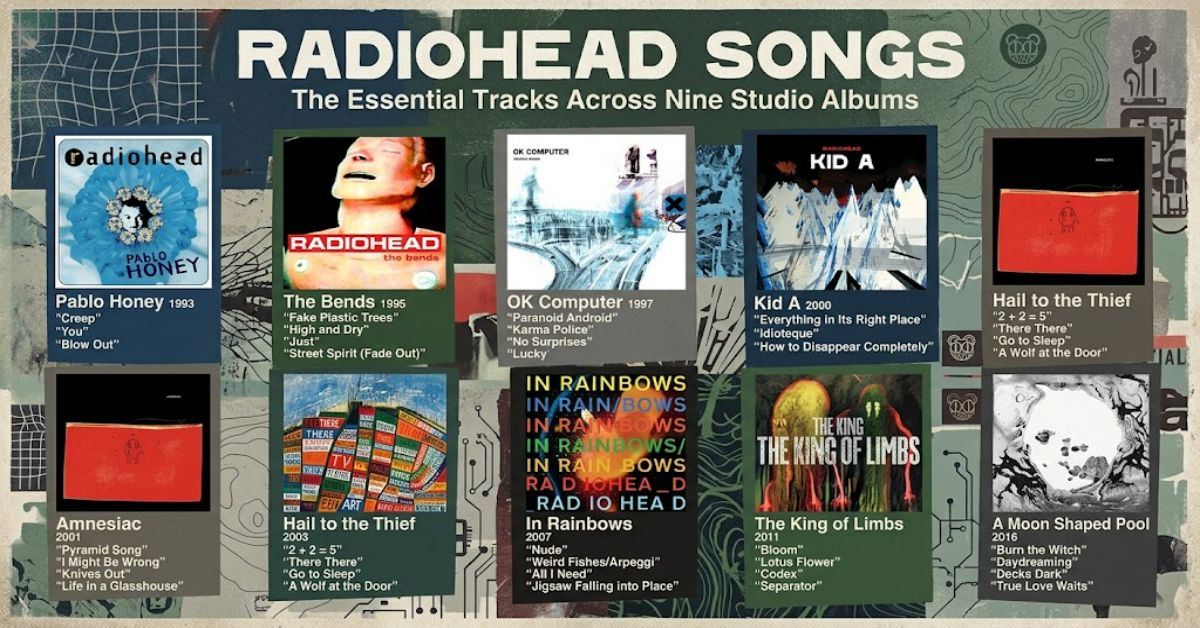
Radiohead has released many famous and acclaimed songs across their nine studio albums, making the phrase Radiohead songs cover an unusually broad musical range. The Oxfordshire band began with guitar-driven alternative rock and eventually incorporated electronic production, ambient textures, jazz influences and unconventional song structures.
That evolution is central to understanding their catalogue. “Creep”, their best-known early single, sounds radically different from “Everything in Its Right Place”, while “Paranoid Android” occupies another space altogether. Rather than relying on one successful formula, Radiohead repeatedly changed their approach.
For new listeners, this can make the discography difficult to navigate. For long-term fans, it is one of the reasons the band’s music remains so rewarding. Their strongest songs tend to reveal additional layers with repeated listening, whether through Thom Yorke’s vocals, Jonny Greenwood’s arrangements, Colin Greenwood’s bass lines, Phil Selway’s drumming or the production decisions that shape each recording.
How Radiohead’s Sound Changed
Radiohead formed in Abingdon, Oxfordshire, in the mid-1980s and initially performed under the name On a Friday. Their first album, Pablo Honey, arrived in 1993 and established a more conventional alternative-rock sound.
“Creep” became an international hit, but its success did not define the band’s long-term direction. The Bends, released in 1995, demonstrated a much wider songwriting range. Songs such as “Fake Plastic Trees”, “High and Dry” and “Street Spirit (Fade Out)” showed greater emotional and musical depth.
The transformation became unmistakable with OK Computer in 1997. “Paranoid Android”, “Karma Police” and “No Surprises” became defining Radiohead songs while the album introduced themes of technology, alienation and modern anxiety.
| Album | Year | Representative songs | Musical character |
| Pablo Honey | 1993 | “Creep”, “Anyone Can Play Guitar” | Alternative rock |
| The Bends | 1995 | “Fake Plastic Trees”, “Street Spirit” | Guitar-driven art rock |
| OK Computer | 1997 | “Paranoid Android”, “Karma Police” | Experimental rock |
| Kid A | 2000 | “Everything in Its Right Place”, “Idioteque” | Electronic and experimental |
| Amnesiac | 2001 | “Pyramid Song”, “Knives Out” | Electronic, jazz and art rock |
| Hail to the Thief | 2003 | “2 + 2 = 5”, “There There” | Rock and electronic fusion |
| In Rainbows | 2007 | “Nude”, “Reckoner” | Warm, intricate alternative rock |
| The King of Limbs | 2011 | “Lotus Flower”, “Codex” | Rhythmic and electronic |
| A Moon Shaped Pool | 2016 | “Daydreaming”, “Burn the Witch” | Orchestral and atmospheric |
The Radiohead Songs That Define Each Era
The band’s catalogue can be understood through several landmark recordings.
“Creep” represents the early period. Its quiet-loud dynamic and memorable guitar distortion helped make it an enduring alternative-rock track, even though the band later moved far beyond that style.
“Street Spirit (Fade Out)” is a different kind of early masterpiece. Its repeating guitar pattern creates a hypnotic quality, while the song’s sombre atmosphere anticipates the darker emotional territory Radiohead would explore later.
“Paranoid Android” captures the ambition of OK Computer. Rather than following a straightforward verse-chorus structure, the song moves through multiple sections, creating a miniature suite. “Karma Police”, meanwhile, demonstrates how Radiohead could make an unconventional record accessible without removing its unsettling qualities.
The transition to Kid A was more radical. “Everything in Its Right Place” opens the album with processed vocals and electronic textures rather than the guitar-led approach associated with the previous records. “Idioteque” pushes further towards electronic rhythm and fragmented vocal delivery.
“Pyramid Song”, from Amnesiac, highlights another side of the same creative period. Its piano-led arrangement feels spacious and mysterious, with an unusual rhythmic character that makes the track difficult to categorise neatly.
By In Rainbows, Radiohead had found a balance between experimentation and warmth. “Reckoner”, “Nude” and “Weird Fishes/Arpeggi” demonstrate intricate arrangements without sacrificing emotional immediacy.
What Makes Their Best Songs Last?
One important distinction in Radiohead’s music is between complexity and purpose. The band does not experiment simply to sound unusual. Production, rhythm and arrangement are usually connected to the emotional idea of a song.
That creates several useful patterns:
| Feature | Effect on the listener |
| Unusual rhythms | Creates uncertainty and movement |
| Layered production | Rewards repeated listening |
| Ambiguous lyrics | Allows different interpretations |
| Dynamic arrangements | Builds emotional tension |
| Electronic textures | Expands the band’s musical vocabulary |
This also explains why ranking Radiohead songs is subjective. A listener looking for guitar music may favour “Just”, “My Iron Lung” or “There There”. Someone interested in electronic experimentation might prefer “Idioteque”, “Everything in Its Right Place” or “Lotus Flower”. Fans drawn to orchestral melancholy may choose “How to Disappear Completely”, “Pyramid Song” or “Daydreaming”.
The Future of Radiohead Songs in 2027
Radiohead’s recorded catalogue is complete enough to stand on its own, but its influence continues through modern alternative, electronic and experimental music. The band’s importance is increasingly less about individual singles and more about demonstrating that a successful rock group can repeatedly rebuild its creative identity.
By 2027, newer listeners are likely to encounter Radiohead through playlists, streaming recommendations and individual songs before exploring the albums. That route can work, but the strongest understanding comes from hearing how one record leads into another.
Their catalogue rewards chronology because the changes are part of the story.
Takeaways
- “Creep” introduced Radiohead to a mass audience but does not represent their complete sound.
- The Bends established a more mature guitar-based identity.
- OK Computer transformed the band’s critical and artistic reputation.
- Kid A marked a decisive move into electronic and experimental territory.
- In Rainbows combined technical detail with unusual warmth and accessibility.
- A Moon Shaped Pool emphasised orchestration, atmosphere and emotional restraint.
Conclusion
The appeal of Radiohead songs lies in their refusal to remain fixed. The band moved from alternative-rock conventions towards increasingly sophisticated combinations of guitars, electronics, rhythm, orchestration and studio production. That progression makes individual tracks more meaningful when heard within their original albums.
For a new listener, “Creep”, “Karma Police”, “Paranoid Android”, “Everything in Its Right Place”, “Idioteque”, “Weird Fishes/Arpeggi” and “Daydreaming” provide a useful route through the catalogue. They represent different periods without suggesting that one style defines the group.
Radiohead’s enduring strength is therefore not simply the number of acclaimed songs they recorded. It is the distance between those songs, and the willingness to make each new phase sound like a genuine creative decision.
FAQ
What is the most famous Radiohead song?
“Creep” is generally regarded as Radiohead’s most widely recognised song, although the band has many other critically acclaimed recordings.
What are the best Radiohead songs for beginners?
“Creep”, “Fake Plastic Trees”, “Paranoid Android”, “Karma Police”, “Everything in Its Right Place” and “Weird Fishes/Arpeggi” provide a broad introduction.
How many studio albums has Radiohead released?
Radiohead has released nine studio albums, from Pablo Honey in 1993 to A Moon Shaped Pool in 2016.
Why did Radiohead change their sound?
The band’s songwriting increasingly incorporated electronic production, unusual rhythms, orchestration and experimental arrangements rather than remaining within conventional guitar rock.
What is Radiohead’s most experimental album?
Kid A is widely regarded as one of the band’s most significant departures from their earlier guitar-based style.
Methodology
This article follows the supplied RubbleMagazine.co.uk production brief, using its core keyword and keyword detail as the basis for the structure and search intent. The analysis distinguishes between Radiohead’s major studio eras and representative recordings rather than presenting a definitive ranking. Album dates and discography details should be checked against primary or authoritative music-industry sources during final editorial review. No firsthand listening test or fabricated expert quotation has been used.
References
Radiohead. (1993). Pablo Honey. Parlophone.
Radiohead. (1995). The Bends. Parlophone.
Radiohead. (1997). OK Computer. Parlophone.
Radiohead. (2000). Kid A. Parlophone.
Radiohead. (2001). Amnesiac. Parlophone.
Radiohead. (2003). Hail to the Thief. Parlophone.
Radiohead. (2007). In Rainbows. XL Recordings.
Radiohead. (2011). The King of Limbs. XL Recordings.
Radiohead. (2016). A Moon Shaped Pool. XL Recordings.