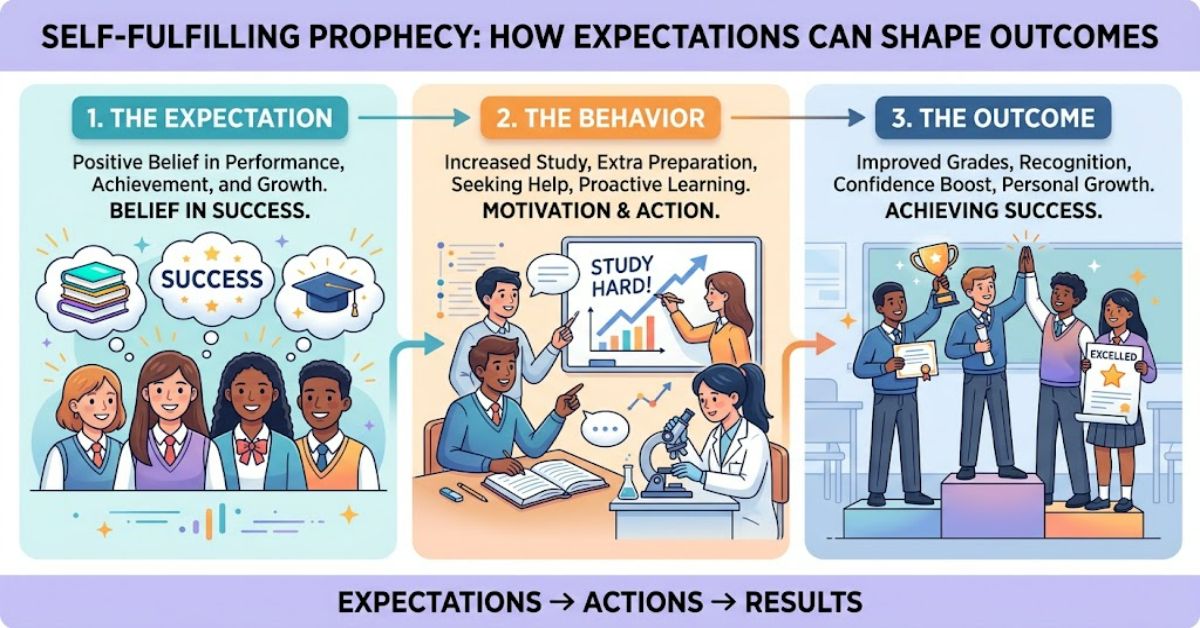
A self-fulfilling prophecy describes a situation in which a prediction or expectation helps bring about the outcome it predicts. In other words, people respond to a belief in ways that can make the original expectation become reality. The concept was named by sociologist Robert K. Merton in 1948.
The idea is easier to understand through a simple example. Imagine a student believes they are going to perform badly in an important presentation. That expectation may make them practise less, avoid opportunities to prepare, become more anxious and speak less confidently. The eventual weak performance can then appear to confirm the original belief.
The process does not mean that every expectation becomes reality. Nor does it mean that thoughts have a direct power to control events. The important mechanism is behaviour. A belief influences actions, interactions or decisions, and those changes can affect the eventual outcome.
This distinction matters because popular explanations sometimes make the concept sound stronger than the evidence supports. Modern research suggests that expectancy effects exist, but their size depends on circumstances, existing evidence and the people involved.
How the Process Works
A self-fulfilling prophecy can be understood as a feedback cycle:
Expectation → Behaviour → Response → Outcome → Reinforced expectation
The first stage is an assumption about what will happen. The person then behaves in ways influenced by that assumption. Other people may respond to the changed behaviour, creating conditions that make the expected result more likely.
| Stage | What happens |
| Expectation | A person forms a belief about a future outcome |
| Behaviour | The belief influences actions or decisions |
| Social response | Other people react to those actions |
| Outcome | The resulting circumstances move towards the expectation |
| Reinforcement | The outcome appears to confirm the original belief |
The cycle can operate without conscious intention. Someone does not have to deliberately manipulate events. Small differences in attention, communication, effort or opportunity can accumulate.
This is why the concept is useful in education, management and interpersonal relationships. It focuses attention not simply on what people believe, but on what those beliefs cause them to do.
The Pygmalion Effect and Education
One of the best-known applications of the theory is the Pygmalion effect, associated with research by Robert Rosenthal and Lenore Jacobson in 1968.
Their classroom study examined whether teachers’ expectations could influence pupil performance. Teachers were given information suggesting that certain randomly selected pupils had unusual potential for intellectual growth. Later assessments showed greater gains among some of the identified pupils.
The interpretation was influential: teachers’ expectations could alter their behaviour towards pupils, which could then affect pupil performance.
Possible mechanisms include differences in encouragement, feedback, attention, questioning and the level of challenge offered to pupils.
However, the original research has also faced significant criticism. Reviewers questioned aspects of the IQ testing and statistical analysis. Later research has generally produced a more cautious picture.
A major modern finding is that teacher expectations are often reasonably accurate. Teachers can recognise genuine differences in ability and performance, meaning that an association between expectations and achievement does not automatically prove a self-fulfilling effect.
Evidence at a Glance
| Research issue | What the evidence suggests |
| Teacher expectations | Often reflect genuine differences between pupils |
| Expectancy effects | Real but generally modest |
| False expectations | Can influence achievement in some circumstances |
| Long-term accumulation | Effects do not necessarily grow year after year |
| Vulnerable groups | Effects can matter more where stereotypes or disadvantage are involved |
A 2020 study involving 1,026 first-graders across 64 classrooms examined teacher expectations, pupil achievement and feedback. The findings supported a nuanced interpretation: expectations were largely accurate, but inaccurate expectations could still influence subsequent achievement.
That distinction is important. The evidence does not suggest that teachers routinely create pupils’ academic futures simply by thinking positively or negatively about them. Instead, expectations may contribute a smaller causal influence alongside ability, motivation, prior achievement and wider circumstances.
Positive and Negative Expectancies
Expectations can operate in both directions.
The Pygmalion effect describes a situation in which higher expectations can contribute to improved performance. Its counterpart, often called the Golem effect, describes how low expectations can contribute to poorer performance.
Consider a workplace example. A manager who believes an employee can handle a demanding project may provide more detailed feedback, greater responsibility and additional opportunities. The employee receives more chances to develop and may perform better.
A manager who expects failure might instead provide less responsibility and less useful feedback. The employee consequently has fewer opportunities to succeed.
The key issue is not simply whether expectations are positive or negative. Unrealistic expectations can also create pressure, while accurate negative feedback can be useful. Productive expectations need to be accompanied by appropriate support and evidence.
The Role of Feedback Loops
The idea can also be viewed as a causal feedback loop. An initial belief changes behaviour, and that behaviour changes the environment. The altered environment then produces evidence that appears to validate the original belief.
Merton illustrated the broader principle through a bank-run example. A rumour that a bank is failing can cause depositors to withdraw their money. If enough people act on the belief, the bank can genuinely experience financial pressure.
The original prediction may therefore become partly responsible for producing the condition it predicted.
This example shows why self-fulfilling prophecies are not limited to individual psychology. Expectations can operate through groups, organisations and institutions when enough people act on the same assumption.
What the Theory Does Not Prove
The phrase is sometimes used too broadly. Not every prediction that comes true is a self-fulfilling prophecy.
If a person predicts rain and it rains, that does not automatically mean the prediction caused the rain. There must be a plausible causal pathway connecting the expectation with behaviour and the eventual outcome.
Similarly, believing that someone will fail does not guarantee that they will fail. External factors, personal agency, preparation and chance can interrupt the cycle.
This limitation is one of the most important analytical points. The theory describes one possible mechanism among many, not a universal law of human behaviour.
The Future of Self Fulfilling Prophecy in 2027
By 2027, research on expectations is likely to remain focused on the conditions under which expectancy effects become meaningful rather than simply asking whether they exist.
Education provides a particularly important setting because expectations can interact with assessment, feedback, motivation and social stereotypes. Better research designs can separate accurate expectations from inaccurate ones, helping researchers identify where expectations genuinely change outcomes.
The practical challenge is to avoid both extremes: assuming expectations have no effect, or treating them as all-powerful. Current evidence supports a middle position in which expectancy effects are measurable but usually modest.
Key Insights
- Expectations can influence outcomes through changes in behaviour and social interaction.
- A correlation between expectation and performance does not automatically demonstrate a self-fulfilling prophecy.
- Teacher expectations often contain accurate information about existing pupil differences.
- Inaccurate expectations can nevertheless create measurable advantages or disadvantages.
- Effects may be particularly important for groups exposed to persistent stereotypes.
- The original Pygmalion findings require cautious interpretation because of methodological criticism.
- Self-fulfilling prophecies are best understood as feedback processes rather than magical effects of thought.
Conclusion
A self-fulfilling prophecy provides a useful framework for understanding how expectations can influence behaviour and, under certain conditions, help produce the outcomes people anticipate. Its significance lies in the behavioural mechanism rather than the idea that thoughts independently control reality.
Robert K. Merton introduced the concept in 1948, and later research made expectancy effects especially prominent in education. The Pygmalion effect demonstrated the possibility that expectations held by teachers can influence pupil outcomes, while subsequent research showed why the original findings should not be treated as proof of a universal or powerful effect.
The modern evidence presents a more balanced picture. Expectations can matter, but they operate alongside existing ability, motivation, social conditions and accurate information. Understanding that distinction makes the concept more useful. It encourages attention to how people are treated while avoiding the assumption that every success or failure is simply the result of belief.
FAQ
What is a self-fulfilling prophecy in simple terms?
It is a prediction or expectation that influences behaviour in ways that help make the predicted outcome happen.
Who introduced the concept of self-fulfilling prophecy?
Sociologist Robert K. Merton introduced the term in 1948 in his article “The Self-Fulfilling Prophecy”.
What is an example of a self-fulfilling prophecy?
A student who expects to fail may become anxious, prepare less effectively and avoid participation, increasing the possibility of poor performance.
What is the Pygmalion effect?
The Pygmalion effect describes a form of expectancy effect in which higher expectations from another person, such as a teacher or manager, can contribute to improved performance.
Can negative expectations become self-fulfilling?
Yes. Low expectations can influence treatment, opportunities and feedback in ways that may contribute to poorer performance. This is often discussed as the Golem effect.
Are self-fulfilling prophecies always powerful?
No. Research indicates that expectancy effects are generally modest and depend heavily on context. Expectations may be accurate rather than causal, and other factors can have greater influence.
Methodology
This article was developed from the supplied topic brief and its documented research material, including Merton’s 1948 work and research on teacher expectations, Pygmalion effects and later critiques. No fabricated firsthand testing, interviews or personal observations have been added. The analysis distinguishes the original influential claims from later evidence that suggests expectancy effects are real but generally modest.
The principal limitation is that a concise article cannot reproduce the full methodological debate surrounding decades of expectancy research. The evidence should therefore be read as a balanced overview rather than a systematic review.
References
Gentrup, S., Lorenz, G., Kristen, C., & Kogan, I. (2020). Self-fulfilling prophecies in the classroom: Teacher expectations, teacher feedback and student achievement. Learning and Instruction, 66, 101296.
Jussim, L., & Harber, K. D. (2005). Teacher expectations and self-fulfilling prophecies: Knowns and unknowns, resolved and unresolved controversies. Personality and Social Psychology Review, 9(2), 131–155.
Madon, S., Jussim, L., & Eccles, J. (1997). In search of the powerful self-fulfilling prophecy. Journal of Personality and Social Psychology, 72(4), 791–809.
Merton, R. K. (1948). The self-fulfilling prophecy. The Antioch Review, 8(2), 193–210.
Raudenbush, S. W. (1984). Magnitude of teacher expectancy effects on pupil IQ as a function of the credibility of expectancy induction: A synthesis of findings from 18 experiments. Journal of Educational Psychology, 76(1), 85–97.
Rosenthal, R., & Jacobson, L. (1968). Pygmalion in the classroom. The Urban Review, 3(1), 16–20.
Thorndike, R. L. (1968). Review of Pygmalion in the classroom. American Educational Research Journal, 5(4), 708–711.