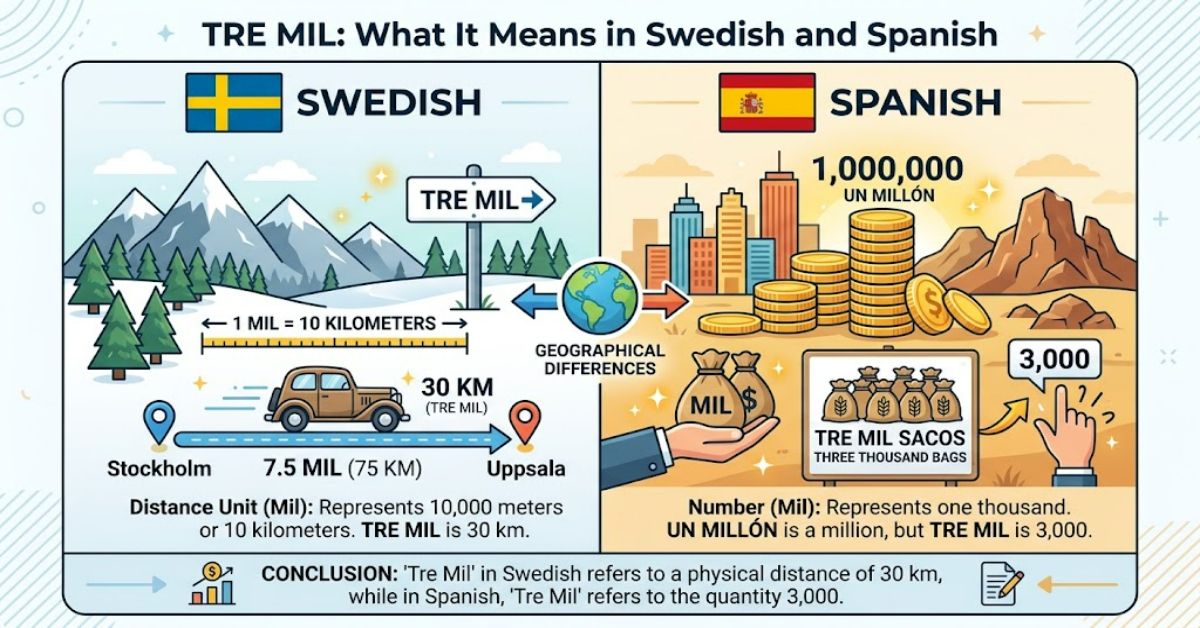
The meaning of tre mil depends on the language and context in which it appears. In Swedish, tre mil means three mil, and one modern Swedish mil is exactly 10 kilometres. That makes tre mil equal to 30 kilometres, or approximately 18.64 English miles. The Swedish and Norwegian mil is a traditional distance unit that survived the transition to the metric system and remains common in everyday speech.
The phrase can be confusing for English speakers because mil looks similar to mile. They are not equivalent. An English mile is about 1.609 kilometres, while a Swedish mil is 10 kilometres. Swedish educational material gives the conversion directly as 1 mil = 10 km.
There is another linguistic complication. In Spanish, tres mil means “three thousand”. The Spanish phrase is therefore not a measurement of 30 kilometres unless the surrounding context supplies a distance unit.
Understanding the distinction is useful when reading Swedish travel information, maps, sporting discussions, historical material or multilingual websites. A simple spelling difference can change the meaning from a distance of 30 kilometres to the number 3,000.
What Does Tre Mil Mean in Swedish?
Swedish uses mil as a distance unit equal to 10 kilometres. Therefore:
| Swedish expression | Kilometres | Approx. English miles |
| 1 mil | 10 km | 6.21 miles |
| 2 mil | 20 km | 12.43 miles |
| tre mil | 30 km | 18.64 miles |
| 5 mil | 50 km | 31.07 miles |
| 10 mil | 100 km | 62.14 miles |
The calculation is straightforward: multiply the number of mil by 10.
So, if a Swedish speaker says that a place is tre mil away, the intended modern measurement is 30 kilometres. The phrase is especially natural in ordinary conversation when discussing journeys and geographical distances.
The Norwegian language uses the same basic modern conversion. The Store norske leksikon defines the Norwegian and Swedish mil as 10 kilometres following the introduction of the metric system.
Why a Swedish Mil Is Not an English Mile
This is the most important distinction for English-speaking readers.
An English mile is defined as 1.609344 kilometres. A Swedish mil is exactly 10 kilometres. They may look related because the words are similar, but their numerical values are very different.
A traveller reading that a Swedish destination is tre mil away could therefore make a substantial calculation error by interpreting it as three English miles. Three English miles is only about 4.83 kilometres, compared with the actual 30 kilometres represented by three Swedish mil.
This difference is particularly relevant for route planning, hiking, running and driving.
The term is also not an SI unit. Sweden uses kilometres in many official contexts, including road signage, but mil remains established in everyday language. Swedish educational resources continue to teach the conversion as 1 mil = 10 km.
Tre Mil and the Historical Swedish Mil
The modern 10-kilometre definition should not automatically be applied to historical Swedish documents.
Before metric standardisation, the Swedish mil was longer. The Swedish National Archives’ historical reference material records an older Swedish mil of approximately 10.69 kilometres. The older measurement was used before the metric system was introduced, meaning that a historical reference to tre mil could represent roughly 32 kilometres rather than today’s 30 kilometres.
This creates an important research issue. Someone translating an old Swedish map, land record or historical account should identify the date before converting the measurement.
| Context | Meaning of one mil | Tre mil |
| Modern Swedish | 10 km | 30 km |
| Older Swedish measurement | About 10.69 km | About 32.1 km |
| English mile | 1.609 km | About 4.83 km |
The date of the source therefore becomes part of the measurement itself.
What Does Tres Mil Mean in Spanish?
Spanish introduces a separate linguistic issue. The standard phrase is tres mil, with tres meaning three and mil meaning thousand. Consequently, tres mil means 3,000. Spanish-language dictionaries confirm this direct translation.
For example:
- tres mil personas = 3,000 people
- tres mil euros = €3,000
- tres mil kilómetros = 3,000 kilometres
This is why the spelling matters. Swedish uses tre mil, while Spanish uses tres mil.
The difference is only one letter, but the grammatical and numerical meaning changes completely.
Three Practical Ways to Interpret Tre Mil
The safest approach is to examine the surrounding language before translating the phrase.
1. Swedish sentence:
If the phrase appears in Swedish, tre mil normally means 30 kilometres in modern usage.
2. Spanish sentence:
If the wording is tres mil, it means 3,000, unless another expression establishes a different context.
3. Historical Swedish source:
If tre mil appears in an old Swedish document, establish the date before applying the modern 10-kilometre conversion.
This context-first approach is more reliable than translating the individual words mechanically.
Cultural and Practical Significance
The survival of mil is an interesting example of how everyday language can outlast changes in formal measurement systems. Sweden adopted metric measurement, yet the older term remained useful in ordinary speech.
That creates a practical split between formal and conversational measurement. A person may encounter kilometres on official road information while hearing mil in everyday discussion about how far away a destination is.
For international readers, this also demonstrates why translation tools need contextual awareness. A literal translation of mil as “mile” can be misleading because it imports an English measurement that does not have the same value.
The deeper lesson is that measurement vocabulary is cultural as well as mathematical.
The Future of Tre Mil in 2027
There is little reason to expect the Swedish mil to disappear from everyday language by 2027. Its continued presence is supported by established usage in Swedish education and ordinary geographical descriptions.
At the same time, kilometres will remain important for formal measurement and international communication. The two systems can therefore coexist: kilometres provide internationally familiar metric precision, while mil remains a culturally established Swedish expression.
For digital translation, mapping and travel platforms, the main practical requirement is disambiguation. Software needs to recognise whether mil refers to the Scandinavian distance unit, another technical meaning or an entirely different word in another language.
Key Insights
- Tre mil equals 30 kilometres in modern Swedish.
- Swedish mil and English mile are fundamentally different units.
- Historical Swedish sources require date-sensitive conversion.
- Spanish tres mil means 3,000, not 30 kilometres.
- Context is essential when translating short multilingual phrases.
- The continued everyday use of mil shows how traditional vocabulary can survive metric standardisation.
Conclusion
Tre mil is a small phrase with a surprisingly large potential for misunderstanding. In modern Swedish, it means three Swedish mil, or 30 kilometres. That interpretation is completely different from an English mile and should not be translated literally as three miles.
Historical context adds another layer. Older Swedish measurements could make three mil approximately 32 kilometres, so researchers working with historical documents need to establish which measurement system was in use.
Spanish creates a separate distinction. The visually similar tres mil means 3,000. The difference between tre and tres therefore matters when identifying the language.
For travellers, translators and researchers, the most reliable method is simple: identify the language, establish the date where relevant, and then apply the correct measurement system. That prevents a small linguistic ambiguity from becoming a substantial numerical error.
FAQ
How many kilometres is tre mil?
In modern Swedish, tre mil equals 30 kilometres because one Swedish mil is exactly 10 kilometres.
Is tre mil the same as three miles?
No. Three English miles are about 4.83 kilometres, while tre mil in Swedish means 30 kilometres.
What does tres mil mean in Spanish?
Tres mil means 3,000 in Spanish. It is a number rather than a Swedish-style distance measurement.
Why does Sweden use mil if it uses the metric system?
Mil survived as an established everyday distance expression even after Sweden adopted metric measurement. Kilometres are also widely used, particularly in formal contexts.
Was the old Swedish mil also 10 kilometres?
No. Historical Swedish mil measurements were longer. The Swedish National Archives records an older standard of about 10.69 kilometres.
How should tre mil be translated?
In modern Swedish distance contexts, it should normally be translated as 30 kilometres rather than three miles.
Methodology
This article treats tre mil primarily as a modern Swedish distance expression and separately addresses the Spanish tres mil distinction. The measurement was validated against Swedish educational material and the Store norske leksikon, while historical information was checked against the Swedish National Archives’ material on the older Swedish mil. Spanish meaning was checked against Spanish-language dictionary sources.
No firsthand field testing was conducted. The principal limitation is that mil has historical and language-specific meanings, so a translation without surrounding context cannot always be interpreted with certainty.
AI Disclosure: This article was drafted with AI assistance and should be independently reviewed by the RubbleMagazine.co.uk editorial team before publication.
References
SpanishDictionary.com. (2026). 3000: Spanish translation and examples.
SpanishDictionary.com. (2026). Tres mil: Spanish to English translation.
Store norske leksikon. (2026). Mil.
Statens arkiv. (2026). Mil (gammal svensk).
Matteboken. (2026). Enheter och prefix.
Norstedts. (2021). Matematik 5000: Yrkesmatematik, enheter och beräkningar.