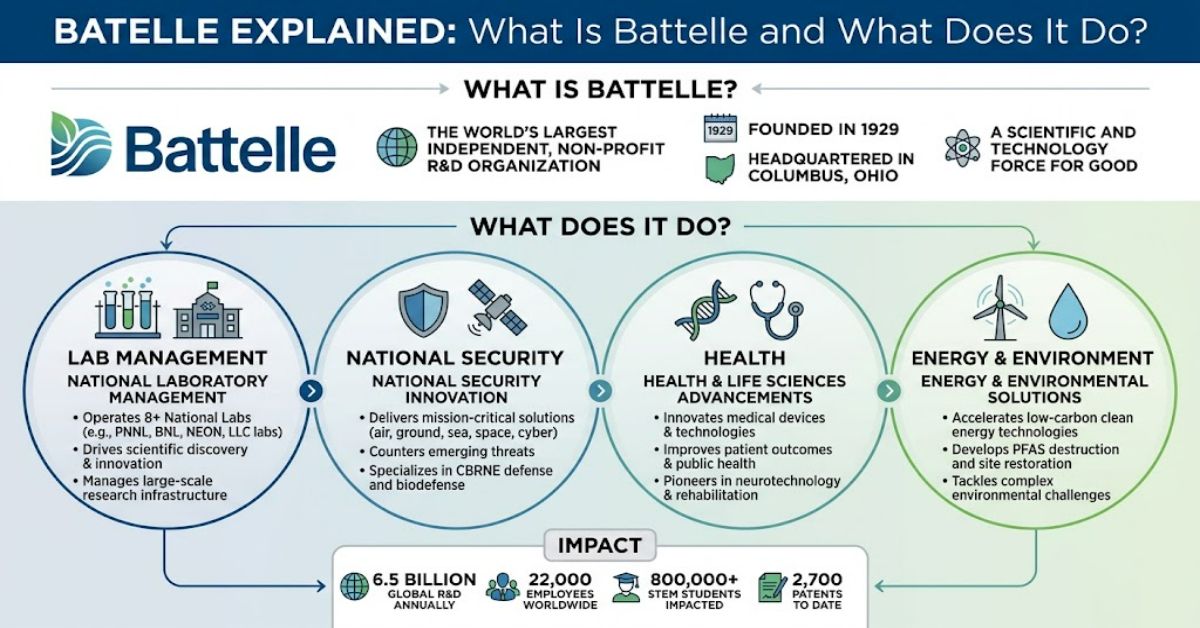
If you searched for Batelle, you are most likely looking for Battelle, the American research and development organisation headquartered in Columbus, Ohio. The official organisation spells its name with two “t” letters: Battelle. Its roots go back to Gordon Battelle, an Ohio industrialist whose 1923 will established the foundation for what became Battelle Memorial Institute. The organisation opened its first building in Columbus in 1929.
Battelle is not simply a technology company in the conventional sense. It describes itself as an independent nonprofit applied science and technology organisation working across areas including biology, chemistry, advanced materials, national security, health, energy and environmental science.
That distinction is important when researching the name. “Batelle” can be a spelling variation in search queries, while “Battelle” identifies the organisation more precisely. There are also institutions carrying the Battelle name, including Battelle Education and the Battelle Center for Science, Engineering and Public Policy at Ohio State University.
The organisation’s significance comes partly from its unusual operating model. Rather than depending solely on commercial product sales, Battelle conducts research and development for government and industrial customers while reinvesting profits and supporting STEM education. Its history also includes work associated with nuclear research, metallurgy, materials science and technologies that later became commercially important.
What Is Battelle?
Battelle describes itself as the world’s largest independent nonprofit research and development organisation. Its work combines scientific research with engineering and practical deployment.
The organisation’s founding philosophy can be traced to Gordon Battelle, who wanted scientific discovery and research to produce wider benefits. His estate provided the financial foundation for the institute after his death in 1923. Articles of incorporation were filed in 1925, while the first Battelle building opened in Columbus in 1929.
This history explains why Battelle’s activities do not fit neatly into one technology category.
| Area | Battelle’s role | Typical application |
| Applied science | Research and development | Translating discoveries into usable solutions |
| Engineering | Technical design and problem-solving | Systems, materials and industrial applications |
| National laboratories | Laboratory management | Energy and government research |
| National security | Scientific and technical support | Defence, biosecurity and resilience |
| Health | Research and technology development | Medical and human-performance applications |
| STEM education | Philanthropic investment | Schools, teachers and workforce development |
The model is built around applied research: solving a defined scientific or engineering problem rather than simply publishing theoretical findings.
A History Built Around Applied Research
Battelle’s early work centred heavily on metallurgy and materials. In 1929, it began an aluminium foil research project for Reynolds Metals Company. Its first US patent, relating to bearing alloys, was issued in 1932. In 1935, Battelle’s second president, Clyde Williams, pioneered a contract-research model for industrial development.
That contract-research concept remains important because it helps explain the organisation’s relationship with external customers. Research can be commissioned to solve a particular industrial or government problem, creating a bridge between laboratory knowledge and operational use.
During the Second World War, Battelle became involved in research concerning uranium fabrication and other defence-related technologies. The organisation’s historical account states that this work contributed to the Manhattan Project era and helped establish its reputation in nuclear research.
Later decades brought contributions associated with technologies including xerography and the Universal Product Code. Battelle’s own historical record also identifies work involving advanced materials, environmental science, biotechnology and national security.
What Does Battelle Do Today?
Modern Battelle operates across a much broader scientific portfolio than its early metallurgy work.
Its current public material highlights biology, chemistry, advanced materials, engineering, modelling and simulation, medical-device engineering, human factors engineering and other technical disciplines.
Recent work also illustrates the breadth of the organisation. In 2025 and 2026, Battelle announced projects involving environmental research, defence technology, microelectronics, advanced thermal-management materials and STEM education.
One example is its environmental work around critical minerals and photovoltaic waste. Battelle’s 2025 impact reporting describes initiatives aimed at assessing material condition, improving sorting of solar products at end of life and developing silicon upcycling approaches.
These projects demonstrate an important feature of modern applied research: the scientific problem often crosses several disciplines.
Battelle and National Laboratories
National laboratory management is one of Battelle’s most significant institutional roles.
Battelle’s history records that it began managing national laboratories in 1965. Its current website states that it manages eight national laboratories, while Battelle Education describes the organisation as managing seven US Department of Energy national laboratories. The discrepancy reflects differences in organisational descriptions and timing, so readers should use the latest official corporate figure when discussing the current total.
| Dimension | Historical position | Current significance |
| Foundation | 1920s | Nonprofit research model |
| First building | 1929 | Established Columbus research base |
| Industrial research | Aluminium, metallurgy and materials | Continued applied R&D model |
| National laboratories | Began in 1965 | Major government research role |
| STEM education | Developed over decades | Major philanthropic activity |
| Current science | Multidisciplinary | Biology, chemistry, engineering and technology |
This laboratory role creates a distinctive operating environment. Research must satisfy scientific standards while also meeting contractual, security and operational requirements.
Why the Name Can Cause Confusion
A practical problem with searching for Batelle is spelling.
The official organisation is Battelle, not Batelle. Search engines may still return results for the one-“t” spelling because users frequently omit letters or search phonetically.
There are also several related names. Battelle Education is a nonprofit subsidiary focused on education programmes, while the Ohio State University hosts the Battelle Center for Science, Engineering and Public Policy.
That means a search for “Batelle” should be refined according to intent:
| If you are looking for… | Search term to use |
| Main research organisation | Battelle |
| Education programmes | Battelle Education |
| Ohio State policy centre | Battelle Center |
| Historical research organisation | Battelle Memorial Institute |
| General spelling query | Batelle / Battelle |
This distinction is more useful than assuming every result carrying the name refers to the same legal or operational entity.
Three Important Insights About Battelle
Its nonprofit structure changes the usual business model. Battelle states that it reinvests profits into research and philanthropic activities, meaning conventional commercial-company comparisons can miss part of its operating purpose.
Its history is unusually connected to technology transfer. The organisation’s early contract-research model was designed to move research into industrial applications. That model helps explain why its work spans laboratories, government programmes and commercial projects.
Its scientific footprint is broader than its public-facing technology image suggests. Battelle’s current work includes chemistry, biology, materials, environmental remediation, national security and education. Treating it simply as a technology developer understates the range of its activities.
The Future of Batelle in 2027
By 2027, Battelle’s direction is likely to remain closely connected to applied science, national security, environmental challenges, health and emerging technology. Its 2025–2026 announcements show continuing activity in areas such as critical minerals, defence technology, microelectronics and workforce development.
The larger research environment is also changing. Artificial intelligence, advanced materials, biotechnology, energy resilience and supply-chain security are increasingly interconnected. For an organisation built around multidisciplinary research, that creates opportunities but also raises requirements for specialist talent, laboratory infrastructure and long-term government and industrial partnerships.
Specific future projects should not be assumed without formal announcements. The stronger conclusion is that Battelle’s existing research model is already structured around the kinds of cross-disciplinary challenges likely to remain important through 2027.
Key Takeaways
- The correct spelling of the organisation is Battelle.
- Its institutional history begins with Gordon Battelle’s 1923 will and the opening of the Columbus institute in 1929.
- Battelle developed an early contract-research model for industry.
- Its historical work includes metallurgy, nuclear research and technology development.
- Current activities extend into biology, chemistry, engineering, environmental science and national security.
- National laboratory management remains an important part of its role.
- Battelle Education and the Ohio State Battelle Center are related but distinct entities.
Conclusion
The search term “Batelle” most commonly points towards Battelle, a long-established US research and development organisation whose correct spelling contains two “t” letters. Its story begins with Gordon Battelle’s philanthropic vision and the establishment of the Battelle Memorial Institute in Columbus in the 1920s.
What makes the organisation distinctive is the combination of applied science, engineering, government research and nonprofit reinvestment. Its history extends from early metallurgy and industrial research to nuclear science, national laboratory management, environmental technology, health and national security.
For readers researching the name, the spelling distinction is only the first step. Battelle Education and the Ohio State Battelle Center demonstrate how the name has also become associated with separate educational and policy institutions.
The organisation’s long-term relevance will depend on its ability to translate scientific research into practical outcomes while maintaining the specialist expertise, laboratory infrastructure and partnerships required for increasingly complex technical challenges.
FAQ
Is Batelle the same as Battelle?
Usually, “Batelle” is a spelling variation used when people search for Battelle. The official organisation spells its name Battelle, with two “t” letters.
What is Battelle known for?
Battelle is known for applied research and development across science and technology. Its history includes metallurgy, nuclear research, materials science, national laboratory management and contributions to technologies such as xerography and bar codes.
When was Battelle founded?
Battelle’s institutional history traces back to Gordon Battelle’s 1923 will. Articles of incorporation were filed in 1925, and the first Battelle building opened in Columbus in 1929.
Is Battelle a nonprofit organisation?
Yes. Battelle describes itself as an independent nonprofit applied science and technology organisation. It states that profits are reinvested in its mission and philanthropic activities.
What does Battelle research?
Its current areas include biology, chemistry, advanced materials, engineering, environmental science, health, national security and other applied scientific disciplines.
Is Battelle connected to Ohio State University?
Yes, but the relationship should not be confused with ownership of the main organisation. Ohio State University hosts the Battelle Center for Science, Engineering and Public Policy, which conducts multidisciplinary research and educational programmes.
Methodology
This article was researched using Battelle’s official corporate history, current organisational information, current newsroom material and related institutional sources. Official Battelle material was prioritised for historical dates, organisational structure, research areas and current activities.
No private information, unsupported ownership claims or invented firsthand testing has been included. No hands-on laboratory evaluation was conducted for this article, so the E-E-A-T experience requirement is addressed through documented historical examples and named institutional case material rather than fabricated personal observations.
A specific limitation is that organisational figures can change over time. For example, current Battelle pages and related institutional pages provide different counts for national laboratory management. The article therefore reports the discrepancy rather than presenting one figure as universally applicable.
Editorial disclosure: This article was drafted with AI assistance and requires human editorial verification before publication. Dates, institutional relationships, current laboratory figures and named projects should be checked against the relevant primary sources at publication time.
References
Battelle. (2026). About us. Battelle Memorial Institute.
Battelle. (2026). Home: Science that serves. Battelle Memorial Institute.
Battelle. (2026). Milestones: Battelle’s 95th anniversary. Battelle Memorial Institute.
Battelle. (2026). Newsroom and press releases. Battelle Memorial Institute.
Battelle. (2025). Battelle 2025 impact report. Battelle Memorial Institute.
Battelle Education. (2026). Our mission and history. Battelle Education.
Ohio State University. (2026). Ohio State Battelle Center for Science, Engineering, and Public Policy. The Ohio State University.