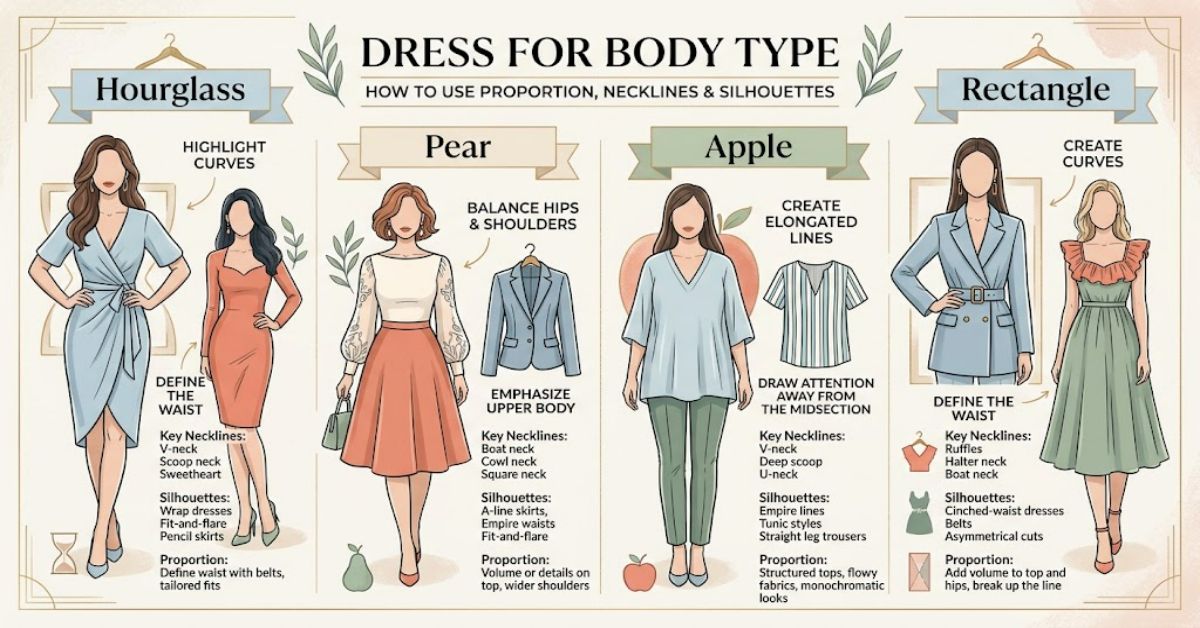
Learning how to dress for body type is less about finding a supposedly perfect shape and more about understanding visual proportion. The same dress can create very different effects depending on where its waistline sits, how wide its neckline is, where its hem finishes and how much structure the fabric provides.
Traditional fashion advice often divides bodies into categories such as pear, hourglass, rectangle, apple or inverted triangle. These labels can be useful shorthand, but they are not scientific classifications and should not dictate what someone is allowed to wear. Bodies are three-dimensional, individual and constantly changing.
A more practical method is to look at the relationship between shoulders, waist, hips and overall height. From there, clothing becomes a tool for adjusting visual emphasis. A V-neck can create a longer vertical line. A structured shoulder can add width to the upper body. A defined waist can separate the torso from the skirt or trousers. A fluid fabric can soften the outline rather than reinforce it.
This approach also fits the modern fashion market, where personal choice matters as much as prescribed dressing rules. UK household spending on clothing and footwear returned to annual volume growth in 2025 after declines in 2023 and 2024, according to the Office for National Statistics. That makes considered wardrobe choices increasingly relevant for shoppers who want clothes that work across multiple occasions.
Understanding Proportion Before Body Shape
The most useful starting point is not a body-shape label but a proportion check.
Stand in front of a full-length mirror and consider three areas: shoulder width, waist definition and hip width. Then consider vertical proportion, particularly the relationship between torso and legs. This helps explain why a garment that looks balanced on one person can appear visually heavy or unusually short on another.
| Visual concern | Styling tool | Typical effect |
| Narrower shoulders | Wider neckline or shoulder detail | Adds visual width |
| Less defined waist | Waist seam or belting | Creates separation |
| Fuller hips | Structured or detailed upper half | Shifts visual emphasis upwards |
| Shorter-looking torso | Higher or lower waist placement, depending on proportions | Changes vertical balance |
| Longer torso | Higher-rise styling or shorter upper layer | Visually shortens the torso |
| Desire for length | Vertical seams and longer lines | Creates a more continuous silhouette |
The key insight is that these techniques are relative. There is no universal “correct” waistline or hem length. The objective is to control the relationship between garments and the wearer’s proportions.
Necklines Can Change the Entire Silhouette
Neckline choice is one of the fastest ways to alter the visual structure of a dress.
A V-neck introduces a strong vertical direction, while a scoop neckline creates a softer curved opening. A square neckline can emphasise the shoulder line and provide a more architectural appearance. A boat neckline extends visually towards the shoulders, which can make the upper body feel broader.
Collars also matter. A high neckline adds visual material around the upper torso, whereas an open neckline leaves more negative space.
This does not mean one neckline is automatically better for one body type. The appropriate choice depends on the desired effect, garment fabric and surrounding details. A deep V-neck on a structured dress behaves differently from the same neckline on a loose jersey garment.
Silhouette, Waist Placement and Fabric
Silhouette is where body-shape advice becomes genuinely practical.
An A-line dress gradually widens from the waist or upper torso, creating a clear relationship between the fitted upper section and fuller skirt. A sheath dress follows the body’s vertical line more closely. A wrap dress uses crossing fabric and waist definition to create movement through the centre of the garment.
Fabric changes these effects. Stiff cotton, denim, wool and structured tailoring hold a shape, while viscose, silk and lightweight jersey generally create softer movement.
One useful distinction is between structural volume and visual volume. A garment can physically contain a lot of fabric without looking oversized if the fabric falls close to the body. Conversely, a relatively simple garment can look substantial when it has stiff pleats, puffed sleeves or architectural shoulders.
Matching Dress Features to Your Intended Effect
Rather than memorising rules for every body category, use the following framework.
| If you want to… | Consider… | Why it can work |
| Emphasise the waist | Wrap construction, waist seams, belts | Creates a central visual anchor |
| Highlight shoulders | Square, boat or wider necklines | Directs attention towards the upper body |
| Create a longer line | V-neck, vertical seams, longer uninterrupted panels | Encourages the eye to travel vertically |
| Add movement around hips | Pleats, gathers or an A-line skirt | Introduces controlled volume |
| Reduce visual interruption | Similar colours through top and skirt | Creates greater continuity |
| Add definition | Tailoring, darts or shaped seams | Gives the garment architectural structure |
The important point is that dressing for your body type should not become a system of concealment. Clothing can emphasise a feature without suggesting that another feature needs hiding.
What Fashion Case Studies Reveal
Runway and red-carpet styling demonstrate how proportion can be deliberately engineered.
At the 2025 Met Gala, Cynthia Erivo’s custom Burberry look was developed around strong shoulders, a slashed neckline, corsetry and a multilayered tulle skirt. British Vogue reported that designer Daniel Lee and the atelier specifically considered the relationship between the structured upper section and softer skirt volume. This is a useful documented example of proportion being treated as a design problem rather than a body-type rule.
The broader lesson is important: professional styling often begins with silhouette. Designers consider where volume sits, where the eye is directed and how separate garments interact as one visual composition.
Risks and Trade-Offs
Rigid body-shape systems have an obvious limitation: they can turn personal style into a list of restrictions.
A pear-shaped person does not automatically need to minimise the hips. Someone with broad shoulders does not need to avoid sleeveless clothing. An individual with a less defined waist does not need every outfit cinched at the middle.
There is also a practical trade-off between visual balance and comfort. A highly structured dress may create a particular silhouette but be less suitable for commuting, sitting for long periods or moving freely. Likewise, a garment that looks ideal in a fitting room may behave differently after several hours of wear.
This is why movement, fabric recovery, seam placement and fastening design deserve attention alongside appearance.
Three Useful Insights for Building a Better Wardrobe
First, waist placement can matter more than garment size. Two dresses in the same nominal size can create completely different proportions because one has a high waist seam and the other has a dropped or natural waist.
Second, fabric weight should be considered alongside silhouette. The same A-line cut in lightweight cotton and heavy wool will create different amounts of volume.
Third, outfit proportion is cumulative. Shoes, coat length, handbag position and trouser or skirt length all contribute to the final visual line. Assessing a dress alone can therefore be misleading.
These considerations also support more deliberate purchasing. ONS data shows UK clothing and footwear household consumption volume grew by 4.2% in 2025, following contractions in 2023 and 2024. Choosing versatile pieces that work with existing wardrobes can therefore be more useful than repeatedly buying trend-specific garments.
The Future of Dress for Body Type in 2027
By 2027, body-shape styling is likely to continue moving away from rigid categories towards more personalised approaches. Digital fitting tools, improved size data and increasingly flexible fashion ranges may make garment selection more focused on measurements and intended fit than simplistic shape labels.
The main limitation will remain fit consistency. A digital recommendation is only as useful as the measurement data, garment specifications and sizing information behind it.
Fashion is also likely to continue balancing trend cycles with longevity. The practical value of a dress will increasingly depend not simply on whether its silhouette is fashionable, but on whether it works across occasions and coordinates with existing clothing.
Takeaways
- Body-shape categories are useful vocabulary, not fixed rules.
- Necklines can influence both horizontal and vertical visual direction.
- Waist placement changes the relationship between the upper and lower sections of an outfit.
- Fabric structure can be as influential as the cut itself.
- Accessories and outerwear can alter the perceived proportion of a dress.
- Comfort and movement should be assessed alongside visual appearance.
- Personal preference remains the most important filter when applying styling principles.
Conclusion
The most effective way to dress for body type is to think in terms of proportion rather than restriction. Shoulders, waist, hips, neckline, hem length and fabric all contribute to the final silhouette, and small changes can alter how an outfit is perceived.
That does not make traditional body-shape categories useless. They can provide a starting vocabulary for experimenting with clothing. Their limitation comes when they become prescriptive.
A better wardrobe strategy is to identify the features you enjoy emphasising, understand which construction details create that effect and then test different silhouettes. A wrap dress may define the waist; a square neckline may strengthen the shoulder line; an A-line skirt may introduce movement. None of those choices is universally right or wrong.
Ultimately, good dressing is a combination of proportion, fit, comfort and personal expression. The strongest outfit is usually not the one that follows the most rules, but the one whose individual elements work together intentionally.
Frequently Asked Questions
What is the best way to dress for body type?
Start by examining your proportions rather than assigning yourself a rigid category. Consider shoulders, waist, hips, torso length and height, then choose silhouettes and necklines according to the visual effect you want.
How do I choose a dress for my body shape?
Look at the dress’s waist placement, neckline, skirt volume and fabric structure. These elements determine how the garment interacts with your proportions more directly than the label attached to your body shape.
Which neckline creates a longer-looking silhouette?
V-necks can introduce a strong vertical line and may create the impression of greater length. However, the effect depends on the garment’s overall construction and the individual’s proportions.
Can I wear clothes that are not recommended for my body type?
Yes. Body-type styling is a set of visual guidelines, not a rulebook. Any silhouette can be adapted through fit, fabric, colour, accessories and proportion.
Does fabric matter when choosing a dress?
Yes. Structured fabrics tend to hold architectural shapes, while softer fabrics usually create more fluid movement. Fabric weight can therefore significantly change the appearance of the same basic silhouette.
How can I make a dress look more balanced?
Assess the complete outfit rather than the dress alone. Waist position, shoes, outer layers, accessories and hem length all affect the overall visual proportion.
Methodology
This article dress for body type combines established fashion terminology with documented design examples and recent UK clothing-consumption data. The styling guidance is presented as visual analysis rather than a scientific classification of human bodies. The Cynthia Erivo case study was validated against British Vogue’s reporting on the 2025 Met Gala. UK clothing-consumption figures were checked against Office for National Statistics time-series data.
No original product testing or firsthand fitting experiment was conducted for this article, so no invented testing results or personal observations have been presented. Body-shape categories also have limitations because individual bodies do not always conform neatly to standardised diagrams.
Editorial disclosure: This article dress for body type was drafted with AI assistance and requires human editorial verification of all data, citations and named claims before publication.
References
British Vogue. (2025). Cynthia Erivo’s Rococo dandy-inspired 2025 Met Gala look took over 2,250 hours to make. British Vogue.
Office for National Statistics. (2026). Household final consumption expenditure: Clothing & footwear: Annual growth rate: Chained volume measures, seasonally adjusted. UK Economic Accounts.
Office for National Statistics. (2026). Household final consumption expenditure: Clothing & footwear: Annual growth rate: Current price, seasonally adjusted. UK Economic Accounts.