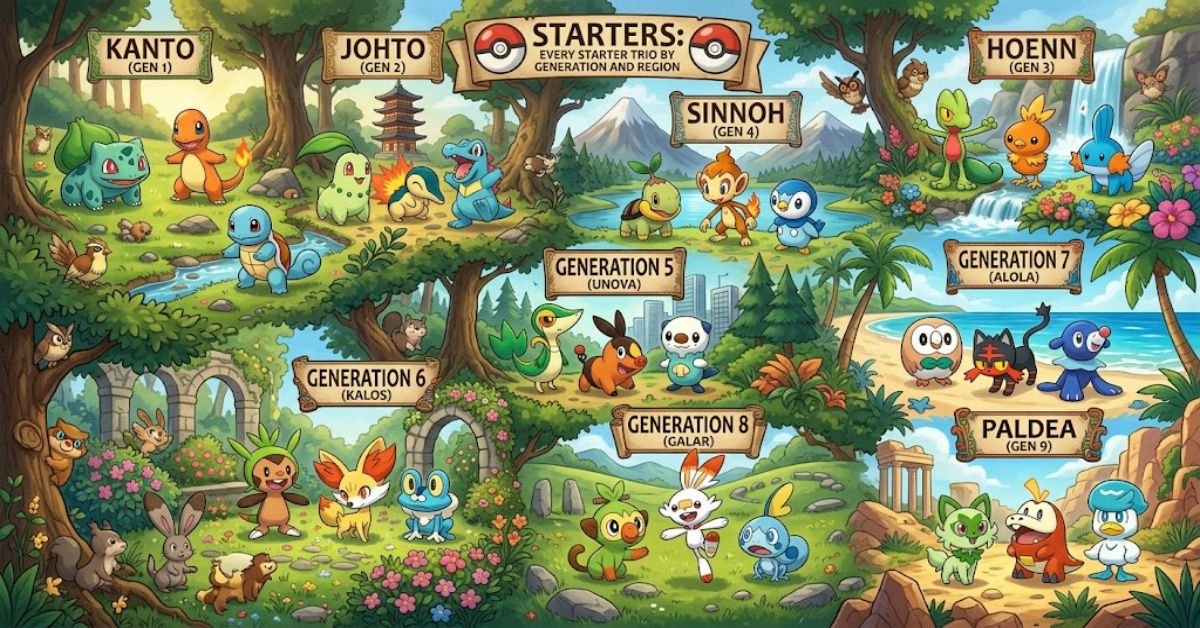
All Pokémon starters are the first-partner Pokémon offered to players at the beginning of most main-series adventures. Across the numbered generations, the familiar structure is consistent: one Grass type, one Fire type and one Water type. This design gives new Trainers a simple choice while introducing the fundamentals of type match-ups.
The tradition began with Bulbasaur, Charmander and Squirtle in Pokémon Red and Green, and it has continued through Paldea with Sprigatito, Fuecoco and Quaxly. Pokémon’s own current material continues to identify these Pokémon as first partners, while its recent Pokémon GO anniversary event grouped the original nine generations’ starters together.
Although the basic formula remains recognisable, each generation gives the trio a different identity. Some starters are based on animals, while others draw on mythology, occupations, historical themes or distinctive visual concepts. Their evolutionary lines also introduce different secondary typings and battle characteristics.
For readers looking for a complete reference, the table below lists the traditional starter trios from Generation I through Generation IX.
Complete List of Pokémon Starters by Generation
| Generation | Region | Grass Starter | Fire Starter | Water Starter |
| I | Kanto | Bulbasaur | Charmander | Squirtle |
| II | Johto | Chikorita | Cyndaquil | Totodile |
| III | Hoenn | Treecko | Torchic | Mudkip |
| IV | Sinnoh | Turtwig | Chimchar | Piplup |
| V | Unova | Snivy | Tepig | Oshawott |
| VI | Kalos | Chespin | Fennekin | Froakie |
| VII | Alola | Rowlet | Litten | Popplio |
| VIII | Galar | Grookey | Scorbunny | Sobble |
| IX | Paldea | Sprigatito | Fuecoco | Quaxly |
This gives the numbered main series 27 traditional starters. Pokémon’s official card and promotional material independently lists these starter Pokémon across its current products, providing a useful cross-check of the names.
Generation I to III: Establishing the Formula
Kanto introduced the template that would become one of the most recognisable structures in video games. Bulbasaur represents Grass, Charmander represents Fire and Squirtle represents Water.
Johto followed with Chikorita, Cyndaquil and Totodile. Their designs remained straightforward but established a different visual identity from the first generation.
Hoenn then introduced Treecko, Torchic and Mudkip. This generation also demonstrated how the starter formula could support very different character designs: Treecko is a gecko-like Pokémon, Torchic resembles a young chick and Mudkip draws heavily from aquatic amphibian characteristics.
| Era | Generations | Starter Pattern |
| Foundation | I | Bulbasaur, Charmander, Squirtle |
| Early expansion | II | Chikorita, Cyndaquil, Totodile |
| Third generation | III | Treecko, Torchic, Mudkip |
| Modern main-series continuation | IV–IX | Six further Grass/Fire/Water trios |
The important point is that the starter system changed gradually rather than being repeatedly reinvented. The elemental relationship remained the anchor.
Generation IV to VI: More Distinctive Evolution Lines
Sinnoh’s Turtwig, Chimchar and Piplup continued the established structure while giving each starter a strong visual identity. Their final evolutionary stages also became important parts of many players’ teams.
Unova introduced Snivy, Tepig and Oshawott. The trio illustrates how Pokémon designs increasingly moved beyond simple elemental representation. Snivy has a serpentine appearance, Tepig is based on a pig and Oshawott is an otter-like Pokémon.
Kalos brought Chespin, Fennekin and Froakie. These designs later became particularly notable because the final evolutionary stages incorporate more specialised concepts, including the ninja-inspired Greninja.
The starter choice therefore became more than a basic type tutorial. Players increasingly considered the entire evolutionary line, including eventual secondary typing, abilities and move options.
Generation VII to IX: Regional Identity Becomes Stronger
Alola’s Rowlet, Litten and Popplio demonstrate how regional themes can influence starter design. Their final evolutions become Decidueye, Incineroar and Primarina, each taking a noticeably different direction.
Galar followed with Grookey, Scorbunny and Sobble. Their designs reflect the region’s broader British-inspired setting, while their evolutionary lines develop strongly differentiated personalities.
Paldea’s Sprigatito, Fuecoco and Quaxly are the ninth numbered-generation trio. Pokémon’s official material specifically identifies Sprigatito as Grass type, Fuecoco as Fire type and Quaxly as Water type.
This latest trio shows how the traditional formula remains flexible. The underlying elemental structure is familiar, but the characters and evolutionary concepts continue to change.
What Makes the Starter System Work?
The Grass, Fire and Water arrangement is easy to understand because it introduces a simplified relationship between the three types. Grass has an advantage against Water, Water against Fire, and Fire against Grass.
That does not mean the starters are interchangeable. Their actual usefulness depends on stats, moves, abilities, evolution stages and the opponents encountered throughout a particular game.
This creates an important distinction between choosing a starter for its type and choosing one because its complete evolutionary line suits a player’s preferred style.
A useful way to understand the system is:
| Factor | Why It Matters |
| Base typing | Determines early type advantages and weaknesses |
| Evolution line | Changes stats, appearance and often secondary typing |
| Moves | Influences offensive and defensive options |
| Abilities | Can significantly alter battle performance |
| Design | A major part of the personal connection players develop |
| Regional setting | Often influences the starter’s visual and thematic identity |
One practical insight follows from this structure: the best starter choice for a particular playthrough cannot be determined from the first-stage Pokémon alone. Its later forms can substantially change how the line functions.
Pokémon Legends: Z-A Adds a Different Kind of Trio
Pokémon Legends: Z-A complicates a simple list of all Pokémon starters because its first-partner Pokémon do not form a new numbered-generation trio.
The game features Chikorita, Tepig and Totodile as its three potential partners. The official Pokémon Legends: Z-A site describes these three as the Pokémon players can set off with on their adventure in Lumiose City.
This is significant because Chikorita and Totodile are already associated with Generation II, while Tepig originates from Generation V. They therefore represent a deliberate mixture rather than a new Grass, Fire and Water trio created specifically for a numbered generation.
Pokémon’s April 2026 Pokémon HOME announcement also confirms Chikorita, Tepig and Totodile as the relevant first partners for Pokémon Legends: Z-A.
The Future of All Pokémon Starters in 2027
As of 2026, the nine numbered generations provide the established 27-Pokémon starter set, while Legends: Z-A demonstrates that Pokémon can use a different selection model for its Legends titles.
Future games could retain the traditional Grass, Fire and Water formula or experiment with returning Pokémon, regional forms and mixed-generation selections. There is no confirmed public basis for assuming what the next numbered generation’s starters will be.
The clearest established trend is flexibility. Pokémon can preserve the recognisable three-type structure while changing which Pokémon occupy those roles.
Key Insights
- The nine numbered generations contain 27 traditional starter Pokémon.
- Every numbered generation from Kanto through Paldea uses Grass, Fire and Water as its starter framework.
- Starter design has become increasingly connected to regional themes and character concepts.
- A Pokémon’s first-stage appearance does not fully describe the eventual battle role of its evolutionary line.
- Pokémon Legends: Z-A shows that a first-partner trio does not necessarily need to represent a new generation.
- Official Pokémon material continues to recognise the long-running first-partner structure.
Conclusion
The history of all Pokémon starters is essentially the history of one of the franchise’s most durable design traditions. From Bulbasaur, Charmander and Squirtle to Sprigatito, Fuecoco and Quaxly, every numbered generation has used the Grass, Fire and Water structure to give players an accessible first strategic decision.
Yet the system has never been completely static. Starter designs have become more distinctive, evolutionary lines have developed more specialised roles and regional themes have influenced their appearance and identities. Pokémon Legends: Z-A takes the concept in another direction by combining Chikorita, Tepig and Totodile as its first partners rather than introducing a new numbered-generation trio.
For anyone building a complete reference, the 27 starters from Generations I–IX remain the core list. The newer Legends approach shows how the franchise can preserve the idea of a meaningful first partner while changing the formula around it.
FAQ
How many Pokémon starters are there?
There are 27 traditional starter Pokémon across Generations I–IX, with three starters per numbered generation.
What are the original Pokémon starters?
The original Kanto starters are Bulbasaur, Charmander and Squirtle.
Are all Pokémon starters Grass, Fire and Water types?
The traditional numbered generations use one Grass, one Fire and one Water starter. Other games can use different selection systems.
What are the Gen 9 starters?
Generation IX, set in the Paldea region, introduced Sprigatito, Fuecoco and Quaxly.
What are the Pokémon Legends: Z-A starters?
Pokémon Legends: Z-A features Chikorita, Tepig and Totodile as its three first-partner choices.
Which regions have traditional starter trios?
Kanto, Johto, Hoenn, Sinnoh, Unova, Kalos, Alola, Galar and Paldea each have a traditional Grass, Fire and Water starter trio.
Methodology
This article treats the nine numbered generations as the core starter list and separates Pokémon Legends: Z-A because its three first partners are drawn from earlier generations. Starter names were cross-checked against official Pokémon material, including Pokémon’s current promotional and first-partner listings.
The main limitation is terminology: “starter” can refer to traditional generation starters, first partners in a particular game, or broader Pokémon game modes. This article uses “starter” primarily for the conventional three-choice opening Pokémon in the numbered main series.
References
The Pokémon Company International. (2026). Pokémon Legends: Z-A — The Pokémon of Pokémon Legends: Z-A.
The Pokémon Company International. (2026). Connect Pokémon HOME with Pokémon Legends: Z-A and Pokémon Champions.
The Pokémon Company International. (2026). Pokémon TCG Promo Card Legality Status.
The Pokémon Company International. (2026). Party Hard with the Pokémon GO Ultra Unlock: 10th Anniversary Edition Event.
The Pokémon Company International. (2026). LEGO Pokémon SMART Play: Sprigatito, Fuecoco and Quaxly Battle.