Knowing how to survive in the wild is less about dramatic survival tricks and more about managing a small number of basic priorities correctly. If you become lost, injured or unexpectedly separated from your route, the first challenge is resisting the urge to panic. Poor decisions made during the first few minutes can create bigger problems later.
The immediate priorities are straightforward: stay calm, assess your situation, protect yourself from the weather, secure safe drinking water and establish a way to attract or contact help. Food is important, but it normally comes after shelter, water, warmth and communication.
Your environment changes the order and urgency of these tasks. A hot, dry landscape creates a different risk from a wet woodland, exposed mountain or cold coastal area. A person carrying a backpack with an emergency shelter, map, torch, first-aid kit and water-treatment equipment has a very different set of options from someone who left without preparation.
Survival therefore begins before an emergency occurs. Understanding your route, checking the forecast, telling someone where you are going and carrying basic equipment are simple measures that reduce the likelihood of needing advanced survival skills.
Stay Calm and Assess the Situation
The first useful survival tool is judgement.
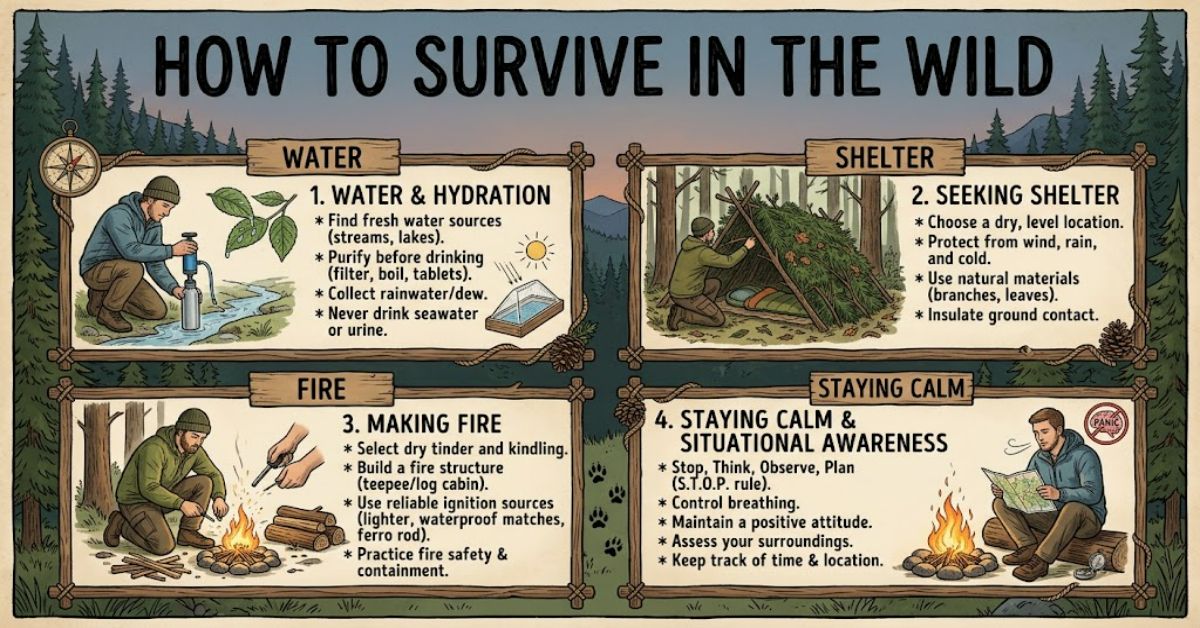
Stop moving if you have realised you are lost. Take a moment to establish what you know. Identify your location if possible, check your phone or GPS, look at your map and consider the last point at which you were certain of your route.
Avoid walking aimlessly. Every unnecessary movement consumes energy and can make your location harder for rescuers to establish.
Use a simple mental checklist:
| Priority | Immediate question |
| Location | Do I know where I am? |
| Communication | Can I contact emergency services or someone I trust? |
| Shelter | Am I protected from rain, wind, cold or excessive heat? |
| Water | Do I have enough safe drinking water? |
| Injury | Am I hurt or unable to travel safely? |
| Visibility | Can rescuers find me? |
If you have mobile reception, contact the appropriate emergency service and provide your location as accurately as possible. If communication is unavailable, conserving energy and remaining somewhere identifiable can be safer than travelling without a clear plan.
Find or Create Suitable Shelter
Shelter protects you from exposure. Depending on the environment, heat loss, wind, rain or excessive sunlight can become serious problems.
Use existing natural protection where it is safe. A sheltered area beneath suitable vegetation or beside a stable natural feature may reduce exposure. However, avoid unstable cliffs, river channels, dead trees and locations vulnerable to falling rocks or flooding.
If you have an emergency blanket, bivvy, tarp or tent, use it early rather than waiting until conditions deteriorate. Keeping clothing dry is particularly important in cold or wet environments.
| Environment | Main shelter concern |
| Cold and wet | Retain body heat and stay dry |
| Hot and exposed | Reduce direct sun and heat exposure |
| Windy | Create a stable windbreak |
| Heavy rain | Avoid drainage channels and low ground |
| Snow or freezing conditions | Prevent prolonged exposure and heat loss |
A common mistake is focusing on building an elaborate shelter when a lightweight emergency shelter is already available. In an emergency, conserving energy can be more valuable than constructing something impressive.
Secure Safe Drinking Water
Water can become a priority surprisingly quickly, particularly during strenuous activity or hot weather.
Look for potential water sources such as streams, springs or collected rainwater, but do not assume clear-looking water is safe. Natural water can contain microorganisms that cause illness.
If you have the ability to boil water, bring it to a proper boil before drinking. Portable filters and approved purification methods can also be useful, provided they are designed for the contaminants you may encounter.
Never rely on appearance alone. Water contaminated with chemicals, fuel or other hazardous substances cannot simply be made safe through ordinary boiling or disinfection.
The practical lesson is simple: treat uncertain water rather than gambling on it.
Make Fire Carefully
Fire can provide warmth, allow cooking and help with signalling. It can also become a serious hazard.
Before lighting one, check local rules and fire restrictions. Dry vegetation, strong winds and periods of high wildfire risk can make an open fire dangerous or prohibited.
If conditions permit, use a controlled location away from combustible vegetation. Keep the fire small and manageable, and make sure it is completely extinguished before leaving.
A lighter, waterproof matches or a reliable fire starter is generally more useful than relying on the ability to produce fire from improvised materials. Practising with your equipment before an emergency is also valuable.
Food Matters, But It Is Not First
People often imagine survival as a search for wild food. In reality, attempting to identify unfamiliar plants, fungi or animals can introduce unnecessary risks.
If you have emergency food, use it sensibly. High-energy, compact foods such as nuts, cereal bars and other durable snacks are useful because they require little preparation.
If you have no food, conserve energy rather than spending hours searching for something edible. A short-term lack of food is generally easier to manage than dehydration, exposure or an untreated injury.
Navigation and Signalling
If you are lost, your objective is not necessarily to walk until you find civilisation. Your objective is to maximise the chance of being located safely.
A whistle, torch, reflective material or brightly coloured clothing can help rescuers identify your position. Make signals from a location where they are likely to be visible or audible.
If you have a map and compass, use them before making major movements. GPS can be extremely useful, but electronic devices depend on battery power and may not always have reliable reception.
This is why traditional navigation equipment remains useful even when modern technology is available.
Three Survival Insights Often Overlooked
1. Energy is a resource. Every unnecessary climb, detour or search consumes calories and water. Survival decisions should consider energy expenditure, not just distance.
2. Shelter can be more important than fire. A person with effective protection from wind and rain may conserve body heat without immediately needing a large fire.
3. Preparation reduces improvisation. The most useful survival skills often involve equipment you have already tested. A map is less useful if you cannot read it, and a water filter is less useful if you have never learned how it works.
The Future of How to Survive in the Wild in 2027
Outdoor survival is increasingly combining traditional skills with digital technology. GPS devices, satellite communicators, emergency beacons and smartphone navigation can make it easier to share a location or request assistance.
However, technology does not eliminate fundamental risks. Batteries fail, weather changes and communication coverage can disappear.
By 2027, the practical balance is likely to remain the same: use technology to improve situational awareness and communication while retaining basic skills in navigation, shelter, water treatment and first aid.
The strongest approach is therefore not technology versus traditional survival skills. It is using both together.
Key Takeaways
- Stop and assess your situation before making major decisions.
- Prioritise shelter, water, warmth, injury management and communication.
- Treat uncertain natural water before drinking it.
- Avoid unnecessary movement when you are lost.
- Use fire only when conditions and local regulations permit it.
- Carry navigation, lighting, first aid, shelter and signalling equipment.
- Practise with important equipment before entering remote areas.
Conclusion
Learning how to survive in the wild is fundamentally about managing priorities. You do not need to become an expert bushcraft practitioner to improve your chances in an emergency. You need to understand what can become dangerous quickly and respond methodically.
Staying calm helps prevent poor decisions. Shelter reduces exposure. Safe water prevents dehydration and waterborne illness. Fire can provide warmth and signalling when appropriate, while navigation and communication equipment can help bring professional assistance to you.
The most important survival lesson is preparation. Checking a route, carrying suitable equipment, telling someone your plans and understanding the environment can prevent a manageable outdoor problem from becoming a serious emergency.
FAQ
How to Survive in the Wild?
Stop, stay calm and assess your location, injuries, equipment, weather and communication options. Avoid travelling randomly.
How do you survive in the wild without water?
Look for a safe water source, but treat uncertain water before drinking it. Conserve energy and avoid unnecessary exertion, particularly in hot conditions.
How important is shelter in a survival situation?
Shelter can protect against cold, rain, wind, heat and other environmental exposure. Use an emergency shelter early when conditions require it.
Is it safe to drink water from a stream?
Not necessarily. Clear natural water can still contain harmful microorganisms. Use boiling, filtration and appropriate disinfection methods as required.
Do you always need to make a fire to survive outdoors?
No. Fire can provide warmth, cooking capability and signalling, but it may be unsafe or prohibited in some conditions. Shelter and appropriate clothing may be more important.
What equipment should you carry for wilderness emergencies?
Useful equipment includes navigation tools, a torch or headlamp, first-aid supplies, emergency shelter, extra food, water and treatment supplies, suitable clothing and signalling equipment.
Methodology
This article How to Survive in the Wild was prepared using established outdoor-safety guidance and public health information concerning wilderness preparation, emergency shelter, navigation, water treatment and outdoor emergencies. Sources consulted include the U.S. National Park Service and the U.S. Centers for Disease Control and Prevention. The article is intended as general educational guidance rather than a substitute for professional survival training, local emergency instructions or location-specific regulations.
The main limitation is that survival priorities vary significantly according to climate, terrain, season, injury status and available equipment. Fire restrictions and emergency procedures should always be checked for the specific location.
References
Centers for Disease Control and Prevention. (2025). About water treatment options when hiking, camping, or travelling.
Centers for Disease Control and Prevention. (2024). How to make water safe in an emergency.
National Park Service. (2026). Ten Essentials.
National Park Service. (2026). Wilderness Travel Basics.
National Park Service. (2026). Outdoor Emergency Plan.
National Park Service. (2026). Hike Smart.
Editorial disclosure: This article How to Survive in the Wild was drafted with AI assistance and should be independently reviewed and fact-checked before publication.