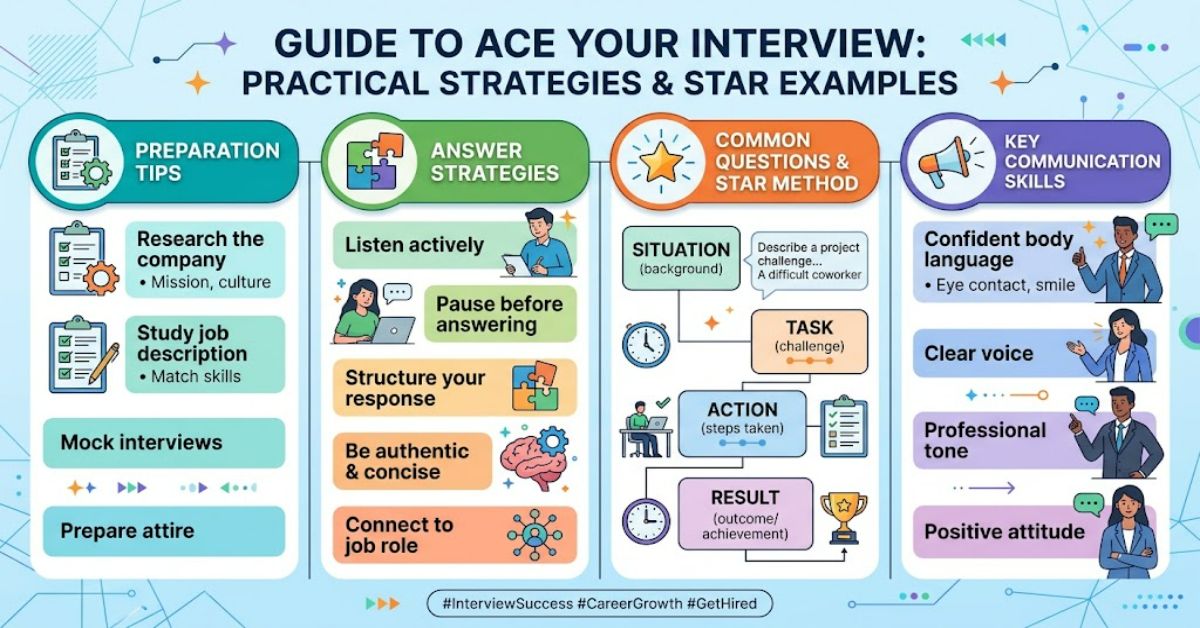
Interview questions are designed to reveal more than what appears on a CV. Employers use them to understand how candidates think, communicate, respond to challenges and apply their skills in practical situations. Preparing for the most common interview questions can therefore make an important difference to the quality of an interview.
Typical questions may include “Tell me about yourself”, “Why do you want this job?”, “What are your strengths and weaknesses?” and “Tell me about a time you faced a challenge”. The exact questions vary by employer, industry and seniority, but most are intended to assess a relatively small group of qualities: competence, motivation, communication, judgement, adaptability and cultural fit. The UK National Careers Service recommends researching the employer, reviewing the job description and preparing relevant examples before an interview.
Preparation does not mean memorising perfect speeches. In fact, overly rehearsed answers can sound unnatural. A better approach is to identify several experiences that demonstrate your abilities and learn how to explain them clearly.
Common Interview Questions and What They Assess
| Interview question | What the employer may assess |
| Tell me about yourself | Communication and relevance |
| Why do you want this job? | Motivation and preparation |
| What are your strengths? | Self-awareness and capability |
| What is your biggest weakness? | Honesty and development |
| Tell me about a challenge | Problem-solving and resilience |
| Describe a time you worked in a team | Collaboration |
| Why should we hire you? | Value and suitability |
| Where do you see yourself in five years? | Career direction |
1. Tell Me About Yourself
This question is often used to open an interview. It is not an invitation to give your entire life story. Instead, focus on your professional background, relevant strengths and why the position interests you.
A useful structure is present, past and future: explain what you currently do, briefly mention relevant previous experience, then connect your background with the opportunity.
2. Why Do You Want This Job?
A strong answer should connect three things: the organisation, the position and your own skills or ambitions.
Avoid saying only that you need a job or that the salary attracted you. Research the organisation beforehand and identify something specific about its work, values, products or direction. The National Careers Service advises candidates to research the employer and demonstrate what they have learned during the interview.
3. What Are Your Strengths?
Choose two or three strengths that genuinely relate to the vacancy. Communication, organisation, problem-solving, adaptability and teamwork are useful examples, but simply naming them is not enough.
Support each important strength with evidence. For example, rather than saying you are organised, briefly describe a situation where your planning helped complete a project on time.
4. What Is Your Biggest Weakness?
This question tests self-awareness rather than whether you can claim to have no weaknesses. Choose a genuine but manageable development area and explain what you are doing to improve it.
Avoid presenting a disguised strength such as “I work too hard”. A more credible response identifies the issue, explains its effect and shows the practical steps being taken to address it.
5. Tell Me About a Challenge You Faced
This is a classic competency-based question. The employer wants evidence of how you respond when circumstances become difficult.
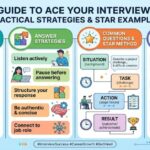
The STAR method is particularly useful here. STAR means Situation, Task, Action and Result. The National Careers Service recommends using this structure to give focused examples in interviews.
The most important part is usually the Action. Explain what you personally did rather than describing only what the wider team achieved.
Using the STAR Method Effectively
| Stage | What to include |
| Situation | Brief background and context |
| Task | Your responsibility or objective |
| Action | The specific steps you took |
| Result | The outcome and what you learned |
Keep the Situation and Task concise. Give most of your attention to the Action and Result. Where possible, include measurable outcomes, but never invent figures simply to make an example sound impressive.
The STAR method can also help candidates who have limited professional experience. Examples may come from education, volunteering, community activities, part-time work or other relevant experiences.
Questions About Teamwork and Problem-Solving
Employers frequently ask candidates to describe teamwork, disagreement, leadership or problem-solving experiences. These questions help reveal behaviour rather than theoretical knowledge.
For teamwork questions, explain your contribution and how you communicated with others. For conflict questions, demonstrate professionalism and focus on resolution rather than criticising another person.
For problem-solving questions, explain how you identified the issue, evaluated possible solutions and selected an appropriate response. A strong answer demonstrates judgement rather than simply describing a successful outcome.
Questions You Should Ask the Interviewer
An interview is not entirely one-way. Candidates are often given an opportunity to ask questions at the end, and preparing several beforehand can demonstrate genuine interest.
Useful questions include:
- What would success look like in this role after six months?
- What are the main priorities for the person joining this position?
- How is performance usually measured?
- What training or development opportunities are available?
- What does a typical working day look like?
Recent Indeed UK guidance also recommends preparing thoughtful questions about areas such as company culture, performance and development opportunities.
Three Preparation Insights
Prepare evidence, not speeches. Build a small bank of real examples covering teamwork, leadership, problem-solving, mistakes, achievements and difficult situations. This gives you material that can be adapted naturally.
Match examples to the job description. If the vacancy repeatedly mentions customer service, analytical thinking or project management, prioritise experiences demonstrating those capabilities. This makes your answers more relevant.
Practise flexibility. Interviewers may ask follow-up questions. The National Careers Service specifically advises candidates to be prepared for follow-up questions when using STAR examples.
The Future of Interview Questions in 2027
Interviewing is likely to continue combining traditional competency questions with greater attention to adaptability, communication and technology-related working practices. Video interviews and remote recruitment are already established parts of the hiring process, while some organisations also use assessments and online screening during recruitment.
The precise format will vary between employers. Candidates should therefore prepare for the role rather than memorise a universal list of answers. Human judgement, clear communication and evidence of practical capability are likely to remain important even as recruitment technology changes.
Key Takeaways
- Research the organisation before the interview.
- Study the job description for the skills the employer prioritises.
- Prepare several adaptable examples from real experience.
- Use STAR for competency-based questions.
- Keep answers focused on your own contribution.
- Be honest about weaknesses and explain how you are improving.
- Prepare thoughtful questions for the interviewer.
Conclusion
Good interview preparation is less about predicting every question and more about understanding what employers need to learn about you. Most common interview questions provide opportunities to demonstrate motivation, relevant experience, judgement, communication and self-awareness.
Candidates should prepare concise examples rather than memorising complete scripts. Researching the organisation and role provides the context needed to make answers specific, while the STAR method gives structure to experience-based responses. The strongest preparation also includes questions for the interviewer, because an interview allows both sides to assess whether the role is suitable.
Confidence comes from preparation, but effective answers should still sound natural. A clear example, explained honestly and connected to the requirements of the role, is usually more valuable than an elaborate response filled with rehearsed phrases.
FAQ
What are the most common interview questions?
Common questions include “Tell me about yourself”, “Why do you want this job?”, “What are your strengths and weaknesses?”, “Why should we hire you?” and questions about previous challenges, teamwork and achievements.
How should I prepare for interview questions?
Review the job description, research the employer, identify relevant examples from your experience and practise explaining them clearly. The National Careers Service recommends preparing examples and practising common questions before an interview.
What is the STAR method for interview questions?
STAR stands for Situation, Task, Action and Result. It helps candidates structure answers to competency-based questions using a specific real-world example.
How should I answer questions about weaknesses?
Choose a genuine development area, explain it briefly and focus on the practical steps you are taking to improve. Avoid claiming that you have no weaknesses.
What questions should I ask at the end of an interview?
Ask about expectations, priorities, team structure, performance measurement, training or development. Choose questions that show you have considered the role rather than questions whose answers are already obvious.
Methodology
This article was prepared using UK career guidance and current interview guidance from the National Careers Service and Indeed UK. The approach prioritises practical preparation, competency-based examples and the STAR framework. The analysis does not claim that every employer uses the same interview structure; recruitment practices differ by organisation, role and industry. Readers should therefore adapt preparation to the specific job description and interview format.
References
Indeed Editorial Team. (2026, 16 June). Common interview questions and answers: Updated for today’s hiring trends. Indeed UK.
Indeed Editorial Team. (2026, 16 June). Job interview tips: How to make a great impression. Indeed UK.
Indeed Editorial Team. (2026, 17 August). Questions to ask at an interview. Indeed UK.
National Careers Service. (2026). How to answer common interview questions. UK Government.
National Careers Service. (2026). The STAR method. UK Government.
National Careers Service. (2026). Interview tips. UK Government.