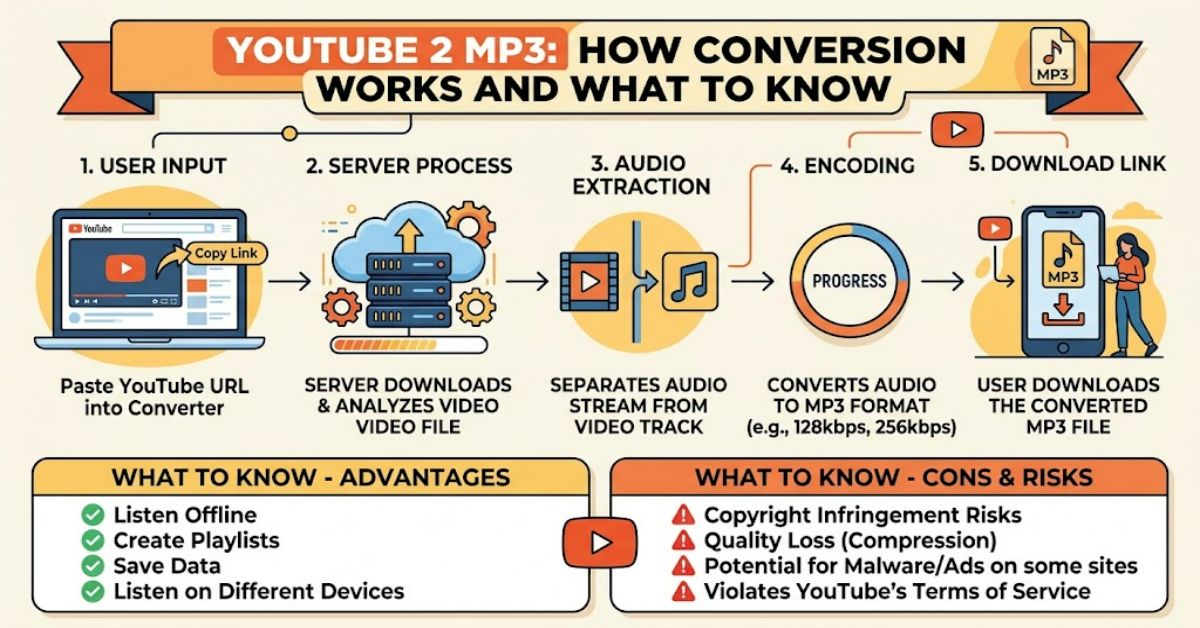
The phrase YouTube 2 MP3 generally refers to converting the audio from a YouTube video into an MP3 file. The basic idea is simple: a video URL is provided to a conversion service or compatible software, the audio stream is processed, and an audio file is produced for local playback.
That simplicity can make the process appear risk-free. It is not.
The important distinction is between whether a conversion is technically possible and whether the user has permission to make that copy. YouTube states that users cannot download other users’ videos through its standard creator-download facility, while Premium provides offline viewing in supported circumstances. YouTube also specifically says that its app does not provide a way to download audio, music or MP3 files directly.
For someone converting their own video, a video released under an appropriate licence, or material for which they have permission, the process is relatively straightforward. For copyrighted music or other protected material, however, additional considerations apply.
What Does YouTube 2 MP3 Actually Do?
An MP3 converter separates the audio component from online video content and encodes it into the MP3 format.
A typical workflow has three stages:
- URL input: The user supplies the address of the relevant video.
- Audio processing: Software or an online service obtains and processes an available media stream.
- MP3 creation: The audio is encoded and saved as an MP3 file.
The resulting file is smaller and easier to transfer than a full video. This makes MP3 useful for ordinary audio playback, provided the user has the right to create and use the copy.
The conversion itself does not create better audio than the source. If the original audio has already been compressed, converting it again can introduce another layer of quality loss.
Online Converter or Desktop Software?
There are two broad approaches.
| Method | Main advantage | Main limitation |
| Online converter | Convenient and requires little setup | Privacy, advertising and security risks can vary |
| Desktop software | Greater control over files and settings | Requires installation and technical configuration |
| Official YouTube offline feature | Platform-supported viewing | Does not normally create standalone MP3 files |
| Original creator download | Direct access to owned content | Applies to content the user controls |
YouTube’s own documentation confirms that creators can download videos they have uploaded, while Premium users can use supported offline features. Those downloads are not equivalent to exporting an unrestricted MP3 file.
Audio Quality Matters More Than the MP3 Extension
One common misconception is that choosing a higher MP3 bitrate automatically improves sound quality.
It does not.
If the source contains compressed audio, encoding it at a higher bitrate cannot restore information that was already lost. A conversion may therefore produce a larger file without providing a meaningful improvement in listening quality.
| Factor | Effect on result |
| Original source quality | Sets the upper practical limit |
| Audio codec | Influences compression and compatibility |
| Bitrate | Affects file size and potential quality |
| Re-encoding | Can introduce additional quality loss |
| Source processing | May already have reduced fidelity |
This is one of the most useful practical insights when evaluating MP3 conversion: file size is not the same thing as audio quality.
Copyright and UK Rules
Copyright is the most important issue surrounding YouTube conversion.
UK government guidance states that copyright protects original musical works, sound recordings, films and other creative material. Copyright generally restricts unauthorised copying and distribution.
The government’s guidance on copying creative works also advises checking whether material is protected, whether an exception applies and whether permission or a licence is required.
That means a converter does not provide legal permission merely because it works.
A person converting their own uploaded video is in a different position from someone extracting a commercial song from another creator’s video. The rights attached to the underlying recording, composition and video can also involve different parties.
For businesses, the position can be even more complicated because using copyrighted music online may require appropriate licensing. GOV.UK identifies organisations including PRS for Music and PPL in relation to certain online and mobile uses of music.
Security Risks of Online Converters
Technical convenience can introduce another problem: the website itself.
Some conversion pages rely heavily on advertising, redirects or unfamiliar download buttons. Users may accidentally download unwanted software instead of the intended audio file.
A safer approach is to avoid executable downloads from unfamiliar pages, check the file extension before opening it and keep browser security protections enabled.
The risk is particularly relevant on desktop computers because a supposedly simple audio download can lead to additional software installation.
What About VLC Media Player?
VLC is widely recognised as a media player capable of handling numerous audio and video formats. Desktop media software can also provide more control than a basic web converter.
However, using software does not change copyright obligations. The technical method and the legal right to make a copy are separate questions.
This distinction is useful because discussions about YouTube conversion often focus entirely on which tool works best. The more important question is whether the underlying material can lawfully be copied.
The Future of YouTube 2 MP3 in 2027
By 2027, the biggest change is likely to be less about MP3 technology itself and more about platform-controlled access to media.
YouTube already distinguishes between creator downloads, Premium offline viewing and ordinary streaming. Its current help documentation also confirms that offline downloads can be restricted by location, account status and content availability.
This suggests a broader shift towards controlled offline access rather than unrestricted file ownership.
MP3 will remain useful because it is widely supported and comparatively lightweight. However, legitimate subscription services, creator-provided downloads and licensed libraries are likely to remain the cleaner options for users who want permanent audio access.
Key Takeaways
- MP3 conversion extracts audio from a video source rather than improving the original recording.
- Higher bitrate does not restore quality already lost during previous compression.
- YouTube’s official offline system is different from creating a standalone MP3 file.
- Copyright permission should be established before copying protected material.
- Online converters can introduce security and privacy concerns.
- Creator-owned or properly licensed material presents a much clearer use case.
Conclusion
YouTube 2 MP3 is fundamentally an audio extraction and encoding process. Technically, it can be straightforward, but the surrounding questions are more important than the conversion itself.
For content you own, content explicitly licensed for downloading, or material where you otherwise have permission, creating an audio file can be a practical way to access content offline. For commercial music and other copyrighted material, users should not assume that a publicly available video can automatically be converted and retained as an MP3.
YouTube’s own documentation separates official offline viewing from standalone audio downloads, while UK copyright guidance reinforces the importance of permission and applicable exceptions.
The sensible approach is therefore to consider three things together: the source, the technical method and the rights attached to the content.
Frequently Asked Questions
What is YouTube 2 MP3?
It describes the process of converting the audio component of a YouTube video into an MP3 file. The resulting file is designed for audio playback rather than video viewing.
Can YouTube videos be downloaded as MP3 files directly?
YouTube’s official help documentation says the YouTube app does not provide a facility for downloading audio, music or MP3 files directly.
Is converting YouTube videos to MP3 legal in the UK?
It depends on the material and the user’s rights. Copyright can restrict copying protected music, recordings and films. Permission, licensing or a relevant copyright exception may be necessary.
Does a higher MP3 bitrate mean better sound?
Not necessarily. A higher bitrate can create a larger file, but it cannot restore audio information that was already lost from a compressed source.
Can I convert my own YouTube videos?
Creators can download videos they have uploaded through YouTube’s supported creator tools. YouTube confirms that this facility applies to the creator’s own uploads.
Why can online MP3 converters be risky?
Some sites may contain aggressive advertising, redirects or misleading download buttons. Users should be cautious with unfamiliar files and avoid installing untrusted software.
Methodology
This article was prepared using current official YouTube Help documentation and UK government copyright guidance, with additional contextual checking of relevant RubbleMagazine.co.uk material. The analysis distinguishes documented platform functionality from general conversion practices and does not claim personal hands-on testing.
A key limitation is that copyright exceptions can depend on the specific work, intended use and jurisdiction. Readers should check the applicable licence or seek professional advice where the legal position is uncertain.
The article also avoids presenting unverified claims about converter performance, security records or user statistics as firsthand findings.
References
Google. (2026). Download YouTube videos that you’ve uploaded. YouTube Help.
Google. (2026). YouTube videos offline FAQs. YouTube Help.
Google. (2026). Watch videos offline on mobile in selected countries and regions. YouTube Help.
UK Government. (2026). How copyright protects your work: Overview. GOV.UK.
UK Government. (2026). Find out if you need a licence to copy a creative work. GOV.UK.
UK Government. (2026). Licences to use music online or on mobile technology. GOV.UK.
Editorial Disclosure
This article was drafted with AI assistance. All cited platform and copyright claims should be independently checked by the editorial team against the original sources before publication.