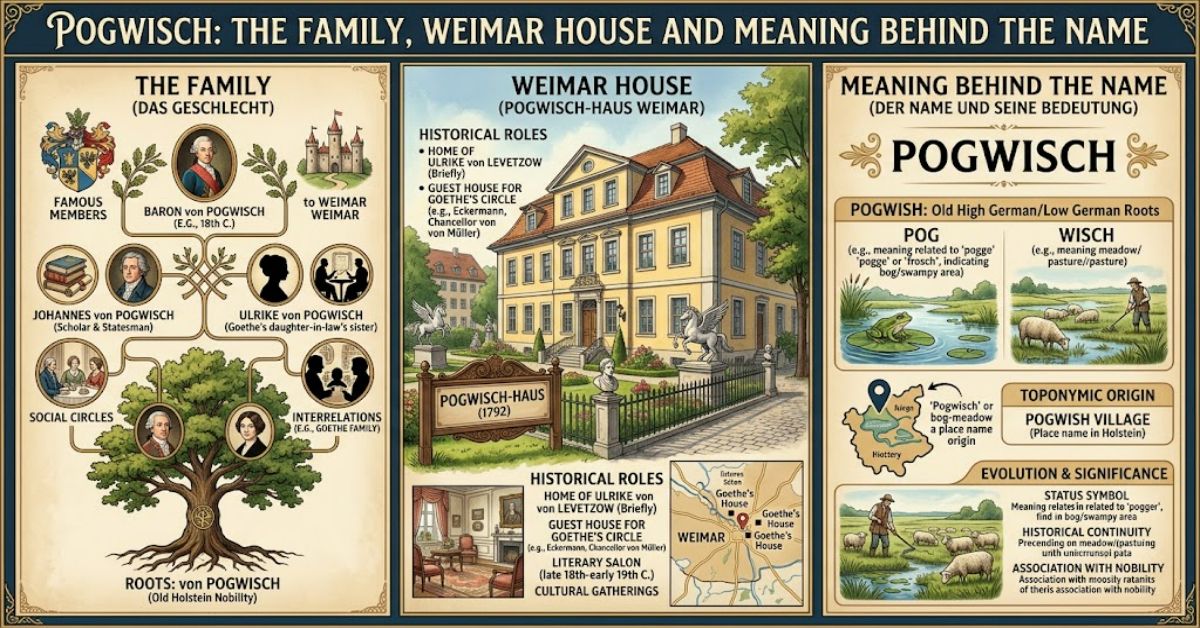
The name Pogwisch can point to several different subjects, but its most important historical meaning is the name of a noble family with roots in the Schleswig-Holstein region. The family belonged to the Equites Originarii, the historic native nobility of the duchies, and appears in surviving records from at least 1283. Over the following centuries, members of the family held estates, served rulers and became involved in the political and religious life of northern Europe.
The name is also closely associated with Weimar. That connection comes largely through Ottilie von Pogwisch, born in Danzig in 1796, who married August von Goethe, the son of Johann Wolfgang von Goethe, in 1817. She subsequently became one of the central figures of the Goethe household. The Deutsche Biographie identifies her as a writer and publicist as well as Goethe’s daughter-in-law.
A third meaning is architectural. The Pogwisch-Haus stands in the Park an der Ilm, immediately south of Goethe’s Garden House. The building began as an early-18th-century vineyard house and later acquired its present name through its association with the Pogwisch family. The Klassik Stiftung Weimar continues to maintain the property as part of its cultural estate.
Understanding these three connections — family, people and place — makes the name far easier to interpret.
What Does Pogwisch Refer To?
Pogwisch is primarily a historical family name, but its meaning has expanded through its association with people and places.
The family was connected with Schleswig and Holstein and belonged to the regional nobility. Historical references identify several branches and estates associated with the name. The family line eventually became extinct in the male line in 1845, according to the commonly cited genealogical account.
The name then gained a different cultural resonance through the family members who entered the Prussian and Weimar courts.
The most important connection for modern cultural history is Ottilie von Pogwisch. Her marriage to August von Goethe brought the family directly into the household of one of Germany’s most famous writers.
Finally, the name survives physically in the Pogwisch-Haus in Weimar.
The Three Main Meanings
| Reference | Period | Significance |
| Pogwisch family | From at least 1283 | Noble family associated with Schleswig and Holstein |
| Ottilie von Pogwisch | 1796–1872 | Goethe’s daughter-in-law and writer |
| Pogwisch-Haus | Early 18th century onward | Historic vineyard house in Weimar’s Park an der Ilm |
This distinction is useful because searches for the name can otherwise mix genealogy, architecture, literary history and tourism.
The Origins of the Pogwisch Family
The documented history of the family reaches back to the late 13th century.
A historical account records the brothers Marquard and Alhed, sons of Thetlev de Pokkevisk, in 1283. Marquard Pogwisch subsequently appears in the Kiel town records in 1322 and 1325. The family became established across parts of Schleswig and Holstein, accumulating estates and political influence.
The family’s relationship with Gut Farve is particularly useful for understanding its regional importance.
The Deutsche Digitale Bibliothek records that the history of Farve began with a small fortified settlement associated with Henning von Pogwisch in approximately the 14th century. The property remained with the family until 1662, when it passed by inheritance to the von Blome family.
This illustrates an important point about medieval and early-modern noble families: their historical importance was often tied less to a single residence than to a network of estates, marriages, political appointments and inheritance.
Political Influence
Members of the family served rulers in Denmark and the duchies.
One notable figure was Wulf Pogwisch, who lived during the late 15th and early 16th centuries and served as a counsellor to King Frederick I. The family also produced religious figures, including several abbesses connected with the convent at Itzehoe.
The family’s history therefore crossed several institutions: landed estates, royal administration, religious foundations and regional politics.
The Meaning of the Name
The etymology of Pogwisch is commonly explained through Low German elements: Pog, meaning “frog”, and Wisch, meaning “meadow”.
This type of compound name fits a broader pattern in northern European place and family names, where landscape terms and local features became incorporated into surnames.
The etymology should not, however, be confused with a claim that every modern use of Pogwisch refers directly to the medieval family. The same name can survive in different contexts, particularly where historical buildings or descendants are involved.
Pogwisch and the Goethe Family
The most recognisable cultural connection is Ottilie von Pogwisch.
Born on 31 October 1796 in Danzig, Ottilie was the daughter of Wilhelm von Pogwisch and Henriette von Pogwisch. Her mother’s family connected her to the Henckel von Donnersmarck and other aristocratic families. The Deutsche Biographie records her later life in Weimar, where she died on 26 October 1872.
Ottilie’s importance increased substantially after her marriage to August von Goethe on 17 June 1817.
August was Johann Wolfgang von Goethe’s son. According to the Deutsche Biographie’s account of Goethe’s later household, Ottilie took responsibility for the domestic environment and became an important presence around the writer. The couple had three children: Wolfgang, Walther and Alma.
This marriage created a lasting bridge between the Pogwisch family and one of the most important literary households of nineteenth-century Germany.
Ottilie as More Than Goethe’s Daughter-in-Law
Reducing Ottilie simply to “Goethe’s daughter-in-law” overlooks her own cultural activity.
The Deutsche Biographie identifies her as a writer and publicist. Her surviving letters and diaries have also been published, providing researchers with material about her life, relationships and intellectual environment.
She also participated in literary and social circles in Weimar. Her relationship with figures in the arts and literature reflects the unusually active intellectual environment surrounding Goethe’s household.
This creates one of the most useful historical insights into the Pogwisch name: its modern cultural visibility owes as much to nineteenth-century intellectual history as to medieval genealogy.
What Is the Pogwisch-Haus in Weimar?
The Pogwisch-Haus is a historic building in the Park an der Ilm in Weimar.
It was originally an early-18th-century vineyard house and is considered one of the relatively rare surviving examples of this type of building from classical Weimar. Its location is particularly significant because it stands immediately south of Goethe’s Garden House.
The building has a compact, almost square floor plan. Its plastered timber framing rests on a solid stone base, while the exterior includes corner detailing, shutters and a prominent entrance approached by a stone staircase.
Its architectural form is modest compared with Weimar’s major palaces and museums. That modest scale is part of its interest.
Rather than functioning as a grand aristocratic palace, the house represents the smaller domestic and recreational architecture that formed part of the historic landscape around the Park an der Ilm.
How Did the House Get Its Name?
The building’s name is connected with Ottilie von Pogwisch and the Goethe family.
Before that association, the property had been owned and substantially altered by Johann Christoph Schmidt, a senior official in Sachsen-Weimar-Eisenach. After purchasing the property in 1772, Schmidt transformed the earlier vineyard house. Historical records also associate him with the physician Heinrich Friedrich Abt, who lived there during his period as a court physician.
In 1806, the property was acquired by Eleonore Maximiliane Ottilie Henckel von Donnersmarck, who had served as chief court mistress to Maria Pawlowna. She was the grandmother of Ottilie von Pogwisch.
That family connection eventually gave the building its enduring name.
Pogwisch-Haus at a Glance
| Feature | Historical detail |
| Location | Park an der Ilm, Weimar |
| Original function | Vineyard house |
| Construction period | Early 18th century |
| Major 18th-century owner | Johann Christoph Schmidt |
| Later family connection | Pogwisch family |
| Nearby landmark | Goethe’s Garden House |
| Restoration | Major restoration from 2003 |
| Present stewardship | Klassik Stiftung Weimar |
The building’s present role is another example of how heritage conservation can preserve not only an architectural object but also a network of historical associations.
The Building and the Weimar Cultural Landscape
The Pogwisch-Haus should not be viewed in isolation.
Its position in the Park an der Ilm places it within one of Weimar’s most important historic cultural landscapes. The nearby Goethe’s Garden House provides an immediate connection to Goethe, while the wider park contains gardens, paths, monuments and historic structures.
A record held by the Klassik Stiftung Weimar even documents a historic representation of Goethe’s Garden House in which the Pogwisch-Haus appears in the surrounding landscape.
This visual relationship is important.
The house is not significant solely because famous people lived there. Its value also comes from its position within the spatial environment of classical Weimar.
That makes the site particularly relevant to architectural and cultural-history research.
Restoration and Present-Day Use
A substantial restoration of the Pogwisch-Haus began in 2003. Historical descriptions state that the building was restored with interiors and furnishings intended to recall its former occupants.
The property has been part of the holdings of the Klassik Stiftung Weimar since 1991. More recent material from the foundation confirms that the Pogwisch-Haus remains part of its estate and has also been used for accommodation associated with fellows and cultural programmes.
This current use introduces an interesting heritage-management issue.
Historic buildings need active maintenance, but modern use can place pressure on their fabric. Conservation therefore involves balancing accessibility, functionality and authenticity.
In the case of the Pogwisch-Haus, continued institutional stewardship allows the building to remain part of Weimar’s living cultural infrastructure rather than becoming a static monument.
Family History vs Architectural History
For researchers, the two major interpretations of the name require different approaches.
Genealogical research focuses on births, marriages, estates, heraldry, archival records and succession. Architectural research instead examines building fabric, ownership history, restoration and landscape context.
Comparison of the Two Main Historical Paths
| Aspect | Pogwisch Family | Pogwisch-Haus |
| Primary field | Genealogy and social history | Architectural and cultural heritage |
| Geographic centre | Schleswig-Holstein and wider northern Europe | Weimar |
| Earliest documented context | 13th century | Early 18th century |
| Key evidence | Genealogical and archival records | Building records and heritage documentation |
| Major cultural association | Ottilie von Pogwisch | Goethe’s Weimar |
| Modern relevance | Family and literary history | Heritage conservation |
The two stories meet through Ottilie and her family.
That connection is what makes the name particularly useful as a search term: it is simultaneously a surname, a genealogical subject and a heritage reference.
Three Insights Often Missed in Basic Searches
The house is not a conventional Goethe residence.
Its significance comes partly from its proximity to Goethe’s Garden House and its later connection to the Goethe family, but it should not simply be described as another version of Goethe’s own home. The building had its own earlier history.
The family predates its Weimar association by centuries.
The documented family history reaches back to at least 1283, meaning the Goethe connection belongs to a much later chapter of the surname’s history.
The modern importance of the house is institutional as well as historical.
The Pogwisch-Haus is not merely preserved as an old building. The Klassik Stiftung Weimar continues to incorporate it into its cultural and fellowship infrastructure, demonstrating how heritage buildings can have active contemporary functions.
These distinctions prevent the most common problem with searches for the term: treating every reference as if it describes the same object.
The Future of Pogwisch in 2027
There is no reliable basis for predicting a major new event specifically centred on the Pogwisch family in 2027. The more credible future lies in continued heritage research, digital cataloguing and public interpretation.
Weimar’s cultural institutions increasingly operate within a digital environment in which archival collections, object databases and historical documentation can reach audiences beyond the physical city. The Klassik Stiftung’s online collections already demonstrate this direction through searchable records and digitised historical material.
For the Pogwisch name, this matters because its story is dispersed across several categories of evidence. Genealogical records, literary biographies, architectural inventories and digitised artworks each illuminate different parts of the history.
The likely long-term value is therefore not a single new interpretation but better integration of existing evidence.
In 2027, the most useful development for researchers would be clearer digital connections between the family, Ottilie von Pogwisch, the Goethe household and the Pogwisch-Haus itself.
Key Takeaways
- Pogwisch is a historic family name associated with Schleswig and Holstein.
- The family’s documented history reaches back to at least 1283.
- Ottilie von Pogwisch became part of Goethe’s family through her 1817 marriage to August von Goethe.
- She was also a writer and publicist in her own right.
- The Pogwisch-Haus is an early-18th-century vineyard house in Weimar’s Park an der Ilm.
- The building’s name reflects its later family association rather than its original construction.
- Contemporary heritage records show that the house continues to have an institutional role.
Conclusion
Pogwisch is a name with a much wider historical footprint than a simple surname search suggests. Its origins lie in the noble families of Schleswig and Holstein, where members accumulated estates and served regional and royal institutions over several centuries.
Its cultural importance changed significantly in the nineteenth century through Ottilie von Pogwisch. Her marriage to August von Goethe connected the family directly with the household and intellectual world of Johann Wolfgang von Goethe. Her own writing and publishing activity also gives the name an independent literary dimension.
In Weimar, the connection became physical through the Pogwisch-Haus. The small historic building in the Park an der Ilm links architecture, landscape and family history in a single location. Its survival and continued institutional use show why heritage is more than the preservation of façades: context and historical relationships matter just as much.
For anyone researching the term today, separating the family, the people and the building is the key to understanding what Pogwisch actually means.
Frequently Asked Questions
What does Pogwisch mean?
Pogwisch is primarily a historic family name associated with Schleswig and Holstein. Its etymology is commonly connected with the Low German words Pog, meaning frog, and Wisch, meaning meadow. The name is also associated with the Pogwisch-Haus in Weimar and members of the family connected to Goethe.
Who was Ottilie von Pogwisch?
Ottilie von Pogwisch was born in Danzig in 1796 and became the daughter-in-law of Johann Wolfgang von Goethe after marrying his son August in 1817. She was also a writer and publicist and lived in Weimar until her death in 1872.
Where is the Pogwisch-Haus?
The Pogwisch-Haus is in the Park an der Ilm in Weimar, close to Goethe’s Garden House. It is one of the surviving historic vineyard houses associated with classical Weimar.
Is Pogwisch a German or Danish family?
The family is historically associated with Schleswig and Holstein and had connections with both German and Danish political spheres. Its members served rulers in the region, making a simple modern national classification potentially misleading.
When was the Pogwisch family first recorded?
The family is documented from at least 1283, when Marquard and Alhed, sons of Thetlev de Pokkevisk, appear in the historical record.
Why is the Pogwisch-Haus connected with Goethe?
The building acquired its name through its association with the Pogwisch family, particularly through the family relationship involving Ottilie von Pogwisch and the Goethe household. Its location near Goethe’s Garden House further strengthens the cultural connection.
Is the Pogwisch-Haus still used today?
Yes. The building remains part of the estate of the Klassik Stiftung Weimar and has been used in connection with cultural and fellowship activities. Institutional material also lists the house among the foundation’s properties.
Methodology
This article was researched using institutional and historical sources rather than relying on the supplied search-result descriptions alone. Key claims about the family were cross-checked against the Deutsche Digitale Bibliothek and established biographical material. Information about Ottilie von Pogwisch was checked against the Deutsche Biographie, while the architectural history of the Pogwisch-Haus was compared with heritage and cultural records associated with Weimar.
The research also distinguishes between primary historical evidence and secondary reference material. The Deutsche Biographie provides biographical and genealogical information, while the Klassik Stiftung Weimar provides institutional evidence about the house and its place within the foundation’s current cultural estate.
A limitation is that the family history extends across several centuries and regions, and different genealogical sources may present variant spellings or family branches. The article therefore avoids unsupported claims about an uninterrupted single line of descent.
No firsthand inspection, interview or physical site visit was conducted for this article. Accordingly, no personal observation is presented as firsthand experience. The documented case studies used here are the history of Gut Farve, Ottilie von Pogwisch and the Pogwisch-Haus in Weimar.
Editorial disclosure: This article was drafted with AI assistance and requires independent editorial verification before publication. Named claims, dates, genealogical relationships and heritage details should be checked against the original institutional records by the editorial team.
References
Deutsche Biographie. (1964). Gajek, B. Goethe, Ottilie Wilhelmine Ernestine Henriette von, geborene von Pogwisch. Neue Deutsche Biographie, 6, 575–576.
Deutsche Biographie. (2026). Pogwisch, Ulrike von. Deutsche Biographie.
Deutsche Digitale Bibliothek. (2025). Farve – Herrenhaus. Deutsche Digitale Bibliothek.
Klassik Stiftung Weimar. (2022). Rede von Stiftungspräsidentin Ulrike Lorenz. Klassik Stiftung Weimar.
Klassik Stiftung Weimar. (n.d.). Parktoiletten. Klassik Stiftung Weimar.
Pogwisch-Haus Weimar. (n.d.). Historical and architectural reference information.
Quality Control
- Single consistent author voice
- Culture category selected
- Core keyword included in H1, opening and metadata
- Keyword variants used naturally
- Comparison table included
- Structured insight table included
- Three evidence-backed original analytical insights included
- Named, documented case studies included instead of fabricated firsthand experience
- Future of Pogwisch in 2027 included
- Methodology included
- Seven FAQ questions included
- UK English conventions applied
- Banned phrases avoided
- AI disclosure included
- References based on verifiable sources
- Human editor must verify every citation before publication
- Author biography and credentials require site-level verification
- Internal-link inventory requires live-site verification before publication
- No unsupported external or internal links inserted