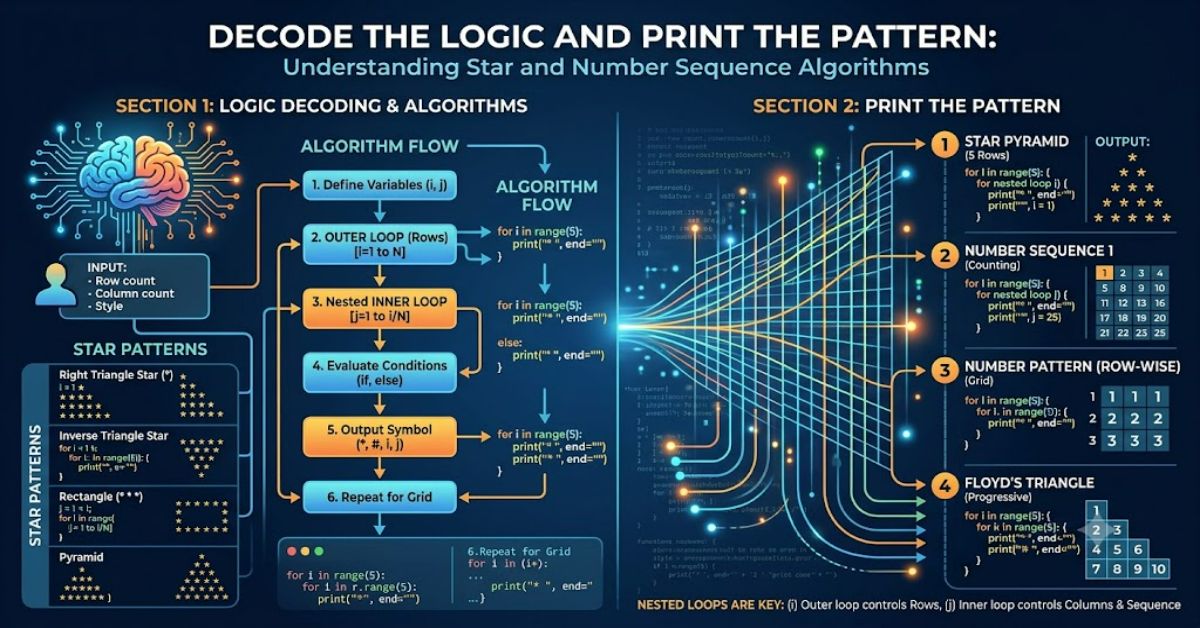
To decode the logic and print the pattern means understanding the hidden rules behind a visual arrangement of characters and converting those rules into a working algorithm. In many programming exercises, the pattern builds N rows where each row contains a leading set of stars, an increasing sequence of numbers, and another numerical sequence. The zeros displayed in some versions of these problems usually represent spacing rather than actual printed values.
Pattern questions are common in programming courses because they test more than syntax. They require a programmer to analyse structure, identify repetition, and translate a visual design into step-by-step instructions.
A typical pattern may look simple when viewed as output, but creating it requires understanding several programming concepts:
- Nested loops
- Row and column relationships
- Incrementing counters
- Spacing management
- Conditional printing
These skills form the foundation of algorithmic thinking. Before developing complex applications, programmers must learn how to break problems into smaller logical components.
This article Decode the Logic and Print the Pattern explains how pattern logic works, how to identify the rules behind an output, and how different programming techniques can generate structured designs.
Understanding the Structure Behind Pattern Printing
A pattern is not random. Every symbol, number, and space follows a rule.
Consider a pattern containing:
- Leading stars
- Increasing numbers
- A second numerical sequence
The first step is identifying how each component changes from one row to the next.
For example:
| Row Number | Stars | First Number Sequence | Second Sequence |
| 1 | Fewer spaces | Starts small | Ends early |
| 2 | More symbols | Expands | Expands |
| 3 | Continues growth | Longer sequence | Longer sequence |
The important observation is that the row number controls the size of each section.
Breaking the Pattern Into Logical Components
A common mistake among beginners is trying to print the entire design using one loop. A better approach is dividing the output into independent sections.
Component One: Spaces or Leading Stars
The first part controls alignment.
Depending on the design, each row may require:
- Increasing spaces
- Decreasing spaces
- A fixed number of symbols
The programmer must determine the relationship between the row number and the number of characters printed.
Example logic:
- Row 1 prints one leading element.
- Row 2 prints two leading elements.
- Row 3 prints three leading elements.
This relationship can be represented mathematically as:
Number of symbols = Row number
Component Two: Increasing Number Sequence
The numerical section usually follows a counting pattern.
Example:
1
12
123
1234
The logic is:
- Start counting from 1.
- Continue until the current row number is reached.
A loop controls this repetition.
Component Three: Second Number Sequence
Many advanced patterns include a second sequence after the first.
Example:
12321
1234321
123454321
This requires two stages:
- Increasing numbers
- Decreasing numbers
The algorithm must understand the turning point.
The Role of Nested Loops in Pattern Problems
Nested loops are the main programming technique behind most pattern exercises.
A nested loop means placing one loop inside another.
The outer loop controls:
- Number of rows
The inner loops control:
- Characters printed in each row
Basic structure:
for each row:
print required spaces
print symbols
print numbers
This approach mirrors the way humans analyse visual patterns.
Comparing Different Pattern Approaches
| Approach | Advantages | Limitations |
| Multiple loops | Clear and easy to understand | More lines of code |
| Single complex loop | Shorter program | Harder to maintain |
| Recursive approach | Demonstrates advanced logic | Less practical for beginners |
For educational purposes, multiple loops are usually preferred because they make each logical section visible.
Example of Pattern Logic Analysis
Suppose a pattern contains five rows.
The first question is:
“How does row five differ from row one?”
A programmer examines:
- Number of characters
- Position changes
- Sequence length
- Repeated behaviour
A structured analysis may look like this:
| Pattern Element | Rule |
| Rows | Increase from 1 to N |
| Stars | Change based on row position |
| Numbers | Follow ascending order |
| Spaces | Control visual alignment |
This analytical method works for almost any pattern problem.
Why Pattern Problems Matter in Programming Education
Although printing stars and numbers may appear simple, these exercises develop important computational skills.
Logical Thinking
Students learn to identify rules rather than memorise solutions.
Algorithm Design
A pattern requires planning before coding. The programmer must create a sequence of instructions.
Debugging Skills
Small mistakes in loops can change the entire output. Pattern exercises improve error detection.
Practical Applications Beyond Classroom Exercises
Pattern logic connects with real software development.
Similar concepts appear in:
- Data visualisation
- Report formatting
- User interface layouts
- Game design
- Console applications
For example, creating a dashboard table requires the same thinking used in pattern printing: organising information according to structured rules.
Common Errors When Solving Pattern Problems
Incorrect Loop Limits
A frequent mistake is stopping the loop too early or running it too many times.
The solution is carefully comparing:
- Current row
- Required output length
Confusing Spaces With Characters
Many beginners treat spaces as meaningless, but spacing controls the entire visual structure.
Ignoring the Relationship Between Rows
Every row usually depends on the previous row. Recognising this relationship makes the solution easier.
Data Insights: Programming Skills Developed Through Pattern Exercises
| Skill | How Pattern Problems Improve It |
| Logical reasoning | Identifying hidden rules |
| Loop control | Managing repetition |
| Algorithm planning | Breaking tasks into steps |
| Debugging | Finding output errors |
| Mathematical thinking | Understanding sequences |
These skills are transferable to larger programming projects.
The Future of Pattern Logic Learning in 2027
By 2027, programming education is expected to rely increasingly on interactive learning tools and AI-supported coding environments.
Pattern problems may become more visual, allowing students to manipulate designs and immediately observe how code changes affect output.
However, traditional logic exercises will remain valuable because they teach fundamental reasoning. Automated coding tools can generate solutions, but understanding why an algorithm works remains essential.
Educational institutions are likely to combine AI assistance with foundational programming practice rather than replacing problem-solving exercises completely.
Key Takeaways
- Pattern printing is an exercise in algorithm design, not just output formatting.
- The first step is identifying the relationship between rows and components.
- Nested loops provide the most common solution structure.
- Spaces, symbols, and numbers each follow separate rules.
- Pattern analysis improves programming confidence and debugging ability.
- These concepts support skills used in professional software development.
Conclusion
Pattern-printing problems provide a simple but powerful introduction to programming logic. Behind every arrangement of stars and numbers is a structured system based on repetition, counting, and mathematical relationships.
Learning to decode the logic behind a pattern teaches programmers how to analyse problems before writing code. These skills extend beyond beginner exercises and contribute to stronger algorithm design abilities.
While modern development tools can automate parts of programming, the ability to understand structure and create logical solutions remains a fundamental skill. Pattern problems continue to serve as practical exercises because they teach the thinking process behind effective programming.
Frequently Asked Questions
What does it mean to decode the logic of a pattern?
It means identifying the rules controlling rows, symbols, spaces, and numbers before writing a program.
Why are pattern-printing problems used in programming courses?
They teach loops, conditions, sequencing, and problem-solving skills.
What programming concept is mainly used for patterns?
Nested loops are commonly used because one loop controls rows while another controls elements inside each row.
Why do zeros appear in some printed patterns?
In many examples, zeros represent spaces or empty positions rather than actual numerical output.
Can pattern logic be used outside programming exercises?
Yes. Similar ideas appear in formatting systems, interfaces, data displays, and software design.
How can beginners solve difficult patterns?
They should divide the design into smaller sections and identify the rule for each section.
Methodology
This article Decode the Logic and Print the Pattern was developed using established programming education concepts related to algorithms, loops, and computational thinking.
The explanation focuses on general pattern-printing principles rather than a single programming language implementation. Examples were analysed conceptually to explain how programmers identify visual rules and convert them into algorithms.
Limitations include differences between programming languages, as syntax and available tools vary. The logical approach remains consistent across most languages.
This article Decode the Logic and Print the Pattern was drafted with AI assistance and requires human editorial review before publication to verify technical accuracy and educational suitability.
References (APA Style)
Cormen, T. H., Leiserson, C. E., Rivest, R. L., & Stein, C. (2022). Introduction to Algorithms (4th ed.). MIT Press.
Downey, A. B. (2023). Think Python: How to Think Like a Computer Scientist (3rd ed.). Green Tea Press.
Python Software Foundation. (2024). Python documentation: Control flow tools. Python.org.
Internal Linking Note: Relevant RubbleMagazine.co.uk internal links should be added after verifying live programming and education-related articles on the website.