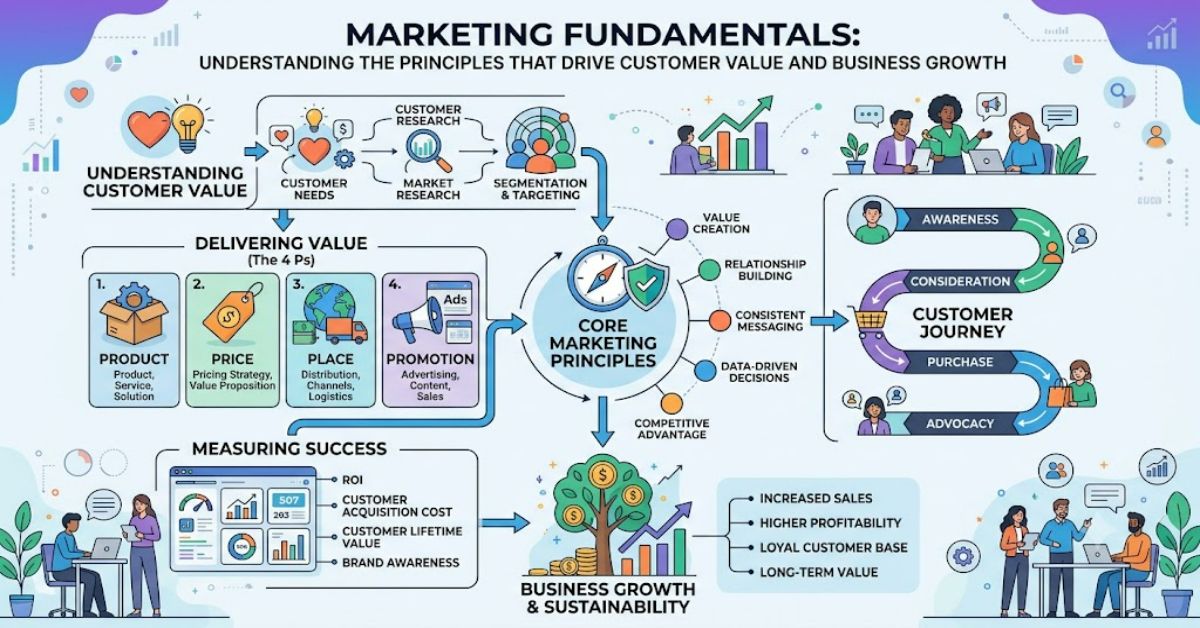
Marketing fundamentals are the core principles that guide how businesses identify customer needs, create value, communicate solutions, and develop profitable relationships. Marketing is not simply about advertising products or increasing sales. It is a strategic process focused on understanding people, solving problems, and delivering experiences that encourage loyalty.
The purpose of marketing is to connect businesses with the right customers at the right time. Whether an organisation operates globally or serves a local community, effective marketing depends on knowing what customers want, why they make decisions, and how a company can provide greater value than competitors.
Modern marketing combines traditional principles with digital tools, customer analytics, and personalised communication. However, the foundation remains unchanged: businesses must understand their audience before attempting to influence purchasing decisions.
From market research and customer segmentation to branding and measurement, marketing fundamentals provide a framework for sustainable growth. Companies that ignore these principles often struggle because they focus on selling rather than creating genuine customer value.
What Are Marketing Fundamentals?
Marketing fundamentals refer to the basic concepts and strategies used to attract, engage, and retain customers. These principles help businesses develop products, set prices, communicate benefits, and build relationships.
The main purpose of marketing is to create a connection between customer needs and business solutions.
The essential areas include:
| Marketing Principle | Purpose |
| Customer Research | Understand customer needs and behaviour |
| Segmentation | Identify different customer groups |
| Positioning | Create a clear market identity |
| Branding | Build trust and recognition |
| Communication | Share value effectively |
| Measurement | Evaluate marketing performance |
These elements work together to create a complete marketing strategy.
Understanding Customer Needs Through Research
The first step in effective marketing is understanding customers. Businesses need accurate information about customer preferences, challenges, expectations, and buying behaviour.
Market research can include:
- Customer surveys
- Competitor analysis
- Online behaviour tracking
- Reviews and feedback
- Sales data analysis
Research prevents businesses from making decisions based only on assumptions. A company may believe it understands its audience, but customer expectations can change due to technology, economic conditions, or cultural trends.
For example, many successful digital companies use customer data to improve personalisation. Online platforms analyse user behaviour to recommend relevant products, services, or content.
This approach demonstrates an important marketing principle: customers respond better when businesses understand their individual needs.
Segmentation, Targeting and Positioning
One of the most important frameworks in marketing is segmentation, targeting, and positioning (STP).
Businesses rarely serve every customer in the same way. Different audiences have different motivations, budgets, and expectations.
Market Segmentation
Segmentation divides a broad market into smaller groups.
Common segmentation methods include:
| Type | Example |
| Demographic | Age, income, occupation |
| Geographic | Location and region |
| Psychographic | Lifestyle and values |
| Behavioural | Buying patterns and loyalty |
After segmentation, businesses choose which groups they want to target.
A premium brand may focus on customers seeking quality and exclusivity, while a budget retailer may prioritise affordability and convenience.
Positioning then determines how customers view the brand compared with competitors.
A strong position answers a simple question:
“Why should customers choose this business?”
The Marketing Mix: The 4Ps and Beyond
The marketing mix is one of the most recognised models in business strategy. Traditionally, it includes four key elements:
| Element | Explanation |
| Product | The goods or services offered |
| Price | The amount customers pay |
| Place | Distribution and availability |
| Promotion | Communication methods |
Service-based businesses often use an expanded 7Ps model by adding:
- People
- Process
- Physical evidence
This framework helps organisations create balanced strategies. A strong product may still fail if pricing is unsuitable or customers cannot easily access it.
Branding and Customer Relationships
Branding plays a major role in how customers recognise and trust businesses. A brand represents more than a logo; it reflects reputation, values, customer experience, and expectations.
Strong brands often create emotional connections with customers.
For example, companies such as Apple have built strong identities by combining product design, innovation, and customer experience.
However, branding requires consistency. Businesses that promote certain values but fail to demonstrate them may damage customer trust.
Modern consumers increasingly consider factors such as transparency, sustainability, and ethical practices when choosing brands.
Digital Marketing and Changing Consumer Behaviour
Technology has transformed how businesses apply marketing principles.
Digital marketing allows organisations to reach audiences through:
- Search engines
- Social media
- Email campaigns
- Websites
- Online advertising
These channels provide valuable information about customer behaviour. Businesses can measure engagement, track conversions, and improve campaigns based on real performance data.
However, technology does not replace strategic thinking. A poorly designed campaign can fail even with advanced digital tools.
Successful digital marketing still depends on understanding customer needs and providing useful information.
Measuring Marketing Success
Marketing performance must be measured to understand whether strategies are effective.
Important metrics include:
| Metric | Meaning |
| Customer Acquisition Cost | Cost of gaining new customers |
| Conversion Rate | Percentage completing desired actions |
| Customer Lifetime Value | Long-term customer profitability |
| Return on Investment | Financial effectiveness |
Measurement allows businesses to improve decisions and allocate resources effectively.
One important consideration is that popularity does not always equal success. A campaign may receive attention but fail to generate sales or customer loyalty.
Risks and Challenges in Modern Marketing
Although marketing creates opportunities, businesses must manage several risks.
Data Privacy Concerns
Modern marketing relies heavily on customer information. Organisations must comply with regulations such as the UK GDPR and ensure customer data is handled responsibly.
Over-Reliance on Technology
Automation and analytics improve efficiency, but businesses should not ignore human behaviour and emotional factors.
Short-Term Strategies
Heavy discounting or aggressive promotion may increase immediate sales but can weaken brand value over time.
Long-term success requires building trust rather than focusing only on quick results.
The Future of Marketing Fundamentals in 2027
By 2027, marketing fundamentals will continue to focus on customer value, but technology will influence how businesses understand and communicate with audiences.
Artificial intelligence, automation, and predictive analytics will support faster decision-making and personalised experiences.
However, businesses will face greater expectations around privacy, transparency, and ethical data use.
The organisations most likely to succeed will be those that combine technology with genuine customer understanding. While marketing tools will continue changing, the fundamental goal will remain the same: creating valuable relationships between businesses and customers.
Key Takeaways
- Marketing begins with understanding customer needs rather than simply promoting products.
- Research helps businesses make informed decisions.
- Segmentation and positioning allow companies to reach suitable audiences.
- Branding creates trust and long-term relationships.
- Digital tools improve marketing effectiveness but do not replace strategy.
- Measurement helps businesses evaluate and improve performance.
Conclusion
Marketing fundamentals provide the foundation for successful business growth. They help organisations understand customers, create meaningful value, and develop strategies that support long-term relationships.
Although marketing methods continue to evolve through technology and changing consumer behaviour, the basic principles remain consistent. Businesses must identify customer needs, communicate clearly, deliver quality experiences, and maintain trust.
Companies that view marketing as a strategic function rather than only a promotional activity are better positioned to compete in changing markets. The future of marketing will involve advanced tools and greater personalisation, but success will continue to depend on understanding people and creating genuine value.
Frequently Asked Questions
What are marketing fundamentals?
Marketing fundamentals are the basic principles used to understand customers, create value, communicate solutions, and build lasting relationships.
Why are marketing fundamentals important?
They help businesses make better decisions about products, pricing, customers, and communication strategies.
What are the main components of marketing?
The main components include research, segmentation, positioning, branding, promotion, and performance measurement.
How has digital marketing changed traditional marketing?
Digital marketing allows businesses to reach targeted audiences, personalise communication, and measure results more effectively.
Can small businesses benefit from marketing fundamentals?
Yes. Small businesses can use these principles to understand customers, compete effectively, and develop stronger relationships.
Methodology
This article was developed using established marketing frameworks, business education resources, and recognised industry guidance. Information was reviewed from marketing institutions and business research sources to provide a balanced explanation of strategic principles.
The analysis focuses on widely accepted concepts, including customer research, segmentation, branding, digital marketing, and performance measurement. Individual business results may vary depending on industry, audience, and market conditions.
Before publication, all examples, statistics, and references should be independently verified through editorial review.
References
American Marketing Association. (2023). Marketing definitions and resources. American Marketing Association.
Chartered Institute of Marketing. (2024). Understanding marketing principles. CIM.
Kotler, P., & Keller, K. L. (2022). Marketing Management (16th ed.). Pearson.
Information Commissioner’s Office. (2024). Guide to UK GDPR. ICO.