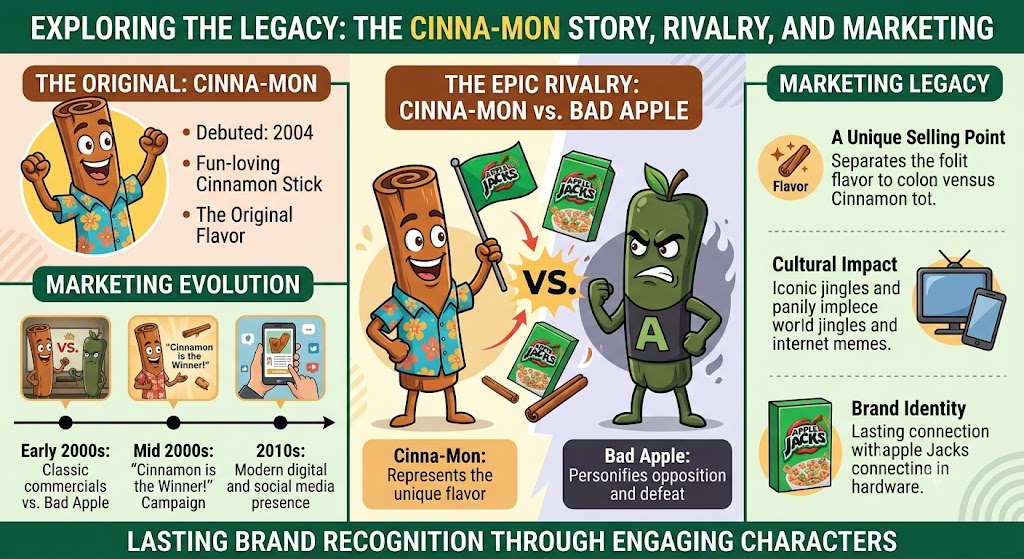
The apple jacks cinnamon stick character became one of the most recognisable symbols of Kellogg’s Apple Jacks cereal marketing during the 2000s. Introduced in 2004, Cinna-Mon was designed as a laid-back cinnamon stick character with dreadlocks, a Jamaican-inspired personality, and a mission to prove that cinnamon was the dominant flavour in Apple Jacks. His rivalry with Bad Apple created a playful competition that turned a simple cereal ingredient into a memorable advertising personality.
Food advertising has long relied on mascots to create emotional connections with audiences. From animated animals to fictional characters, brands often use personalities to make products easier to remember, especially among younger consumers. Cinna-Mon represented more than a flavour; he represented confidence, humour, and the idea that every product has a story behind it.
The Apple Jacks campaign arrived during a period when cereal companies were investing heavily in character-driven marketing. Television advertisements, online campaigns, and collectible promotions were important tools for creating brand recognition.
Although the character was created for entertainment rather than nutritional education, his popularity highlights an important lesson in marketing: consumers often remember personalities more than product descriptions.
The Origins of the Apple Jacks Cinnamon Character
Kellogg’s introduced Cinna-Mon in 2004 as part of a campaign built around the idea that Apple Jacks contained two competing flavours: apple and cinnamon.
Before Cinna-Mon appeared, Apple Jacks marketing focused mainly on the unusual combination of flavours. The introduction of a cinnamon mascot gave the brand a stronger narrative.
The campaign introduced a rivalry:
| Character | Role | Personality |
| Cinna-Mon | Cinnamon representative | Relaxed, confident, humorous |
| Bad Apple | Apple representative | Competitive and determined |
The storyline centred around a race to reach the cereal bowl, with Cinna-Mon attempting to prove that cinnamon was the winning flavour.
His famous phrase, “Cinnamon is da winna, mon!” became closely associated with the campaign.
Why Cinna-Mon Worked as a Marketing Character
Successful mascots usually combine three elements:
- Recognition
- Personality
- Emotional connection
Cinna-Mon achieved these through a simple but effective design.
A Distinct Visual Identity
The character was immediately recognisable because of his unusual appearance. A cinnamon stick with expressive features and dreadlocks stood out among traditional cereal mascots.
The design gave children a character they could identify with rather than simply a product ingredient.
A Simple Story
The apple versus cinnamon rivalry was easy to understand. Children did not need detailed explanations about flavour profiles. The message was clear: two ingredients were competing for attention.
This type of storytelling follows a common advertising principle where brands simplify complex ideas into memorable conflicts.
The Cultural Impact of Food Mascots
Food mascots have historically played an important role in consumer culture. Characters such as cereal animals, cartoon figures, and fictional personalities often become part of childhood memories.
The Apple Jacks cinnamon stick character reflected the early 2000s advertising environment, when television commercials heavily influenced brand awareness among younger audiences.
| Marketing Element | Purpose | Impact |
| Character design | Create recognition | Improved brand recall |
| Humour | Entertain viewers | Increased engagement |
| Rivalry storyline | Create interest | Encouraged repeat viewing |
| Catchphrase | Improve memory | Strengthened association |
One important insight from this campaign is that mascots do not always need to represent the entire product. Sometimes representing a single ingredient can create a stronger identity.
The Business Strategy Behind Apple Jacks Marketing
The creation of Cinna-Mon was part of a wider strategy used by food companies to differentiate products in crowded markets.
Breakfast cereal shelves contain many competing brands. A product needs more than taste alone to attract attention.
By creating a flavour-based rivalry, Kellogg’s transformed a basic ingredient discussion into entertainment.
This approach provided several advantages:
- Increased brand personality
- Created advertising opportunities
- Encouraged customer conversations
- Supported merchandise possibilities
The strategy also reflected changing consumer behaviour during the early digital era, when memorable characters could move beyond television into websites, games, and online communities.
Risks and Limitations of Mascot-Based Marketing
While memorable characters can strengthen brands, they also have limitations.
Short-Term Attention
A successful mascot does not automatically guarantee long-term product growth. Consumer preferences change, and advertising trends evolve.
Changing Views on Children’s Advertising
Since the 2000s, discussions around marketing food products to children have increased. Organisations and regulators have placed greater attention on transparency, nutrition messaging, and responsible advertising.
Character Recognition Does Not Equal Product Loyalty
A consumer may remember Cinna-Mon years later without necessarily buying Apple Jacks regularly.
This shows the difference between brand awareness and purchasing behaviour.
The Legacy of Cinna-Mon in Modern Marketing
The popularity of nostalgic characters has grown significantly in recent years. Many brands have revisited older mascots because consumers who grew up with them now have purchasing power.
The continued interest in characters like Cinna-Mon demonstrates how advertising campaigns can become part of cultural memory.
| Factor | Effect on Brand |
| Nostalgia | Creates emotional connections |
| Character recognition | Improves recall |
| Social media sharing | Extends campaign lifespan |
| Limited appearances | Can increase curiosity |
An interesting marketing lesson is that disappearing characters can sometimes become more memorable because audiences remember what they no longer see.
The Future of Cereal Mascots in 2027
By 2027, cereal marketing is likely to continue shifting towards digital platforms, interactive experiences, and personalised advertising.
Traditional television commercials remain important, but younger audiences increasingly discover brands through social media, gaming environments, and online communities.
Future mascots may become more interactive, appearing through augmented reality experiences, mobile applications, or digital storytelling.
However, successful characters will still require the same foundations that made Cinna-Mon effective: a clear identity, simple message, and emotional connection.
Key Takeaways
- Cinna-Mon transformed a cereal ingredient into a memorable advertising personality.
- The Apple Jacks campaign used storytelling to make flavour competition entertaining.
- Strong visual identity helped the character stand out.
- Mascots can create nostalgia that lasts beyond original campaigns.
- Marketing characters must balance entertainment with changing consumer expectations.
- Brand recognition does not always guarantee continued sales.
Conclusion
The apple jacks cinnamon stick character remains an interesting example of how food advertising can turn simple ingredients into memorable cultural figures. Cinna-Mon was not just a cinnamon representation; he was part of a larger storytelling strategy that gave Apple Jacks a distinctive personality.
The character’s success came from combining humour, visual recognition, and an easy-to-follow rivalry. While advertising approaches have changed since 2004, the principles behind effective mascots remain relevant.
Brands continue searching for ways to build emotional connections with consumers, and characters like Cinna-Mon show why personality can sometimes be as important as the product itself.
FAQ
What was the Apple Jacks cinnamon stick character called?
The cinnamon stick character was called Cinna-Mon. He appeared in Kellogg’s Apple Jacks advertising campaigns beginning in 2004.
Why was Cinna-Mon created?
Cinna-Mon was created to represent cinnamon as a flavour in Apple Jacks and compete against the apple character, Bad Apple.
What was Cinna-Mon’s famous phrase?
His most recognised phrase was “Cinnamon is da winna, mon!” which reinforced his role as the cinnamon champion.
Is Cinna-Mon still used in Apple Jacks advertising?
The character is no longer a major part of current marketing campaigns, but he remains memorable among many consumers who grew up with the advertisements.
Why do food companies create mascots?
Companies use mascots to increase brand recognition, create emotional connections, and make products easier for consumers to remember.
References
- Kellogg Company. (2004). Apple Jacks marketing campaigns and brand communications.
- Federal Trade Commission. (2023). Food advertising and marketing practices involving children.
- McNeal, J. U. (2015). Children as Consumers: Insights and Implications. Business Expert Press.
- Aaker, D. A. (2014). Aaker on Branding: 20 Principles That Drive Success. Morgan James Publishing.