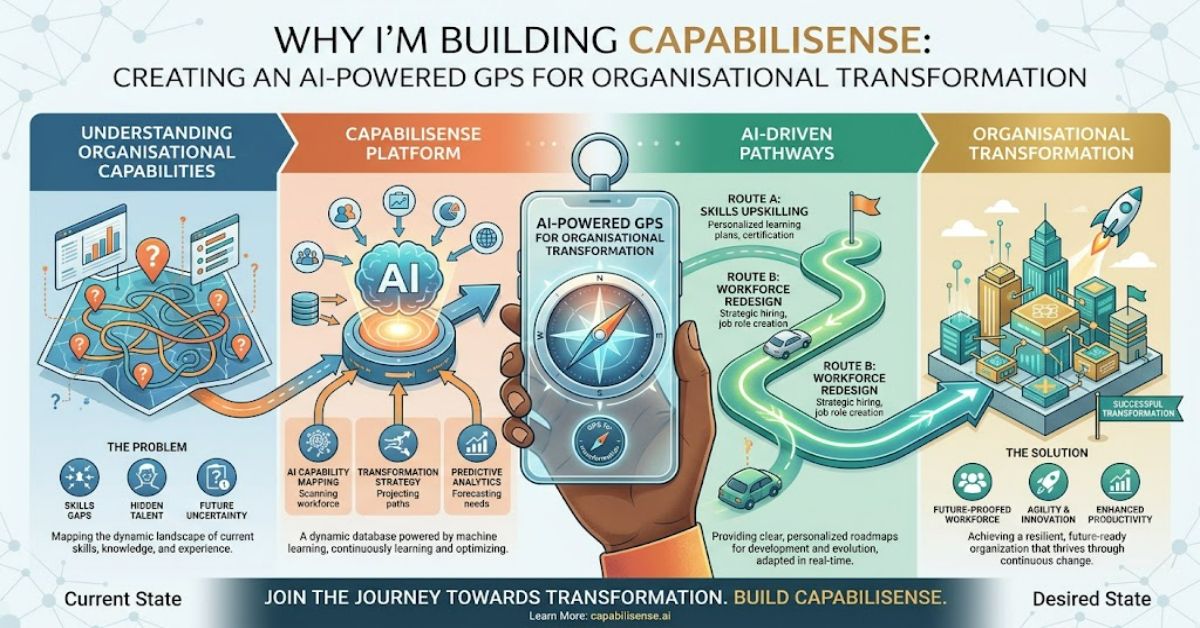
Why I’m building CapabiliSense comes down to a simple observation: many organisations attempt transformation without a clear understanding of their current capabilities. Businesses often create ambitious roadmaps, invest in new technology, and launch improvement programmes, yet still struggle because they lack a reliable view of what works, what fails, and where resources are being wasted.
CapabiliSense is designed as an AI-powered GPS for organisational transformation. Its purpose is to map a company’s capabilities, identify operational bottlenecks, and reduce avoidable mistakes created by fragmented information and manual processes.
Modern organisations operate through complex networks of people, systems, workflows, and technologies. Without a unified capability map, leaders often make decisions based on incomplete information. This creates delays, duplicated effort, and misalignment between strategy and execution.
The concept behind CapabiliSense reflects a wider shift in business technology: moving from reactive problem-solving towards proactive intelligence. Instead of waiting for transformation projects to fail, organisations can use structured insights to understand their current position and plan improvements with greater confidence.
The Organisational Problem CapabiliSense Aims to Solve
Many businesses understand their goals but struggle to understand their operational reality. Strategic documents may describe future ambitions, but they rarely provide a complete picture of existing capabilities.
Common challenges include:
- Different departments using disconnected systems
- Limited visibility into operational weaknesses
- Repeated manual processes
- Poor communication between business and technology teams
- Difficulty measuring transformation progress
Traditional approaches often rely on workshops, spreadsheets, interviews, and consultant-led assessments. While valuable, these methods can become time-consuming and may capture only a temporary snapshot of the organisation.
CapabiliSense aims to create a continuous intelligence layer that helps organisations understand capability maturity over time.
From Business Mapping to AI-Powered Decision Support
A capability map identifies what an organisation does rather than focusing only on departments or technology systems. For example, customer management is a capability, while a CRM platform is simply a tool supporting that capability.
CapabiliSense applies this thinking by connecting organisational capabilities with operational data, transformation goals, and improvement opportunities.
| Traditional Transformation Approach | CapabiliSense Approach |
| Periodic assessments | Continuous capability visibility |
| Manual documentation | AI-supported analysis |
| Department-focused thinking | Organisation-wide capability view |
| Reactive problem solving | Predictive improvement planning |
| Separate stakeholder perspectives | Shared transformation understanding |
This approach can help leaders understand not only what needs improvement but why certain issues exist.
How CapabiliSense Creates Strategic Clarity
The central idea behind CapabiliSense is reducing uncertainty. Organisational transformation often fails because businesses invest in solutions before properly diagnosing problems.
An AI capability platform can support leaders by analysing:
- Current capability strengths
- Process inefficiencies
- Technology dependencies
- Operational risks
- Transformation priorities
This creates a stronger foundation for decision-making.
A key advantage is alignment. When executives, operational teams, and technology specialists share a common view of organisational capabilities, transformation discussions become more practical.
Instead of asking, “Which technology should we buy?” organisations can ask, “Which capability gap are we solving?”
The Practical Impact of Removing Manual Process Errors
Manual processes create hidden costs. Employees spend significant time collecting information, updating documents, and reconciling inconsistent data.
CapabiliSense focuses on reducing avoidable mistakes by creating structured intelligence around organisational operations.
| Problem Area | Potential Business Impact |
| Duplicate processes | Increased operational costs |
| Poor data visibility | Slower decision-making |
| Capability gaps | Failed transformation projects |
| Department silos | Reduced collaboration |
| Unclear priorities | Wasted investment |
The opportunity is not simply automation. The bigger goal is improving organisational understanding.
Risks and Trade-Offs of AI Transformation Platforms
While AI-powered organisational tools offer significant opportunities, they also introduce challenges.
Data Quality
AI systems depend on accurate information. If organisational data is incomplete or outdated, recommendations may become unreliable.
Human Trust
Transformation decisions affect employees, workflows, and business structures. Teams need confidence that AI insights support human expertise rather than replace it.
Implementation Complexity
Large organisations often have legacy systems and complex processes. Connecting different information sources can require significant planning.
These limitations mean CapabiliSense must be designed with transparency, governance, and human oversight as core principles.
The Wider Market Shift Towards Intelligent Organisations
Businesses increasingly recognise that transformation is not only about adopting new technology. It is about understanding how technology, people, and processes work together.
Research from organisations such as McKinsey has highlighted that many digital transformation efforts struggle because companies fail to connect technology investments with business capabilities.
This creates demand for platforms that bridge strategy and execution.
CapabiliSense fits within this movement by focusing on capability intelligence rather than isolated digital tools.
The Future of CapabiliSense in 2027
By 2027, organisational AI platforms are likely to become more focused on decision intelligence, automation, and continuous improvement.
Several trends will influence this development:
- Increased adoption of enterprise AI systems
- Greater demand for operational transparency
- More emphasis on responsible AI governance
- Integration between business architecture and artificial intelligence
However, adoption will depend on practical factors. Organisations will still need strong data foundations, clear governance frameworks, and leadership support.
The future of CapabiliSense will likely depend on how effectively it transforms complex organisational information into understandable, actionable guidance.
Key Takeaways
- CapabiliSense addresses the challenge of understanding organisational capability before transformation begins.
- AI can help businesses identify bottlenecks and improve strategic decision-making.
- Capability mapping creates stronger connections between business goals and operational reality.
- Successful transformation requires both technology and human collaboration.
- Data quality and trust remain critical factors for AI adoption.
- The future of business intelligence is moving towards continuous organisational awareness.
Conclusion
CapabiliSense is being built around the belief that organisations need better visibility before they can successfully transform. Many businesses have ambitious strategies, but their ability to execute depends on understanding their existing capabilities, limitations, and opportunities.
By acting as an AI-powered GPS for organisational transformation, CapabiliSense aims to provide direction, clarity, and alignment across complex business environments. The platform represents a move away from fragmented assessments towards continuous capability intelligence.
The challenge will be balancing automation with human judgement, ensuring accurate information, and building trust among stakeholders. If these foundations are addressed, AI-driven capability mapping could become an important part of how organisations plan and execute future change.
Frequently Asked Questions
What is CapabiliSense?
CapabiliSense is an AI-powered organisational transformation platform designed to map business capabilities, identify bottlenecks, and support strategic decision-making.
Why is CapabiliSense being built?
The platform is being built to solve challenges caused by unclear processes, disconnected teams, and limited visibility into organisational capabilities.
How does CapabiliSense help businesses?
It helps organisations understand their current state, identify improvement opportunities, and create clearer transformation roadmaps.
Is CapabiliSense replacing business leaders?
No. The platform is designed to support human decision-making by providing structured insights and better visibility.
What makes capability mapping important?
Capability mapping helps organisations understand what they do, how effectively they operate, and where improvements can create the most value.
Methodology
This article was developed using the provided CapabiliSense concept description alongside established research on digital transformation, business architecture, and enterprise AI adoption. The analysis focuses on the strategic purpose, potential applications, and challenges of capability intelligence platforms. No claims of independent product testing or user performance data are made.
References
McKinsey & Company. (2023). The state of digital transformation and technology-enabled business change. McKinsey Global Institute.
Deloitte. (2024). State of digital transformation: Building intelligent organisations. Deloitte Insights.
The Open Group. (2023). TOGAF Standard and enterprise architecture guidance. The Open Group.
UK Government. (2023). Artificial intelligence regulation: A pro-innovation approach. Department for Science, Innovation and Technology.