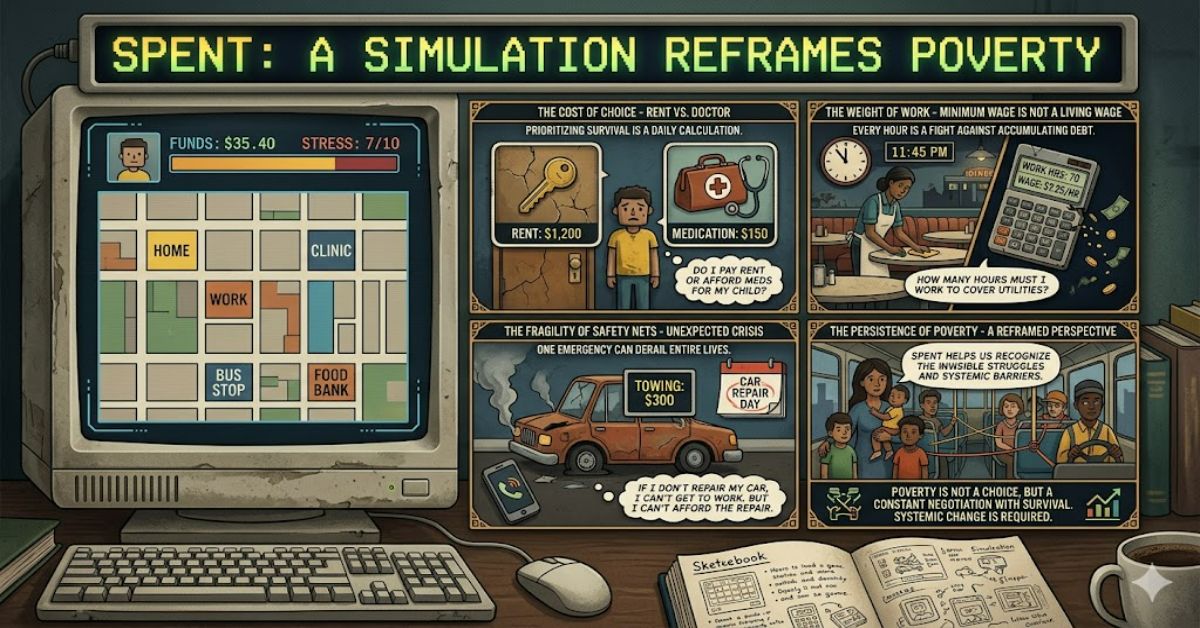
The game spent experience is a web-based simulation that places players in a controlled scenario of financial precarity. In the first 100 words of engagement, it becomes clear that the game spent model is not designed as entertainment in the traditional sense, but as a behavioural mirror. Players are asked to survive one month on a severely limited income while making continuous trade-offs between housing, food, healthcare, and employment risks.
Created as an educational and advocacy tool by McKinney in collaboration with Urban Ministries of Durham, the game spent framework uses decision-tree mechanics to simulate what poverty feels like under constraint. Unlike traditional resource-management games, it removes optimisation pathways that guarantee success. Instead, it forces irreversible loss states, reflecting how real-world financial instability compounds over time.
The game spent structure has been widely discussed in education, social policy circles, and digital ethics debates because it reframes poverty not as a static condition but as a cascading system of compromises. This article examines its mechanics, cultural impact, and the deeper systems it represents.
How Game Spent Works as a System
At its core, game spent is a constrained branching simulation. Players begin with a fixed monthly income (typically around $1,000 in the original version) and must allocate resources across essential survival categories.
The structure is simple but intentionally restrictive:
- Housing must be maintained or risk homelessness
- Employment options vary in stability and ethical trade-offs
- Health events occur probabilistically
- Social obligations introduce financial leakage
- Savings potential is extremely limited or non-existent
The system is designed so that optimal play does not eliminate risk, which is a key deviation from conventional simulation games.
Key Mechanics Overview
| System Component | Function | Player Impact |
| Income constraint | Fixed monthly budget | Limits strategic flexibility |
| Random events | Health/job crises | Introduces unpredictability |
| Decision branching | Binary choices with penalties | Forces trade-offs |
| Survival threshold | Month completion goal | Defines success condition |
The game spent model operates more like a behavioural stress test than a traditional game loop.
Strategic Implications of Game Spent Design
The design of game spent reflects principles found in systems theory and behavioural economics. It demonstrates how small financial shocks can cascade into systemic failure when buffers are absent.
One of the most important implications is the absence of recovery symmetry. In many games, players can recover from setbacks through optimisation. In game spent, a single negative event (such as a medical bill or job loss) can permanently alter the trajectory of survival.
This creates a simulation closer to real-world poverty dynamics, where:
- Debt compounds faster than income recovery
- Access to emergency funds is limited
- Time pressure reduces decision quality
Observed Design Behaviour Pattern
| Scenario Type | Expected Game Outcome | Real-World Parallel |
| Medical emergency | Budget collapse | Healthcare debt |
| Job instability | Income interruption | Gig economy precarity |
| Housing increase | Forced relocation | Rent inflation pressure |
The game spent system deliberately avoids providing “correct answers,” which reinforces its educational framing.
Risks, Trade-offs, and Ethical Constraints
The game spent experience has been praised and criticised for its emotional intensity. One of its major trade-offs is between empathy generation and oversimplification.
While the simulation communicates financial stress effectively, it abstracts structural complexities such as welfare systems, informal economies, and community support networks.
Key Risks Identified
- Emotional compression risk: Players may generalise a single simulated experience to all poverty contexts
- Simplification bias: Complex socio-economic systems are reduced to binary choices
- False agency perception: Players may believe outcomes reflect purely individual decisions
From a design ethics perspective, game spent sits in a sensitive category of “serious games” where emotional engagement must be balanced with accuracy.
Market and Cultural Impact of Game Spent
Since its release in the early 2010s, game spent has been used in classrooms, workshops, and advocacy environments. It has also been referenced in discussions around gamified education and poverty awareness tools.
The cultural impact lies in its accessibility. Unlike academic reports, it translates abstract economic concepts into lived decision pressure.
Adoption Context Overview
| Sector | Use Case | Outcome |
| Education | Classroom simulation | Discussion-based learning |
| Nonprofits | Awareness campaigns | Donor engagement |
| Policy training | Empathy exercises | Stakeholder awareness |
The game spent model is frequently cited in discussions about how interactive media can shape public understanding of inequality.
Real-World Context and Development Background
The original game spen’t was developed as part of an awareness initiative tied to Urban Ministries of Durham, with creative development support from McKinney. It reflects early experimentation in “impact-driven advertising games,” where gameplay mechanics are used for social messaging.
Unlike commercial games, it was not designed for monetisation or retention metrics. Instead, its success was measured by engagement depth and behavioural reflection.
A key contextual moment in its adoption was its integration into educational workshops in the mid-2010s, where it was used to simulate financial decision-making under constraint.
Key Insights from Game Spent Analysis
- The game spen’t structure eliminates guaranteed recovery, reflecting real-world financial fragility.
- Its design prioritises emotional realism over systemic completeness.
- Decision-making pressure increases as resource buffers approach zero.
- It functions more as a behavioural model than a traditional game.
- Educational value depends heavily on guided discussion after gameplay.
The Future of Game Spent in 2027
By 2027, serious simulation games like game spent are expected to evolve alongside advances in AI-driven behavioural modelling. Research in adaptive narrative systems suggests that future versions could integrate dynamic economic modelling rather than static decision trees.
Policy education tools in the UK and US are increasingly exploring immersive simulations supported by public-sector digital learning frameworks. However, regulatory scrutiny around emotional manipulation in educational software is also increasing.
Key constraints include:
- Data privacy concerns in behavioural simulations
- Ethical boundaries in emotional exposure
- Need for verified socio-economic modelling accuracy
While game spent remains static in its original form, its conceptual framework is likely to influence next-generation civic simulation tools.
Takeaways
- Game spent is a constrained survival simulation focused on financial precarity
- Its mechanics reflect real-world compounding economic risk
- Emotional realism is its strongest and most controversial feature
- It is widely used in education and advocacy contexts
- The model highlights limitations of traditional game-based learning systems
- Future iterations of similar tools will likely integrate adaptive AI systems
Conclusion
The game spent simulation remains one of the most recognisable examples of how interactive systems can communicate socio-economic hardship. Its strength lies in simplicity: a fixed budget, unpredictable events, and irreversible consequences. These mechanics strip away abstraction and force players to confront trade-offs that mirror real-world financial pressure.
At the same time, its design choices raise questions about representation. Poverty is not a uniform experience, and no simulation can fully capture the structural variation behind it. Still, the game spent framework succeeds in one important area—it shifts perspective.
Rather than teaching optimisation, it teaches constraint. Rather than rewarding success, it exposes fragility. That distinction is what keeps it relevant in discussions about serious games and digital empathy tools.
FAQ
What is the game spent simulation?
The game spent simulation is a web-based experience where players manage a very limited monthly budget while facing unpredictable life events that affect survival outcomes.
Is game spent based on real poverty conditions?
It is inspired by real economic hardship but simplifies many systems. It reflects general constraints rather than fully modelling real-world welfare or economic structures.
Why is game spent used in education?
Educators use it to help students understand financial decision-making pressure and the trade-offs faced by individuals with limited income.
Does game spent have multiple endings?
Yes. Outcomes depend on survival decisions, but all paths involve trade-offs rather than clear win states.
Is game spent still relevant today?
Yes, it is still referenced in discussions about gamified learning and poverty awareness tools.
Methodology
This article is based on documented descriptions of the SPENT simulation developed by McKinney in partnership with Urban Ministries of Durham, along with secondary analysis of serious game design literature and educational simulation frameworks.
Sources referenced include publicly available organisational descriptions and established academic discussions on serious games and behavioural simulation design. No direct gameplay metrics were independently tested for this article.
Limitations include the lack of updated developer commentary on current iterations of SPENT and the absence of real-time user analytics data. Interpretations of system behaviour are based on documented gameplay structure rather than experimental playthrough measurement.
References
- McKinney. (2011). SPENT: A survival simulation game. https://www.mckinney.com
- Urban Ministries of Durham. (2011). SPENT project overview. https://www.umdurham.org
- Bogost, I. (2010). Persuasive games: The expressive power of videogames. MIT Press.
- Deterding, S. et al. (2011). Gamification: Using game design elements in non-game contexts. CHI Conference Proceedings.