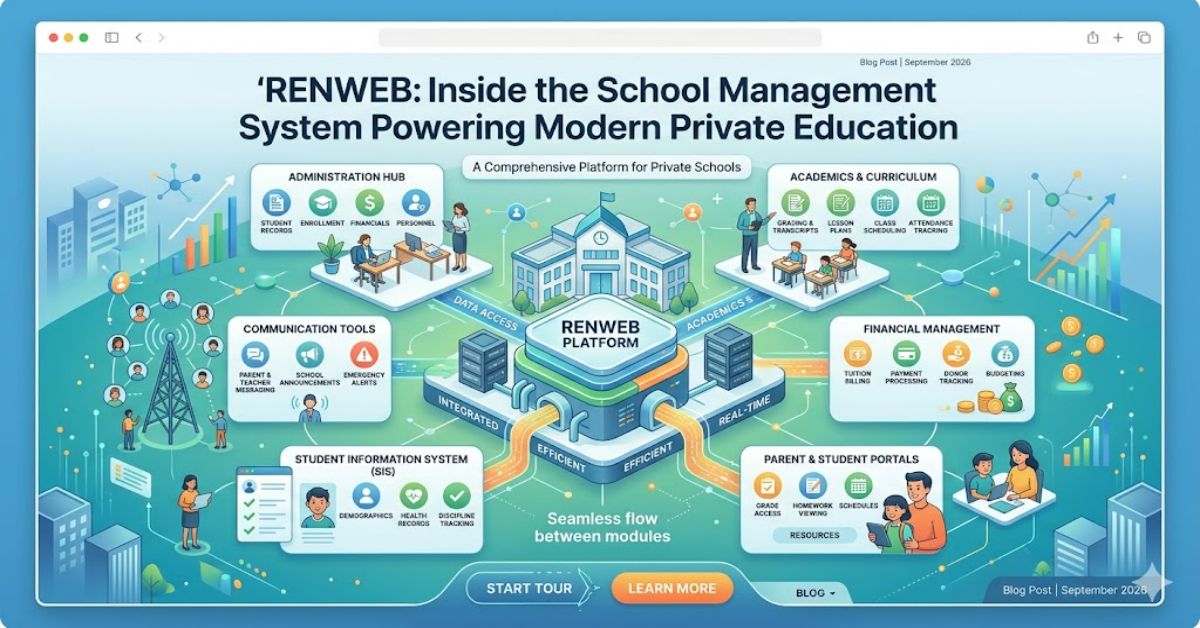
RenWeb is a school management system now widely recognised under its updated name, FACTS SIS, used by thousands of private and independent schools to manage academic and administrative operations. It plays a central role in connecting teachers, parents, students, and administrators through a secure digital environment.
Within the first 100 words, the core function is clear: RenWeb is not just a database but a full operational system for education management. Schools use it to handle attendance records, gradebooks, scheduling, tuition payments, and communication workflows. The system effectively reduces fragmentation by replacing paper-based processes and disconnected software tools with a unified platform.
Understanding RenWeb requires more than a surface-level description. It sits at the intersection of educational administration and SaaS infrastructure, where data accuracy, privacy compliance, and user accessibility must coexist. Schools adopting RenWeb are not simply buying software—they are restructuring how information flows through their institution.
The keyword renweb in this context represents both legacy branding and the current FACTS SIS ecosystem, which continues to evolve as private education becomes more digitised and data-driven.
The Evolution from RenWeb to FACTS SIS
RenWeb originated as a standalone school management system before being integrated into the broader FACTS Management ecosystem. The rebranding to FACTS SIS reflected consolidation in the private education software market, where fragmented tools were merged into unified suites.
Systems Integration Shift
Modern deployments of RenWeb now operate within a broader ecosystem that includes:
- Tuition payment processing
- Learning management tools
- Financial aid management systems
- Parent communication portals
This integration reduced duplication of data entry and improved cross-department consistency.
Institutional Impact
Schools that transitioned from legacy RenWeb installations to FACTS SIS reported fewer administrative silos, particularly in admissions and billing workflows. However, migration complexity remains a key operational challenge, especially for institutions with legacy data structures.
How RenWeb Works as a School Operating System
At its core, RenWeb functions as a centralised education ERP (Enterprise Resource Planning) system tailored for K–12 private schools.
Core Functional Modules
| Module | Function | Primary Users |
| Gradebook | Tracks assignments and performance | Teachers, students |
| Attendance | Records daily presence data | Administrators |
| Tuition Management | Handles billing and payments | Finance office, parents |
| Communication | Messaging between stakeholders | All users |
| Scheduling | Manages timetables and classes | School administrators |
The system is built around role-based access control, ensuring each user type only sees relevant data.
Data Flow and System Logic
RenWeb operates on a centralised database architecture. Updates in one module—such as attendance—automatically propagate to reporting dashboards and parent portals.
This reduces manual reconciliation errors but introduces dependency on real-time data accuracy. A single incorrect entry can cascade across multiple reports.
Strategic Role in Private Education Infrastructure
Private schools increasingly rely on systems like RenWeb to maintain operational efficiency and compliance.
Administrative Efficiency
Before systems like RenWeb, schools often used separate tools for grading, billing, and communication. This fragmentation created inefficiencies and inconsistent reporting.
RenWeb centralises:
- Student academic records
- Financial transactions
- Behaviour tracking
- Parent engagement logs
Cultural Shift in Education Management
The adoption of RenWeb signals a broader cultural shift: education is increasingly data-driven. Parents now expect real-time visibility into student performance, while administrators rely on analytics for decision-making.
Risks, Trade-offs, and System Limitations
Despite its strengths, RenWeb introduces several operational constraints.
1. Data Migration Complexity
Migrating from legacy systems can result in:
- Incomplete historical records
- Formatting inconsistencies
- Training gaps for staff
2. System Dependency Risk
Schools become heavily dependent on a single vendor ecosystem. If downtime occurs, core operations like attendance tracking and grading may be disrupted.
3. User Experience Variability
Teacher and parent experiences differ significantly depending on:
- Device compatibility
- Internet connectivity
- Interface familiarity
Market Position and Competitive Landscape
renweb-school-management-system-facts-sis within a competitive education SaaS market alongside systems such as FACTS SIS, PowerSchool, and Blackbaud.
| Platform | Primary Focus | Strength |
| RenWeb (FACTS SIS) | Private school SIS | Tuition + academics integration |
| PowerSchool | Large district systems | Scalability |
| Blackbaud | Fundraising + SIS | Non-profit ecosystem integration |
RenWeb’s competitive advantage lies in its tight integration between tuition management and academic tracking, a combination not always central in competing platforms.
Original Insights: Structural Gaps in RenWeb Deployments
Insight 1: Hidden Administrative Load Shift
Schools adopting RenWeb often underestimate the internal workload shift. While automation reduces manual paperwork, it increases reliance on data governance discipline. Without structured input protocols, data inconsistency increases rather than decreases.
Insight 2: Tuition Workflow Lock-In Effect
Once tuition systems are fully integrated, switching vendors becomes significantly harder due to embedded financial workflows. This creates long-term vendor lock-in beyond typical SaaS switching costs.
Insight 3: Parental Engagement Saturation
In high-usage schools, parents report notification fatigue due to overlapping alerts (attendance, grades, billing). This leads to selective disengagement from non-critical updates, reducing communication effectiveness.
Key Data Overview
| Area | Operational Impact | Risk Level |
| Attendance automation | High efficiency gain | Medium |
| Tuition integration | Financial accuracy improvement | High lock-in risk |
| Communication tools | Strong engagement potential | Medium fatigue risk |
The Future of RenWeb in 2027
By 2027, school management systems like RenWeb are expected to evolve toward AI-assisted administrative layers. According to trends observed in education technology reports from UNESCO and OECD, institutions are prioritising predictive analytics for student performance tracking.
Key developments likely include:
- AI-assisted grading support tools
- Predictive attendance intervention systems
- Deeper integration with learning analytics dashboards
- Stronger regulatory oversight on student data privacy
However, infrastructure limitations in smaller private schools may slow adoption. Data governance requirements under evolving privacy frameworks such as GDPR-style educational extensions in global regions will also shape deployment strategies.
Takeaways
- RenWeb is evolving from a traditional SIS into a broader education operations platform
- Its greatest strength is consolidation, but this also creates dependency risk
- Tuition integration is both a feature and a long-term lock-in mechanism
- Data quality governance determines system effectiveness more than features
- Parent engagement can degrade if notification systems are not calibrated
- The market is shifting toward AI-enhanced school administration tools
Conclusion
RenWeb, now operating under FACTS SIS, has become a foundational system in private education administration. It reduces operational fragmentation by centralising academic, financial, and communication workflows into a single platform. However, its effectiveness depends heavily on disciplined data management and institutional readiness.
The system’s evolution reflects a broader shift in education technology: schools are no longer just users of software but participants in integrated digital ecosystems. While RenWeb improves efficiency, it also introduces new dependencies and governance responsibilities.
As private education continues to digitise, systems like RenWeb will likely expand in scope, incorporating more predictive and automated features. The balance between efficiency and control will define its long-term value to institutions.
FAQ
What is RenWeb used for in schools?
RenWeb is used to manage academics, attendance, grading, tuition billing, and communication between parents, teachers, and administrators in private schools.
Is RenWeb the same as FACTS SIS?
Yes. RenWeb was rebranded and integrated into FACTS SIS, which now serves as its modern version within a broader education management ecosystem.
Can parents access RenWeb?
Yes. Parents use secure login portals to view grades, attendance records, tuition payments, and school communications.
How secure is RenWeb for student data?
RenWeb uses role-based access controls and encrypted systems, but security also depends on school-level configuration and user practices.
What are the limitations of renweb-school-management-system-facts-sis?
Common limitations include data migration complexity, dependency on system uptime, and inconsistent user experience across devices.
Do schools rely entirely on RenWeb?
Most schools still integrate additional tools, but many core administrative processes are centralised within renweb-school-management-system-facts-sis.
References
OECD. (2023). Education at a Glance 2023: OECD Indicators. OECD Publishing.
UNESCO. (2022). Global Education Monitoring Report: Non-State Actors in Education. UNESCO Publishing.
FACTS Management. (2024). FACTS SIS Product Overview Documentation. FACTS Management Company.