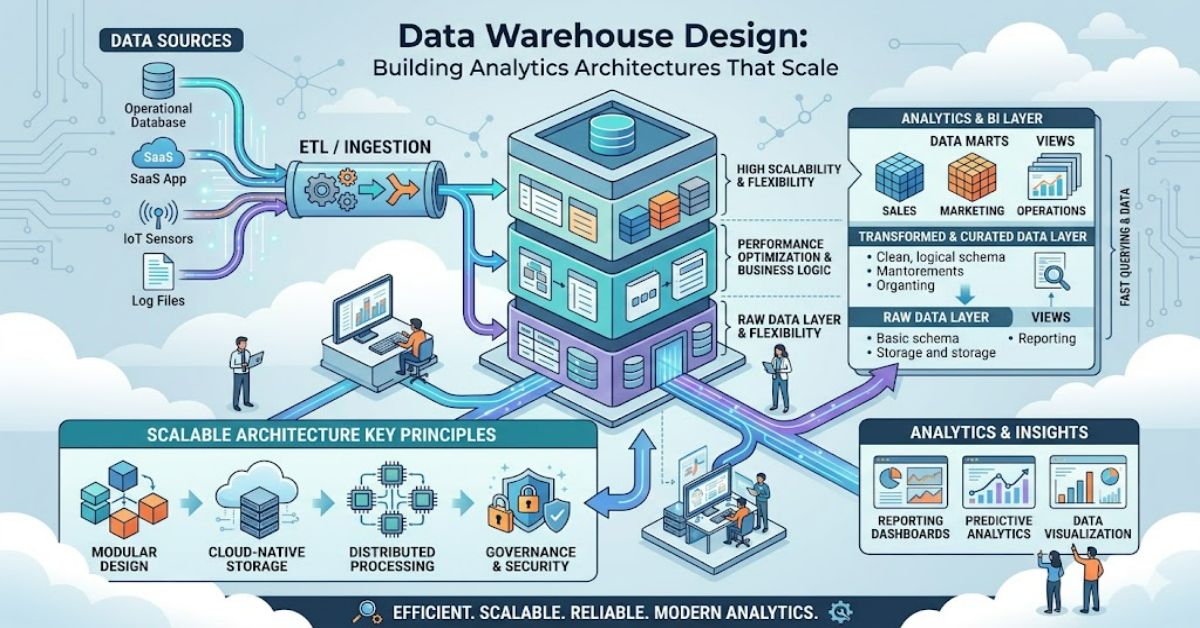
Modern organisations generate data from CRMs, ERP systems, websites, mobile applications, IoT devices, and third-party platforms. Data warehouse design is the process of building an architecture that stores, cleans, and organises this information for analytics. It involves extracting data from multiple sources, transforming it into a consistent format, and structuring it into fact and dimension tables so analysts can run reports and answer business questions efficiently.
The challenge is not collecting information. Most companies already possess enormous quantities of data. The real difficulty is creating a reliable analytical environment where finance, operations, marketing, and leadership teams work from the same version of the truth.
A well-designed warehouse supports reporting, business intelligence, forecasting, compliance, and increasingly, artificial intelligence applications. Poorly designed environments often lead to inconsistent metrics, slow dashboards, duplicated data pipelines, and escalating infrastructure costs.
Since the rise of cloud-native platforms such as Snowflake, Google BigQuery, Amazon Redshift, and Microsoft Fabric, warehouse architecture has evolved significantly. Yet the core principles remain unchanged: clear modelling, governed data quality, and scalable architecture.
This guide examines how modern warehouse architectures are designed, the trade-offs involved, common implementation mistakes, and what organisations should expect as the sector moves towards 2027.
What Is Data Warehouse Design?
At its core, a warehouse acts as a central repository for analytical data.
Operational systems are designed for transactions. Analytics systems are designed for questions.
For example:
| Operational System | Warehouse Purpose |
| Process customer orders | Analyse sales trends |
| Record inventory changes | Forecast stock requirements |
| Store employee records | Evaluate workforce performance |
| Manage invoices | Assess profitability |
The design process typically includes:
- Data source identification
- Data extraction
- Transformation and cleansing
- Data modelling
- Storage architecture
- Governance and security
- Reporting integration
The result is a platform that supports decision-making across the organisation.
The Foundation: Fact and Dimension Tables
One of the most important concepts in data warehouse design is dimensional modelling.
According to Microsoft’s guidance on analytical modelling, a star schema consists of fact tables containing measurable events and dimension tables that provide descriptive business context. This approach remains the preferred structure for analytical workloads because it simplifies querying and improves performance.
Fact Tables
Fact tables contain measurable business events.
Examples include:
- Sales transactions
- Website visits
- Inventory movements
- Financial postings
- Customer support interactions
Typical measures include:
- Revenue
- Quantity sold
- Cost
- Profit
- Duration
Dimension Tables
Dimension tables describe the business context surrounding those events.
Examples include:
- Customer
- Product
- Store
- Date
- Geography
Together they form a structure that allows analysts to ask questions such as:
- Which products generated the highest revenue?
- Which regions grew fastest?
- Which customer segments are most profitable?
Star Schema vs Snowflake Schema
Choosing a modelling approach is one of the earliest architectural decisions.
Comparison Table
| Feature | Star Schema | Snowflake Schema |
| Query performance | Fast | Moderate |
| Complexity | Lower | Higher |
| Storage efficiency | Lower | Higher |
| Ease of reporting | Excellent | Moderate |
| Maintenance | Simpler | More complex |
| Analyst usability | High | Medium |
Industry guidance continues to favour star-schema modelling because analytical queries require fewer joins and are easier for reporting tools to optimise.
For most organisations, star schemas remain the practical choice.
The Modern Warehouse Architecture Stack
A modern warehouse is more than a database.
Typical architecture includes:
Data Sources
- ERP platforms
- CRM systems
- SaaS applications
- APIs
- Event streams
- IoT devices
Ingestion Layer
Data is collected through:
- Batch ETL processes
- ELT pipelines
- Real-time streaming
Transformation Layer
Raw data is cleaned and standardised.
Activities include:
- Deduplication
- Standardisation
- Data quality validation
- Business rule application
Storage Layer
This is where analytical datasets are stored.
Popular platforms include:
- Snowflake
- BigQuery
- Redshift
- Microsoft Fabric
- Databricks
Consumption Layer
Users access data through:
- Power BI
- Tableau
- Looker
- Custom dashboards
- AI applications
Practical Design Process
A structured design process reduces project risk significantly.
Step 1: Define Business Objectives
Start with decisions, not datasets.
Questions might include:
- What drives customer churn?
- Which products generate the highest margins?
- Where are operational bottlenecks occurring?
Step 2: Identify Data Sources
Document:
- Source ownership
- Refresh frequency
- Data quality issues
- Security requirements
Step 3: Define Grain
A warehouse succeeds or fails on granularity decisions.
For example:
- One row per order?
- One row per order line?
- One row per customer per month?
Experts consistently identify grain definition as one of the most critical modelling decisions because it determines every downstream relationship and aggregation rule.
Step 4: Build Dimensions
Develop conformed dimensions shared across multiple subject areas.
Examples:
- Date
- Customer
- Product
- Location
Step 5: Build Facts
Create measurable event tables aligned to business processes.
Step 6: Establish Governance
Implement:
- Data ownership
- Quality monitoring
- Access controls
- Retention policies
Common Mistakes Organisations Make
Real-world implementation often reveals recurring problems.
Mixing Multiple Levels of Detail
Combining daily summaries with transaction-level records creates analytical confusion and inaccurate calculations.
Ignoring Historical Changes
Customer territories, products, and organisational structures change over time.
Without Slowly Changing Dimensions (SCDs), historical reporting becomes unreliable.
Over-Normalisation
Many teams attempt to replicate operational database structures.
Analytical workloads benefit from denormalisation and simpler relationships.
Weak Governance
Even technically excellent architectures fail when ownership is unclear.
Data quality becomes everyone’s responsibility—and therefore nobody’s responsibility.
Practitioners regularly report that unclear grain, excessive relationships, and poorly governed dimensions are among the most common causes of reporting problems.
Data Warehouse Design and AI Readiness
One emerging trend receives less attention than it deserves.
Many organisations view AI adoption as a separate initiative from warehouse strategy.
That separation is becoming increasingly difficult to justify.
Modern AI systems require:
- Governed data
- Consistent definitions
- Historical records
- Trusted metadata
Recent enterprise partnerships between cloud data providers and AI vendors highlight how closely analytical platforms and AI infrastructure are becoming connected.
Original Insight #1
Many AI projects fail not because of model quality but because source data lacks consistency. Warehouse governance increasingly determines AI success rates.
Original Insight #2
The cost of poorly designed dimensions rises sharply when organisations deploy AI assistants that rely on semantic understanding of business entities.
Original Insight #3
Warehouse architecture is shifting from a reporting asset to a business knowledge asset. The distinction matters because governance requirements become substantially stricter.
Risks and Trade-Offs
No architectural decision is free of compromise.
Cost
Cloud warehouses reduce infrastructure management but can create unpredictable consumption costs.
Vendor Dependence
Migration between warehouse platforms remains expensive.
Complexity
Adding real-time pipelines, machine learning integrations, and governance tooling increases operational overhead.
Compliance
Data residency and sovereignty requirements continue expanding globally.
Recent industry analysis suggests organisations are placing greater emphasis on governance, localisation, and sovereign cloud strategies as regulatory scrutiny increases.
Market Impact and Industry Direction
The market continues moving towards cloud-native deployment.
Data and Industry Trends
| Trend | Impact on Warehouse Design |
| Cloud adoption | Increased scalability |
| AI integration | Greater governance requirements |
| Real-time analytics | More streaming architectures |
| Regulatory scrutiny | Stronger security controls |
| Self-service BI | Simpler modelling requirements |
Industry research indicates public-cloud warehouse services account for the majority of new deployments because of elasticity, reduced infrastructure overhead, and integration with analytics and AI tooling.
The Future of Data Warehouse Design in 2027
Several trends appear likely to shape the next phase of warehouse evolution.
Greater Convergence with AI Platforms
Warehouses will increasingly function as trusted data foundations for generative AI systems.
More Hybrid Architectures
Many organisations will combine cloud and on-premise environments to meet governance and sovereignty requirements.
Semantic Layers Become Strategic
Business definitions will become centrally managed assets rather than dashboard-specific logic.
Governance Automation
Metadata management, lineage tracking, and quality monitoring will become increasingly automated.
Data Architecture Consolidation
Research into modern data architectures suggests organisations are evaluating warehouse, lakehouse, fabric, and mesh approaches more systematically rather than adopting new paradigms solely because they are fashionable.
Not every prediction will materialise. Economic conditions, regulation, and infrastructure costs will influence adoption rates significantly.
Key Takeaways
- Business requirements should drive architecture decisions.
- Dimensional modelling remains highly relevant despite new architectural trends.
- Governance is now as important as performance.
- AI readiness increasingly depends on warehouse quality.
- Grain definition is one of the most consequential design decisions.
- Cloud warehouses simplify operations but introduce new cost-management challenges.
- Hybrid and governed architectures are likely to become more common by 2027.
Conclusion
Data warehouse design remains one of the most important disciplines in modern analytics. While technology platforms continue to evolve, successful implementations still depend on clear business objectives, robust data modelling, strong governance, and practical architectural choices.
The most effective warehouses are not necessarily the largest or most technically sophisticated. They are the environments that deliver trusted information quickly, consistently, and at scale. Organisations that prioritise data quality, dimensional modelling, and governance establish a stronger foundation for reporting, forecasting, regulatory compliance, and AI initiatives.
As businesses move towards increasingly data-driven operations, warehouse architecture is becoming a strategic capability rather than a purely technical asset. The organisations that recognise this shift early will be better positioned to adapt to future analytical and operational demands.
FAQ
What is data warehouse design?
Data warehouse design is the process of creating an architecture that collects, cleans, organises, and stores data from multiple systems so it can be analysed efficiently for reporting and decision-making.
Why are fact and dimension tables important?
Fact tables store measurable events, while dimension tables provide business context. Together they create analytical structures that support fast reporting and intuitive querying.
What is the difference between ETL and ELT?
ETL transforms data before loading it into the warehouse. ELT loads data first and performs transformations inside the warehouse environment.
Is a star schema still relevant in 2026?
Yes. Star schemas remain widely recommended because they improve query performance, simplify reporting, and align closely with analytical business questions.
How does data warehouse design support AI projects?
AI systems require consistent, governed, and trustworthy data. A well-designed warehouse provides structured information that improves model reliability and governance.
What are Slowly Changing Dimensions?
Slowly Changing Dimensions track historical changes to business entities such as customers, products, or organisational structures, preserving analytical accuracy over time.
Should organisations choose a warehouse, lakehouse, or data fabric?
The answer depends on governance requirements, workload types, skill availability, and existing infrastructure. Many organisations now operate hybrid architectures combining multiple approaches.
Methodology
This analysis was developed using publicly available documentation, industry guidance, market research, practitioner discussions, and vendor technical documentation. Particular attention was given to dimensional modelling practices, cloud warehouse architecture, governance trends, and enterprise AI integration.
Sources were cross-referenced where possible to reduce reliance on vendor-specific viewpoints. Industry discussion forums were used only to identify recurring implementation challenges and not as sole evidence for technical recommendations.
Limitations include the rapid pace of platform development and varying implementation practices across organisations. Readers should validate architectural decisions against their own regulatory, operational, and commercial requirements.
Editorial Disclosure: This article was drafted with AI assistance and reviewed and verified by the editorial team at RubbleMagazine.co.uk. All data, citations, and claims should be independently confirmed before publication.
References
Microsoft. (2025). Dimensional modeling in Fabric Data Warehouse. Microsoft Learn.
Microsoft. (2025). Understand star schema and the importance for Power BI. Microsoft Learn.
Grand View Research. (2025). Data Warehouse as a Service Market Report.
Reuters. (27 May 2026). Snowflake boosts forecast, signs $6 billion AWS deal as enterprise AI adoption grows.
ITPro. (2026). Snowflake and Anthropic deepen AI partnership.
Hoseini, S., Quix, C., & Decker, S. (2026). Data Architectures and their Technical Requirements (DATER). arXiv.
Khan, F. A. (2026). Dimensional Modeling: A Guide for Practitioners.
Snowflake. (2026). What Is a Star Schema? A Complete Guide for Data Modeling.