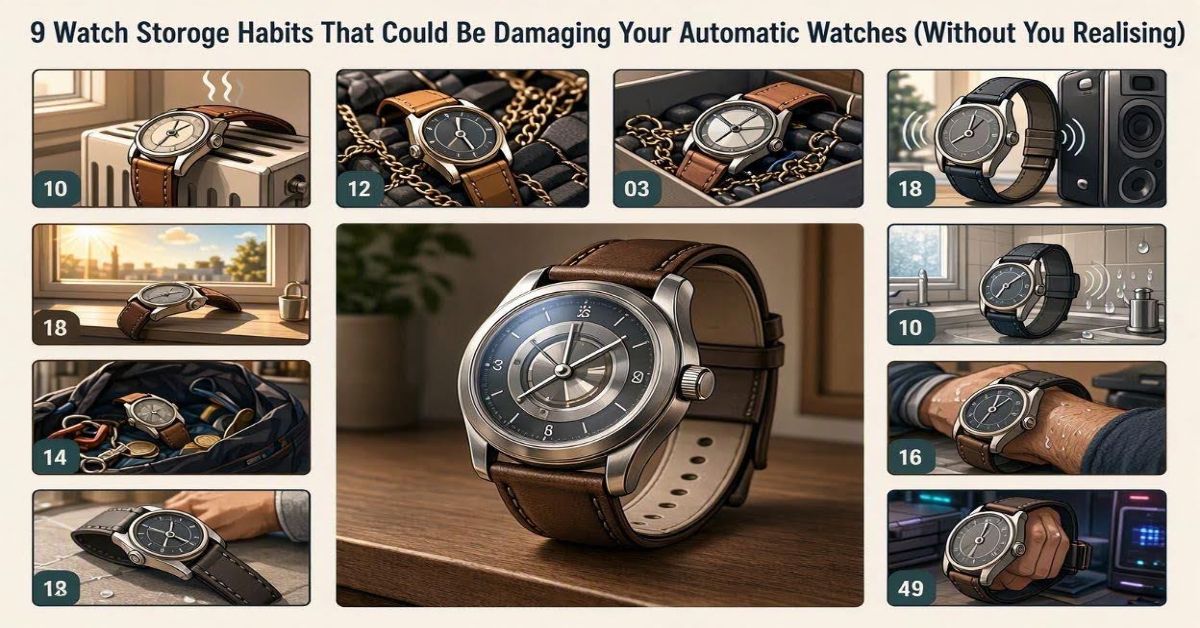
Most watch owners think about protecting their timepieces the moment they buy them, then forget about storage entirely once the watch is home. That gap is where the damage happens. A scratched crystal is obvious. A dried-out gasket, a demagnetised movement, or a mainspring that’s lost its elasticity from months of neglect is not — and by the time you notice, the repair bill is already on its way.
Automatic watches are especially vulnerable because they rely on motion to stay accurate. Leave one sitting still in a drawer for a few weeks and it stops. Store it badly for a few years and you’re looking at a full service. This guide walks through the storage habits that quietly wear down watches, and what to do instead.
1. Leaving Watches Loose in a Drawer
A watch tossed into a drawer with keys, coins, or other jewellery picks up scratches within weeks. Metal-on-metal contact is one of the most common (and most preventable) causes of case and crystal damage.
The fix is simple: give each watch its own compartment. A drawer isn’t storage — it’s just a place things go missing or get scuffed. If you want something you can click here to browse, Aevitas stocks storage solutions built specifically to stop this kind of everyday wear.
2. Ignoring Humidity Levels
Moisture is one of the biggest threats to a mechanical movement. Excess humidity causes internal condensation, which leads to rust on steel components and corrosion on the tiny gears that keep the watch running. Too little humidity, on the other hand, dries out leather straps and gaskets, making them brittle and prone to cracking.
Most horology experts recommend keeping relative humidity somewhere between 40% and 55%. Longines’ guide to watch storage conditions is a useful reference if you want to get more precise about the numbers for your climate. A watch box with a tight seal, kept away from bathrooms and kitchens, does most of the work here.
3. Storing Watches in Direct Sunlight
It’s tempting to display a watch collection somewhere it can be seen — a windowsill, a shelf near a lamp, a display case by a bright window. Unfortunately, UV exposure fades dials, discolours leather straps, and can even warp certain plastics and lacquered finishes over time.
Display your watches somewhere you enjoy looking at them, just not somewhere the sun reaches directly for hours at a stretch. A closed cabinet or a lined box near — but not in — natural light gives you the best of both.
4. Keeping Watches Near Magnets
Modern life is full of magnets: phone cases, laptop speakers, kitchen appliances, even some handbag clasps. Mechanical movements are sensitive to magnetic fields, and prolonged exposure can throw off a watch’s accuracy by minutes a day. In some cases, a magnetised hairspring needs a technician to demagnetise it properly.
Keep your watch storage away from speakers, chargers, and anything with a strong magnetic clasp. If a watch suddenly starts running fast or slow for no obvious reason, magnetism is one of the first things worth ruling out.
5. Using the Wrong Kind of Box
Not all watch boxes are built the same way, and the cheap foam-lined versions sold as generic gift items rarely do much to protect a serious collection. Wood, in particular, plays a genuine functional role here. A well-made wooden box regulates humidity more naturally than plastic, doesn’t transfer static, and cushions the watch against knocks far better than a flimsy case.
If you’re building or upgrading a collection, it’s worth looking at something purpose-made rather than whatever box the watch happened to arrive in. Aevitas UK’s Wooden Watch Boxes range covers everything from single-watch cases to larger multi-compartment collector’s boxes, so you’re not stuck compromising on space or protection.
6. Letting Automatic Watches Sit Completely Still
This is the mistake most specific to automatic and self-winding watches. Their movement relies on the natural motion of your wrist to keep the mainspring wound. Leave one in a drawer for a few weeks, untouched, and it will stop — not because anything is broken, but because nothing has kept it powered.
That’s not a disaster on its own, but repeatedly letting a watch run down and restarting it from scratch adds unnecessary wear over the years, and constantly resetting the time and date on a complicated watch is genuinely annoying. If you rotate between several automatics and don’t wear each one often enough to keep it running, a watch winder solves this properly. You can browse Aevitas Top 7 Best Watch Winders to see which models suit different movement types and collection sizes.
7. Choosing the Wrong Winder Settings
Buying a winder is only half the job — using the wrong settings can do more harm than leaving the watch stationary. Every automatic movement has a recommended turns-per-day (TPD) figure and a preferred winding direction (clockwise, counter-clockwise, or bidirectional), and running a winder outside those specifications puts unnecessary strain on the rotor and mainspring.
Before setting up a winder, check your watch’s TPD and direction requirements, usually available from the manufacturer or in the original documentation. Getting this right is what makes a winder genuinely useful rather than just another gadget on the shelf.
8. Overpacking a Single Storage Space
A watch box packed tightly with pieces jammed against each other might look organised, but it invites scratches every time you open the lid and shift things around to get to the one you want. Crowns catch on neighbouring cases, bracelets tangle, and softer metals like gold pick up marks from harder steel pieces sitting right next to them.
Give each watch enough room to sit without touching its neighbours. If your collection has outgrown its current box, that’s usually a sign to size up rather than squeeze in one more piece.
9. Forgetting About Straps and Bracelets
Storage advice tends to focus on the case and movement, but straps need attention too. Leather dries out and cracks if it’s kept somewhere too dry or too warm, and metal bracelets can tarnish if they’re stored somewhere damp without proper airflow. Wipe down leather straps occasionally with a suitable conditioner, and give metal bracelets a light clean before long-term storage rather than putting them away with skin oils and dust still on the links.
Final Thoughts
None of these habits cause damage overnight, which is exactly why they’re so easy to overlook. A watch that’s stored carelessly for a few weeks looks fine. Do it for a few years, and the wear shows up as scratches, a fogged crystal, a sluggish movement, or a service bill that could have been avoided. Good storage isn’t complicated or expensive — it just needs to be consistent. A proper box, sensible humidity control, and a winder for the automatics you don’t wear daily will do more for your collection’s long-term condition than almost anything else you can buy.
FAQs
How often should I wind an automatic watch that’s not in a winder?
If you’re not wearing it, give it a full manual wind every few days to keep the mainspring lubricated and the movement running, then reset the time when you next wear it.
Is a watch winder actually necessary, or just a nice extra?
It depends on your collection. If you own one or two automatics you wear regularly, you can manage without one. If you rotate between several pieces, especially ones with the date or moonphase complications that are tedious to reset, a winder saves real time and reduces unnecessary wear.
What’s the ideal humidity level for storing watches?
Most guidance points to somewhere between 40% and 55% relative humidity. Outside that range, you risk either internal condensation and corrosion or dried-out straps and seals.
Can storing a watch near a phone or speaker actually damage it?
Yes. Mechanical movements are sensitive to magnetic fields, and regular close contact with magnets can affect timekeeping accuracy or, in more serious cases, require professional demagnetising.
Do I need a wooden watch box, or will any case do?
Any enclosed case offers some protection, but wood specifically helps regulate humidity and cushions the watch better than plastic or foam. For anything beyond a single everyday piece, it’s worth the upgrade.