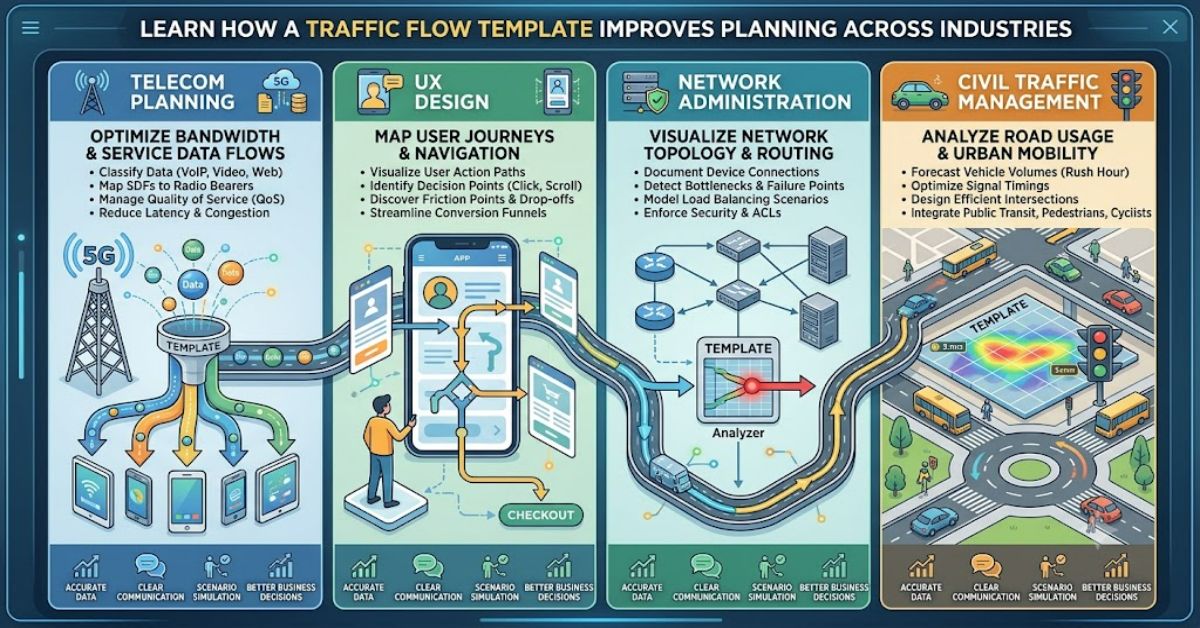
A traffic flow template is a structured framework used to visualise, document, and optimise the movement of traffic within a system. Depending on the industry, “traffic” may refer to mobile network data, website visitors, computer network packets, or vehicles on roads. The concept remains the same: organise traffic movement into an easy-to-understand format that supports planning, monitoring, and optimisation.
From telecom engineers designing 5G LTE networks to UX designers analysing website user journeys, network administrators monitoring data packets, and city planners managing road congestion, traffic flow templates simplify complex systems into clear visual models. By using standardised diagrams, tables, and workflows, organisations can improve efficiency, reduce errors, and make better operational decisions.
What Is a Traffic Flow Template?
A traffic flow template is a predefined layout that maps how traffic moves through a system. Rather than creating diagrams from scratch for every project, professionals use templates to maintain consistency and simplify analysis.
A typical template identifies:
- Traffic source
- Movement path
- Decision points
- Destination
- Performance metrics
- Potential bottlenecks
These templates can be simple flowcharts or detailed engineering diagrams depending on the project’s complexity.
Traffic Flow Templates in Telecom (4G/5G LTE)
Telecommunications engineers use traffic flow templates to visualise how voice and data travel across mobile networks.
Typical components include:
| Component | Purpose |
| User Equipment (UE) | Mobile device initiating communication |
| Radio Access Network (RAN) | Connects devices to the network |
| Core Network | Routes and manages traffic |
| Internet Gateway | Connects users to external services |
| Network Functions | Authentication, billing, and security |
These templates help engineers optimise latency, capacity, and overall network performance.
Website and UX Design Applications
UX designers use traffic flow templates to understand how visitors navigate a website or application.
Typical user flow includes:
- Landing page
- Product page
- Shopping cart
- Checkout
- Confirmation page
By identifying where users abandon their journey, designers can improve navigation, simplify interfaces, and increase conversion rates.
Network Administration
In IT environments, administrators use traffic flow templates to monitor how data packets move between devices.
A network traffic template may include:
| Network Element | Function |
| Client Device | Sends requests |
| Firewall | Filters traffic |
| Router | Directs packets |
| Switch | Connects devices |
| Server | Processes requests |
These diagrams assist with troubleshooting, security analysis, and capacity planning.
Civil Traffic Management
Transportation engineers rely on traffic flow templates to manage vehicle movement through road networks.
Common applications include:
- Junction design
- Roundabout planning
- Signal timing
- Highway traffic analysis
- Emergency evacuation planning
Traffic flow diagrams allow planners to identify congestion points and develop safer, more efficient road systems.
Benefits of Using a Traffic Flow Template
Organisations benefit from standardised templates in several ways.
Key advantages include:
- Improved planning consistency
- Faster problem identification
- Better communication between teams
- Simplified documentation
- Reduced operational errors
- More efficient resource allocation
- Easier training for new staff
Because everyone works from the same framework, projects become easier to manage and maintain.
Choosing the Right Template
The best traffic flow template depends on the industry and project objectives.
Consider:
- System complexity
- Required level of detail
- Audience
- Available software tools
- Compliance requirements
- Reporting needs
A telecom network diagram differs significantly from a website user journey, even though both represent traffic movement.
Common Challenges
Although traffic flow templates improve organisation, they also present challenges.
Common issues include:
- Outdated documentation
- Excessive complexity
- Missing decision points
- Poor collaboration between departments
- Failure to update templates after system changes
Regular reviews help keep templates accurate and useful.
The Future of Traffic Flow Templates in 2027
Traffic flow templates are expected to become increasingly dynamic through automation and artificial intelligence. Network monitoring platforms will generate real-time diagrams automatically, while UX analytics tools will continuously update customer journey maps based on live user behaviour.
Smart cities are also expected to integrate IoT sensors with traffic management platforms, enabling planners to visualise congestion and optimise traffic signals using real-time data. Across industries, intelligent templates will improve operational visibility and support faster decision-making.
Key Takeaways
- Traffic flow templates organise complex systems into clear visual models.
- Telecom, IT, UX, and civil engineering all use specialised versions.
- Standardised templates improve collaboration and efficiency.
- Accurate documentation supports troubleshooting and planning.
- Automation and AI will enhance future traffic flow modelling.
Conclusion
A traffic flow template is much more than a simple diagram. It provides a structured method for understanding how information, users, vehicles, or network traffic move through complex systems. Whether applied to 5G telecommunications, website design, enterprise networking, or road infrastructure, these templates improve communication, support better decision-making, and reduce operational risks.
As organisations become increasingly data-driven, well-designed traffic flow templates will remain valuable tools for analysing performance, identifying inefficiencies, and planning future improvements. Selecting the appropriate template and keeping it updated ensures that teams can respond quickly to changing requirements while maintaining reliable and efficient operations.
Frequently Asked Questions
What is a traffic flow template?
A traffic flow template is a structured diagram or framework used to map how traffic moves through a system.
Which industries use traffic flow templates?
Telecommunications, UX design, network administration, civil engineering, logistics, and transportation all use traffic flow templates.
Why are traffic flow templates important?
They improve planning, simplify documentation, identify bottlenecks, and support better operational decisions.
Can traffic flow templates be customised?
Yes. Templates are usually adapted to meet the specific requirements of each industry and project.
Will AI improve traffic flow templates?
Yes. Artificial intelligence is expected to automate template generation, analyse live data, and provide real-time optimisation recommendations.