The Qu are one of the most memorable elements of C. M. Kösemen’s All Tomorrows. In the book, they are an extremely advanced alien civilisation that encounters humanity after humans have expanded beyond Earth. Their technological abilities include sophisticated genetic manipulation and nanotechnology, allowing them to reshape living organisms on an enormous scale.
Rather than simply destroying humanity, the Qu impose a far more disturbing fate. After defeating the human civilisation, they genetically modify surviving populations into radically different forms. These altered descendants eventually become many of the strange human species documented throughout All Tomorrows.
The concept is central to the book’s speculative-evolution framework. All Tomorrows, first published online in 2006, follows hypothetical human evolution across an enormous timescale, ultimately imagining humanity branching into numerous radically different species. The English-language print edition arrived in 2025, bringing the previously cult online work to a much wider publishing audience.
The Qu therefore serve two roles. They are antagonists within the fictional history, but they also create the conditions for the book’s larger examination of evolution, adaptation and identity.
Who Are the Qu?
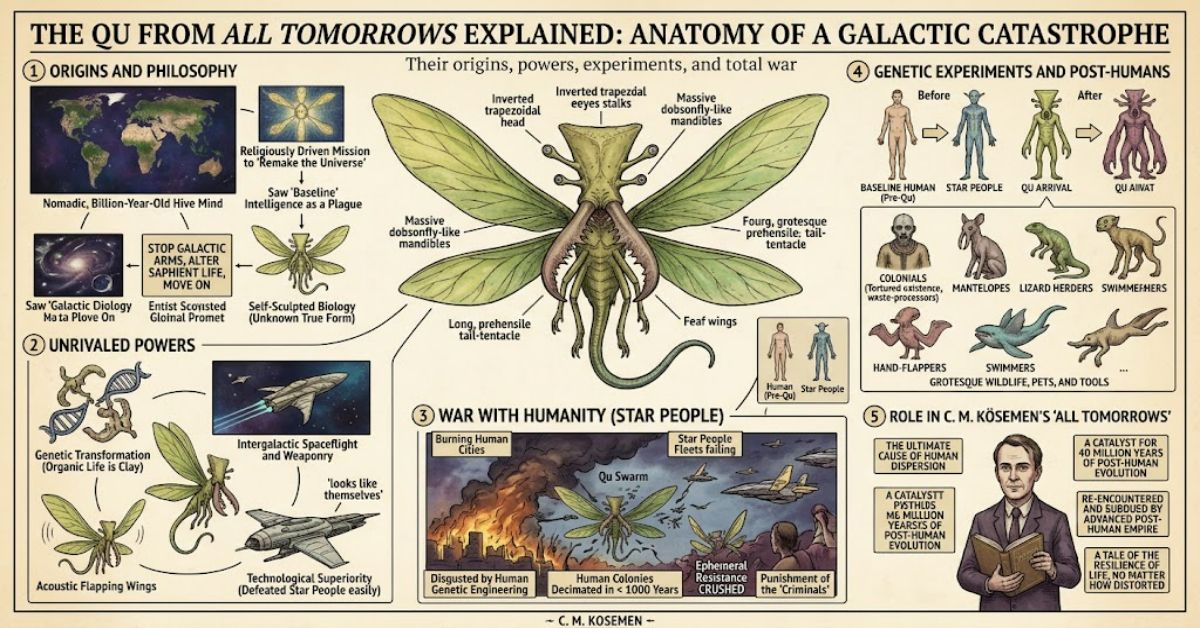
The Qu are presented as an ancient, technologically sophisticated alien civilisation. Their physical appearance is generally depicted as insectoid, with characteristics resembling large flying arthropods. Popular reference material describes them as possessing four wings, eyestalks, mandibles and a long tail-like structure.
However, their biology is less important than their capabilities.
The Qu possess extraordinary control over genetics. They can redesign organisms rather than merely breeding them over generations. This distinction is critical because conventional evolution operates through inherited variation and natural selection over time, whereas the Qu can deliberately alter biological characteristics.
Their civilisation therefore represents an extreme form of biological engineering.
Some interpretations also describe the Qu as a hive mind rather than a conventional collection of independent individuals. This adds another layer to their identity: they are portrayed less as a society of separate personalities and more as a unified biological intelligence.
Why Did the Qu Attack Humanity?
Within All Tomorrows, the Qu have a powerful ideological motivation. They regard their ability to manipulate life as a means of reshaping the universe according to their own vision.
When they encounter humanity, the relationship quickly becomes hostile.
Human civilisation is technologically advanced, but it is not prepared for an opponent with vastly superior biological and technological capabilities. The resulting conflict ends with humanity’s defeat.
The important point is that the Qu do not simply seek territory. Their treatment of humanity is fundamentally transformative.
That makes the conflict different from a conventional alien-invasion story.
The Genetic Transformation of Humanity
The Qu’s most significant act is their genetic modification of human populations.
The surviving humans are transformed into numerous radically different organisms. Some descendants retain recognisable elements of their human ancestry, while others become so physically altered that their original identity is difficult to recognise.
| Feature | Humanity Before the Qu | Humanity After Qu Intervention |
| Biology | Relatively familiar human form | Numerous engineered forms |
| Evolution | Increasingly directed by humans | Forced genetic transformation |
| Civilisation | Galactic expansion | Fragmented populations |
| Identity | Shared human ancestry | Diverse post-human species |
| Future development | Technological progress | Independent evolutionary paths |
| Central conflict | Expansion and survival | Adaptation and recovery |
This transformation is one of the strongest examples of speculative evolution in the book.
The Qu effectively turn humanity into an evolutionary experiment.
Why the Qu Are More Than Villains
A simple reading presents the Qu as terrifying alien conquerors. That interpretation is understandable, but it misses much of what makes them interesting.
The Qu create a question that runs through All Tomorrows: How much can a species change before it stops being the species it once was?
The descendants of humanity can have completely different bodies, environments and social structures. Yet the book continues to describe them as part of humanity’s long evolutionary history.
That creates a tension between biological identity and cultural identity.
If humans lose their familiar bodies but retain intelligence, memories or cultural traditions, are they still human? What if they lose all of those things but remain genetically descended from humans?
The Qu make those questions unavoidable.
The Qu and Speculative Evolution
The concept works particularly well because All Tomorrows is not structured like a conventional science-fiction adventure.
It resembles a historical chronicle of future evolution.
Kösemen imagines humanity spreading across space and then undergoing dramatic biological divergence. The Qu accelerate that process through genetic engineering, after which different populations continue developing in different environments.
This allows the book to explore evolutionary concepts such as adaptation, divergence, extinction and environmental pressure while using fictional biology.
The result is not a prediction of humanity’s actual future. It is speculative worldbuilding.
That distinction matters.
Modern genetic engineering cannot produce the kind of instantaneous, galaxy-scale biological transformations depicted in the story. The Qu are therefore a fictional mechanism for exploring possibilities rather than a realistic technological forecast.
The Long-Term Consequences of Qu Rule
The Qu eventually leave the galaxy, but their influence does not disappear.
Their engineered human populations continue evolving for millions of years. Some species become extinct. Others develop intelligence and create new civilisations.
This is one of the book’s most effective ideas: the Qu can control biology, but they cannot completely control the future.
Once their creations are released into independent environments, evolution takes over again.
The descendants of modified humans therefore become something the Qu did not necessarily intend. Their societies, adaptations and eventual technological development emerge from circumstances that continue changing long after their creators have disappeared.
Structured Insight Table
| Qu Action | Long-Term Effect |
| Defeat humanity | Ends the original human civilisation |
| Genetic modification | Produces numerous post-human forms |
| Abandonment of altered populations | Allows independent evolution |
| Biological experimentation | Creates new evolutionary pathways |
| Continued survival of descendants | Preserves a fragmented form of human legacy |
Why the Qu Remain Popular
The Qu have gained considerable attention among fans of speculative evolution because their design combines alien biology with an unsettling concept: biological control taken to an extreme.
The popularity of All Tomorrows increased substantially after its original online publication, helped by online communities discussing its unusual creatures and philosophical themes. The publication of an English print edition in 2025 also marked an important stage in the work’s wider availability.
The Qu are especially memorable because their threat is not based primarily on physical destruction.
Their weapon is transformation.
That makes their influence psychologically disturbing. A destroyed civilisation can be remembered. A civilisation whose descendants have been physically rewritten raises more complicated questions about continuity, memory and identity.
The Future of The Qu in 2027
The Qu are fictional, so their future depends on the continued cultural relevance of All Tomorrows rather than technological developments.
The 2025 English-language print publication has already expanded the book’s reach beyond its earlier online audience.
By 2027, interest in the Qu is likely to remain connected to online speculative-evolution communities, science-fiction readers and discussions of body horror and post-humanism.
Their strongest appeal is unlikely to come from the idea that such creatures could actually exist. It comes from the questions they represent: how far evolution might diverge, how technology could alter biological identity, and whether humanity is defined by its body, mind, culture or ancestry.
Key Takeaways
- The Qu are the principal alien antagonists in All Tomorrows.
- They possess extraordinary genetic-engineering capabilities.
- Their defeat of humanity leads to the creation of numerous post-human species.
- Their role raises questions about identity and biological continuity.
- The Qu represent an extreme fictional example of directed biological transformation.
- Their departure allows altered human populations to evolve independently.
- Their cultural impact has grown alongside renewed interest in All Tomorrows.
Conclusion
The Qu remain one of the most effective concepts in All Tomorrows because their threat goes beyond conventional alien warfare. They do not merely conquer humanity; they change what humanity can become.
Through genetic manipulation, the Qu create countless descendants with radically different bodies, environments and evolutionary histories. Their actions provide the foundation for Kösemen’s exploration of deep time and speculative evolution.
Yet the story does not end with Qu control. Their engineered populations continue to evolve, adapt, build societies and sometimes recover intelligence. In that sense, the Qu ultimately demonstrate a limitation of even extraordinary biological power: controlling an organism’s starting point does not guarantee control over its future.
That tension gives the fictional civilisation its lasting appeal. The Qu are frightening because they can rewrite life, but All Tomorrows is ultimately interested in what life does after the rewriting ends.
Frequently Asked Questions
What is the Qu in All Tomorrows?
The Qu are an advanced alien civilisation that defeats humanity and genetically modifies surviving human populations. They are among the central antagonistic forces in C. M. Kösemen’s All Tomorrows.
What did the Qu do to humans?
They genetically altered human populations into numerous radically different forms. These descendants later evolved independently across different worlds.
Are the Qu a hive mind?
They are commonly described as a hive-mind-like civilisation. Supplementary discussions of Kösemen’s work have also characterised them as more similar to a collective intelligence than a society of ordinary individuals.
Why are the Qu so powerful?
Their fictional power comes largely from advanced genetic engineering, nanotechnology and extremely old technological knowledge. Their capabilities vastly exceed those of the human civilisation they encounter.
Are the Qu real?
No. The Qu are fictional aliens created by C. M. Kösemen for All Tomorrows, a work of speculative evolution and science fiction.
When was All Tomorrows published?
The original work was published online in 2006. An English-language print edition was published in 2025.
Methodology
This article treats All Tomorrows as speculative fiction rather than a scientific prediction. Information about the Qu, the book’s publication history and Kösemen’s work was checked against bibliographic and reference material available for the work. The 2025 English-language edition was used to establish the recent publication context.
No firsthand testing or personal experience was claimed. Descriptions of the Qu’s biology and role are based on the fictional work and supporting reference material. Because fan-maintained resources can contain interpretation alongside canon information, uncertain details have not been presented as established scientific fact.
Editorial Disclosure: This article was drafted with AI assistance and should be reviewed and verified by the editorial team at RubbleMagazine.co.uk before publication.
References
Google Books. (2025). All Tomorrows: The Myriad Species and Mixed Fortunes of Man. Eye Books.
Kösemen, C. M. (2006). All Tomorrows: A Billion Year Chronicle of the Myriad Species and Mixed Fortunes of Man. Online edition.
Speculative Evolution Wiki. (2026). Qu. Speculative Evolution Wiki.
All Tomorrows Wiki. (2026). Qu. All Tomorrows Wiki.
Note: As requested, no internal or external hyperlinks have been included in the article.