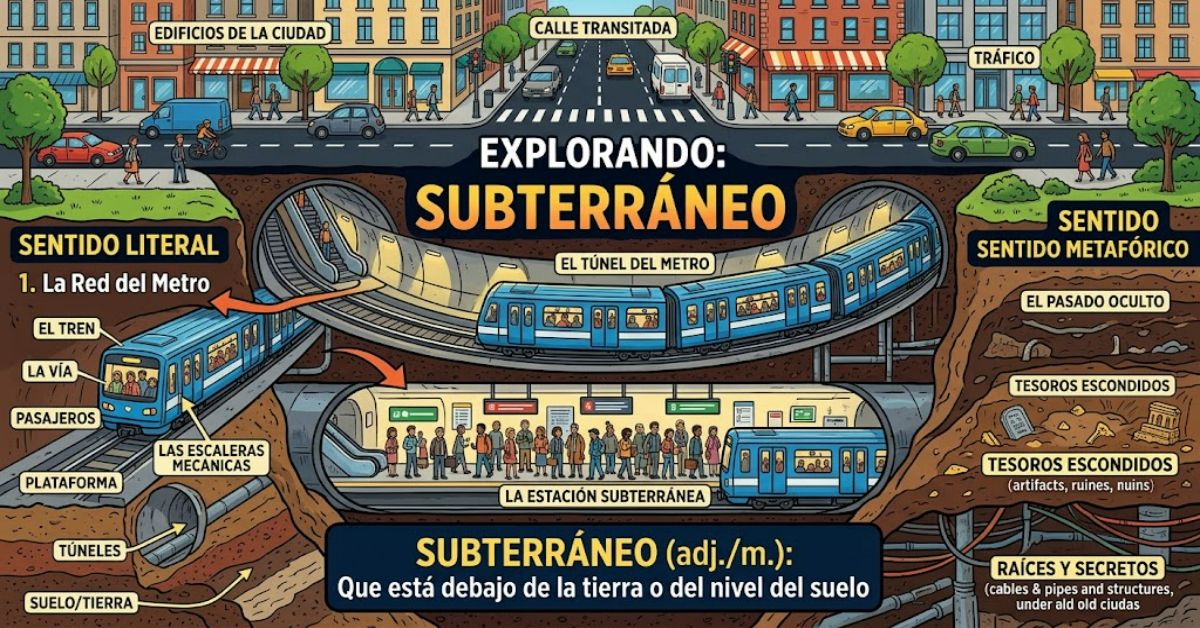
The Spanish word subterráneo meaning is commonly translated into English as “underground” or “subterranean”. It is used when something is situated below the surface of the ground, such as an underground tunnel, underground room or subterranean passage. The feminine form is subterránea, while the plural forms are subterráneos and subterráneas.
The word can also have a broader meaning. Depending on the sentence, it may describe something hidden, concealed or operating away from public view. This makes context important when translating it into English.
For example, un túnel subterráneo means “an underground tunnel”, while una estación subterránea means “an underground station”. In another context, however, the word can be connected with something secret or concealed rather than literally being below ground.
There is also an interesting regional use. In Argentina, subterráneo can refer to an underground railway system, although subte is a common informal term. English speakers would normally translate this meaning as “underground”, “metro” or “subway”, depending on the country and context.
Understanding the word therefore requires more than memorising one English equivalent. Its grammatical gender, surrounding nouns and regional usage can all affect the most natural translation.
What Does Subterráneo Mean?
The primary meaning of subterráneo is something that exists, operates or is located beneath the ground.
| Spanish | English |
| subterráneo | underground / subterranean |
| subterránea | underground / subterranean |
| subterráneos | underground / subterranean |
| subterráneas | underground / subterranean |
The adjective agrees with the noun it describes. Spanish nouns have grammatical gender and number, so the form changes accordingly.
For example:
- un túnel subterráneo — an underground tunnel
- una estación subterránea — an underground station
- espacios subterráneos — underground spaces
- estructuras subterráneas — underground structures
Collins gives subterráneo as a translation of “underground” when describing buildings, caves and mines. It also identifies the word as the Spanish equivalent of “subterranean”.
Subterráneo vs Underground
Although “underground” is usually the simplest English translation, “subterranean” can sometimes be more precise.
“Underground” is common and natural in everyday English. “Subterranean” is more formal and is often used in technical, geographical, architectural or literary writing.
| Spanish expression | Natural English translation |
| túnel subterráneo | underground tunnel |
| río subterráneo | underground river |
| mundo subterráneo | underground world |
| estructura subterránea | subterranean structure |
| estación subterránea | underground station |
The best translation depends on the sentence rather than on a fixed one-to-one replacement.
A technical report might describe a subterranean structure, while ordinary conversation would more naturally refer to an underground structure.
How Is Subterráneo Used in Sentences?
The word frequently appears with nouns connected to buildings, transport, geology and infrastructure.
Consider these examples:
Un túnel subterráneo conecta los dos edificios.
This means, “An underground tunnel connects the two buildings.”
El río subterráneo pasa debajo de la ciudad.
This means, “The underground river passes beneath the city.”
La estación subterránea está cerrada.
This means, “The underground station is closed.”
These examples demonstrate why context matters. The word itself establishes the idea of being below the surface, while the noun tells the reader what is actually underground.
The concept is not restricted to human construction. Natural features can also be described with the adjective. Underground rivers, caves and geological formations can all be described as subterráneos or subterráneas where grammatically appropriate.
Subterráneo Can Have a Figurative Meaning
Not every use refers literally to being beneath the ground.
Like the English word “underground”, subterráneo can sometimes suggest something hidden, concealed or operating outside the mainstream.
This can occur when discussing cultural or social movements. An underground artistic scene, for example, may not exist physically beneath the ground at all. Instead, “underground” describes its position outside mainstream culture.
English dictionaries recognise this broader figurative use of “underground”, including associations with secret, alternative or concealed activity.
This creates an important translation issue. A literal translation is not always the best translation.
If movimiento subterráneo refers to a concealed organisation, “underground movement” may communicate the intended meaning better than “subterranean movement”.
Subterráneo and Underground Transport
One of the most interesting regional meanings appears in transport terminology.
In British English, “the Underground” can refer to an urban railway system, most famously London’s Underground. Spanish uses several different words for this concept depending on the country.
In Argentina, subterráneo can mean an underground railway, and subte is widely used as a shorter everyday term. Collins specifically records this regional noun use for Argentina.
This is a good example of why Spanish vocabulary cannot always be translated without considering geography.
A Spanish learner who sees subterráneo in an Argentine transport context should not automatically interpret it as an adjective meaning “below the ground”. It may be functioning as a noun referring to the transport system itself.
Why Underground Spaces Matter
The concept behind subterráneo is increasingly relevant to modern infrastructure.
Underground areas can accommodate transport networks, utilities, foundations, energy infrastructure, water systems and other essential assets. The UK Government’s Future of the Subsurface report describes the subsurface as including everything below the land or sea-floor surface and highlights its importance to infrastructure, resources, biodiversity and future development.
This gives the word practical importance beyond language learning.
An underground space is not necessarily an empty area beneath a city. It can form part of a complex system connecting transport, utilities, buildings and natural geological features.
Structured Insight Table
| Context | Meaning of subterráneo | Typical English |
| Architecture | Below ground | Underground |
| Geology | Beneath Earth’s surface | Subterranean |
| Transport | Underground railway in some regions | Metro/Underground |
| Culture | Hidden or alternative | Underground |
| Infrastructure | Buried or below-surface system | Underground/subterranean |
Subterráneo or Bajo Tierra?
Spanish has another common expression for “underground”: bajo tierra.
The two expressions are not always interchangeable.
Bajo tierra literally means “under the ground” and commonly functions as an adverbial phrase.
For example:
Los animales viven bajo tierra.
“Animals live underground.”
Subterráneo, by contrast, is generally an adjective or, in certain regional contexts, a noun.
This distinction is useful for Spanish learners because English often uses the single word “underground” for grammatical structures that Spanish expresses in different ways. Collins translates bajo tierra as “underground”.
Three Important Insights About the Word
1. Translation depends on grammar.
Subterráneo changes to subterránea, subterráneos or subterráneas according to the noun it modifies.
2. Context determines whether the meaning is literal.
The word can describe a physical underground location or, in some contexts, something hidden or outside the mainstream.
3. Regional Spanish matters.
In Argentina, subterráneo can refer to an underground railway, demonstrating how the same Spanish word can develop a specialised regional meaning.
The Future of Subterráneo in 2027
The linguistic meaning of subterráneo is unlikely to change significantly by 2027. Its core association with underground and subterranean spaces is well established.
However, the real-world subjects described by the word are becoming increasingly important. The UK Government’s research into the future of the subsurface identifies urban densification, climate adaptation, technology demand and net-zero objectives as factors increasing interest in below-ground environments.
That means readers are likely to encounter the concept in discussions about transport, utilities, energy infrastructure, construction and urban planning.
The word’s regional transport meaning should also remain relevant in Spanish-speaking contexts, particularly where underground rail networks are part of everyday city life.
Key Takeaways
- Subterráneo normally means underground or subterranean.
- The feminine form is subterránea.
- Plural forms are subterráneos and subterráneas.
- It can describe natural features, buildings, tunnels and infrastructure.
- It can have figurative associations with hidden or alternative activity.
- In Argentina, it can function as a noun referring to an underground railway.
- Bajo tierra is another common Spanish expression meaning underground.
Frequently Asked Questions
What does subterráneo mean in English?
Subterráneo generally means “underground” or “subterranean”. The exact translation depends on the sentence and whether the word is describing a physical location, infrastructure or something figuratively hidden.
Is subterráneo the same as subterranean?
Yes, in many contexts. Both words describe something located below the Earth’s surface. “Subterranean” is generally more formal in English, while “underground” is more common in everyday speech.
What is the feminine form of subterráneo?
The feminine form is subterránea. Spanish adjectives normally agree with the nouns they describe in gender and number.
What does subterráneo mean in Argentina?
In Argentina, subterráneo can refer to an underground railway system. The shorter term subte is also commonly used for this transport system.
What is the difference between subterráneo and bajo tierra?
Subterráneo is generally an adjective meaning underground or subterranean, while bajo tierra is a phrase meaning “under the ground” or “underground”. Their grammatical roles differ.
Can subterráneo have a figurative meaning?
Yes. In suitable contexts, it can describe something hidden, concealed or outside the mainstream rather than something physically located beneath the ground.
Conclusion
Subterráneo is a useful Spanish word because its meaning extends beyond a simple dictionary translation. Its primary sense is connected to something below the surface of the Earth, making “underground” and “subterranean” its most common English equivalents.
Its grammatical forms change according to gender and number, while expressions such as bajo tierra provide another way to communicate the idea of being underground. Context can also give subterráneo a figurative meaning associated with hidden or alternative activity.
Regional usage adds another layer. In Argentina, the word can refer to an underground railway, making it particularly relevant when reading Spanish-language material about urban transport.
For learners, translators and general readers, the key is to look at the complete sentence rather than translating the word in isolation. The surrounding noun, grammatical role and regional context determine which English expression sounds most natural.
Methodology
This article was researched as a Spanish terminology explainer. Dictionary sources were used to establish the principal translation of subterráneo and related uses of “underground” and “subterranean”. Government material was consulted to provide current context around the practical importance of underground infrastructure in the UK.
No personal language-testing experience or fabricated expert interview has been presented. Regional vocabulary can vary across Spanish-speaking countries, so the article distinguishes general meaning from the specific Argentine transport usage.
The article focuses on the supplied keyword detail: subterráneo translates primarily as underground or subterranean.
Editorial disclosure: This article was drafted with AI assistance and should be reviewed and independently verified by the RubbleMagazine.co.uk editorial team before publication.