Large infrastructure projects, hospitals, renewable energy facilities, industrial developments, and major residential communities often require a planning process that goes beyond local council approval. In New South Wales (NSW), these developments may qualify as State Significant Development (SSD). This planning pathway is designed for projects that deliver substantial economic, environmental, or social benefits to the state while ensuring they undergo rigorous environmental and technical assessment.
The NSW Government manages SSD applications through a centralised assessment process. Instead of navigating multiple approval pathways across different local councils, eligible projects are evaluated under a consistent framework that considers environmental impacts, community concerns, planning policies, and economic outcomes.
Understanding the SSD process is important for developers, investors, government agencies, and local communities. While the framework can accelerate decision-making for major developments, it also requires detailed studies, public consultation, and compliance with strict planning legislation.
What Is State Significant Development?
State Significant Development is a specialised planning approval pathway reserved for developments considered essential to the future of New South Wales. These projects often involve significant investment, create employment opportunities, improve public infrastructure, or support long-term population growth.
Examples include:
- Major hospitals
- Universities
- Renewable energy projects
- Industrial facilities
- Transport infrastructure
- Large residential developments
- Waste and recycling facilities
The NSW Government determines which developments qualify as SSD based on planning legislation and project criteria.
Why the SSD Process Exists
Large projects frequently affect multiple communities, government agencies, and environmental systems. Assessing these developments solely through local councils may not provide sufficient coordination.
The SSD pathway aims to:
- Support strategic economic growth.
- Deliver essential infrastructure more efficiently.
- Maintain consistent planning standards.
- Protect environmental and cultural values.
- Encourage transparent public consultation.
Rather than replacing environmental safeguards, the system centralises decision-making while maintaining detailed technical assessments.
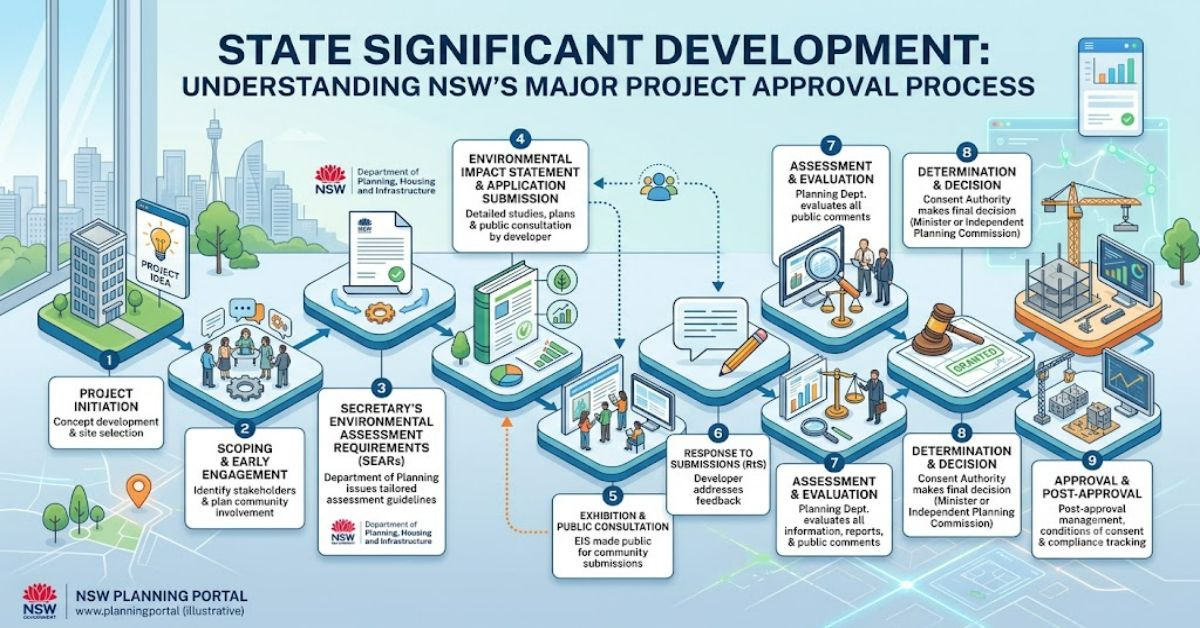
How the Approval Process Works
The SSD approval process generally includes several stages.
| Stage | Purpose |
| Project Identification | Determine whether the proposal qualifies as SSD. |
| Environmental Studies | Assess environmental, traffic, biodiversity, and social impacts. |
| Public Exhibition | Invite community feedback on the proposal. |
| Government Assessment | Planning authorities review all documentation. |
| Final Determination | Approval, modification, or refusal based on planning merits. |
Each stage helps ensure developments are evaluated from multiple perspectives before construction begins.
Benefits of State Significant Development
The SSD framework provides advantages for both government and project proponents.
Faster Decision-Making
Central government assessment reduces duplication between multiple planning authorities.
Greater Investment Confidence
Developers gain a clearer understanding of regulatory expectations for major projects.
Improved Infrastructure
Many SSD projects deliver hospitals, schools, transport systems, renewable energy facilities, and housing that support long-term economic growth.
Consistent Standards
State-wide assessment helps apply uniform planning principles across different regions.
Challenges and Considerations
Although SSD provides many benefits, it also faces challenges.
Some communities believe local councils should have greater influence over developments affecting their neighbourhoods. Others argue that large projects require extensive environmental assessment before approval.
Common concerns include:
- Traffic impacts
- Noise pollution
- Biodiversity protection
- Heritage conservation
- Community consultation
- Long-term environmental sustainability
Balancing these competing priorities remains one of the most important aspects of the SSD framework.
Comparison of Planning Pathways
| Feature | Local Development | State Significant Development |
| Decision Maker | Local Council | NSW Government |
| Project Scale | Local projects | Major state projects |
| Assessment Complexity | Moderate | Extensive |
| Environmental Review | Required where applicable | Comprehensive |
| Public Consultation | Local | State-managed |
The Future of State Significant Development in 2027
As NSW continues investing in housing, transport, renewable energy, and healthcare, the importance of the SSD framework is expected to grow.
Future improvements may include greater use of digital planning systems, faster environmental data analysis, improved public participation through online consultation platforms, and stronger sustainability requirements. Governments are also likely to place greater emphasis on climate resilience and renewable infrastructure when assessing major developments.
While planning regulations will continue evolving, the core purpose of SSD is expected to remain the same: enabling projects that deliver lasting benefits while protecting communities and the environment.
Key Takeaways
- SSD supports projects with significant value to New South Wales.
- The NSW Government manages approvals rather than local councils.
- Environmental assessment remains a central part of the approval process.
- Community consultation plays an important role.
- The framework encourages efficient delivery of major infrastructure.
- Sustainable planning is becoming increasingly important.
Conclusion
State Significant Development has become an essential part of New South Wales’ planning system. By providing a dedicated approval pathway for projects with substantial economic, environmental, or social importance, it helps deliver critical infrastructure while maintaining rigorous planning standards.
Although the process can be complex, its structured approach promotes transparency, accountability, and balanced decision-making. As NSW continues to grow, the SSD framework will remain an important mechanism for supporting housing, transport, healthcare, renewable energy, and other projects that contribute to the state’s long-term development.
Frequently Asked Questions
What is State Significant Development?
It is a planning approval pathway in NSW for large or complex developments that provide significant benefits to the state.
Who approves SSD projects?
The NSW Government assesses and determines SSD applications rather than local councils.
Do SSD projects require environmental assessments?
Yes. Environmental studies are a key requirement before approval decisions are made.
Can the public comment on SSD applications?
Yes. Most SSD proposals include a public exhibition period during which community members can submit feedback.
What types of projects qualify as SSD?
Major infrastructure, hospitals, renewable energy projects, industrial developments, educational facilities, and large residential projects may qualify depending on NSW planning criteria.