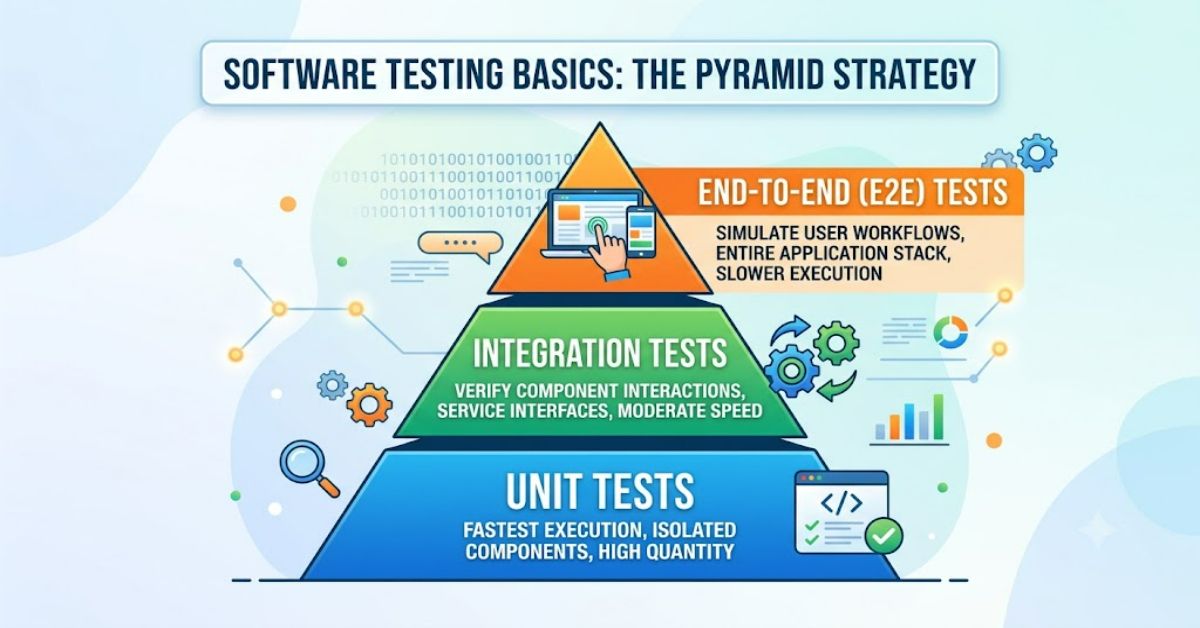
Understanding software testing basics is essential for developers, quality assurance professionals, project managers, and business leaders. Software testing is the systematic process of evaluating an application to verify that it functions correctly, meets specified business requirements, and is free of critical defects before reaching real users.
Testing is often misunderstood as simply finding bugs. In reality, it is a structured quality assurance practice designed to reduce business risk, improve software reliability, strengthen security, and support successful product releases. Without testing, even well-designed applications can fail unexpectedly, leading to customer dissatisfaction, financial losses, security incidents, and reputational damage.
Modern applications operate in increasingly complex environments. Cloud infrastructure, APIs, mobile devices, microservices, and third-party integrations introduce numerous points of potential failure. Testing provides organizations with confidence that systems will behave as expected under real-world conditions.
Whether you’re new to technology or preparing for a career in software development, understanding testing fundamentals provides a strong foundation for building and maintaining reliable software systems.
What Is Software Testing?
Software testing is the process of evaluating software behavior against expected outcomes.
Its primary objective is to identify defects and verify that the application performs according to requirements.
Testing helps answer questions such as:
- Does the application work correctly?
- Are business requirements satisfied?
- Can users complete critical tasks?
- Does the system remain secure?
- Will the application perform under heavy load?
- Do recent changes introduce new problems?
Testing is performed throughout the Software Development Life Cycle (SDLC), not only at the end of development.
Why Software Testing Matters
Organizations invest heavily in testing because software failures can be extremely costly.
Business Benefits
- Reduced production failures
- Improved customer satisfaction
- Lower maintenance expenses
- Faster product releases
- Better regulatory compliance
Technical Benefits
- Early defect detection
- Improved code quality
- Stronger security posture
- Better scalability
- Increased system reliability
Real-World Example
In July 2024, a faulty software update from cybersecurity company CrowdStrike caused widespread outages affecting airlines, hospitals, financial institutions, and government agencies worldwide. The incident demonstrated how software defects can create significant operational disruptions and highlighted the importance of rigorous testing and deployment controls.
Core Objectives of Software Testing
Testing serves several important purposes.
Verification
Ensures the software is built according to specifications.
Validation
Confirms the software meets user needs and business expectations.
Defect Detection
Identifies bugs before users encounter them.
Risk Reduction
Minimizes operational, financial, and security risks.
Quality Improvement
Provides feedback that improves future development practices.
Types of Software Testing
Different testing methods address different quality concerns.
| Testing Type | Purpose | Typical Stage |
| Unit Testing | Validate individual components | Development |
| Integration Testing | Verify component interactions | After coding |
| System Testing | Test complete application | Pre-release |
| Acceptance Testing | Validate business requirements | Final review |
| Performance Testing | Assess speed and scalability | Optimization |
| Security Testing | Identify vulnerabilities | Throughout lifecycle |
| Regression Testing | Verify existing functionality | Continuous |
| Usability Testing | Evaluate user experience | Pre-launch |
Each testing type contributes to overall software quality.
Manual Testing vs Automated Testing
One of the most important concepts in software testing basics is understanding the distinction between manual and automated approaches.
| Factor | Manual Testing | Automated Testing |
| Human Involvement | High | Low |
| Execution Speed | Slower | Faster |
| Initial Cost | Lower | Higher |
| Maintenance Cost | Higher | Moderate |
| Exploratory Testing | Excellent | Limited |
| Repeatability | Moderate | Excellent |
| Scalability | Limited | High |
Most successful organizations use a hybrid approach.
Manual testing remains valuable for exploratory testing, user experience evaluation, and complex scenarios. Automation excels at repetitive validation and continuous integration workflows.
The Software Testing Life Cycle (STLC)
The Software Testing Life Cycle provides a structured framework for quality assurance activities.
1. Requirement Analysis
Teams review functional and non-functional requirements to determine testing scope.
2. Test Planning
Test managers define:
- Resources
- Timelines
- Risks
- Testing environments
- Success criteria
3. Test Case Design
Detailed test scenarios and expected outcomes are created.
4. Environment Setup
Infrastructure and tools are configured.
5. Test Execution
Tests are performed and results are documented.
6. Defect Reporting
Issues are identified, prioritized, and assigned for resolution.
7. Test Closure
Final reporting, lessons learned, and quality assessments are completed.
Common Testing Methodologies
Black Box Testing
Testers evaluate functionality without knowledge of internal code.
White Box Testing
Testers examine internal code structures and logic.
Gray Box Testing
Combines external testing with partial knowledge of implementation.
Each methodology serves different objectives and often works best when combined.
Essential Testing Metrics
Quality assurance teams rely on measurable indicators.
| Metric | Purpose |
| Defect Density | Bugs per unit of code |
| Test Coverage | Percentage of code tested |
| Defect Leakage | Bugs found after release |
| Test Execution Rate | Progress tracking |
| Mean Time to Resolution | Defect correction speed |
| Pass/Fail Rate | Test outcome measurement |
These metrics help teams assess quality trends and identify improvement opportunities.
Strategic Implications of Effective Testing
Testing influences more than software quality.
Faster Releases
Organizations using automated pipelines often deploy updates more frequently and with greater confidence.
Reduced Technical Debt
Early defect detection prevents costly architectural problems.
Better Security
Security testing identifies vulnerabilities before attackers can exploit them.
Competitive Advantage
Reliable applications improve customer retention and brand reputation.
Risks and Trade-Offs
Testing is essential, but it is not without challenges.
Common Risks
| Risk | Potential Impact |
| Insufficient Test Coverage | Undetected defects |
| Over-Reliance on Automation | Missed usability issues |
| Limited Test Environments | Production surprises |
| Poor Requirements | Ineffective testing |
| Time Constraints | Reduced quality assurance |
The Cost Trade-Off
Extensive testing requires time and resources. However, insufficient testing often creates far greater costs after deployment.
Research consistently shows that defects discovered later in development cost significantly more to fix than those identified early.
Three Insights Often Missing from Beginner Guides
Insight 1: Requirements Cause More Problems Than Code
Many critical defects originate from unclear or incomplete requirements rather than programming errors. Testing cannot fully compensate for poor requirements gathering.
Insight 2: Automation Is Not a Universal Solution
Automated tests require maintenance. Poorly designed automation frameworks can become technical debt that slows development.
Insight 3: Environment Accuracy Matters More Than Test Volume
A large test suite executed in an unrealistic environment can provide false confidence. Production-like environments often reveal issues that thousands of tests miss.
Real-World Industry Trends
Several developments are reshaping quality assurance practices.
Shift-Left Testing
Testing activities begin earlier in development rather than waiting for completed software.
DevOps Integration
Testing is increasingly embedded within Continuous Integration and Continuous Deployment (CI/CD) pipelines.
Security Testing Growth
Growing cybersecurity threats have increased demand for application security testing.
AI-Assisted Testing
Artificial intelligence tools now assist with test generation, defect prediction, and test maintenance.
Structured Insight Table
| Quality Objective | Testing Contribution |
| Reliability | High |
| Security | High |
| User Satisfaction | High |
| Compliance | Moderate |
| Performance | High |
| Scalability | Moderate |
| Development Speed | Moderate to High |
The Future of Software Testing Basics in 2027
The future of software testing will be shaped by automation, artificial intelligence, and increasingly complex software ecosystems.
AI-Powered Test Generation
AI tools are becoming capable of generating test cases, analyzing failures, and identifying high-risk code changes.
Continuous Quality Engineering
Organizations are moving beyond traditional testing toward continuous quality monitoring throughout the development lifecycle.
Increased Security Requirements
Regulations and cybersecurity frameworks are placing greater emphasis on secure software development practices.
Cloud-Native Testing
As cloud-native architectures expand, testing strategies must adapt to distributed systems, containers, and microservices.
Despite technological advances, human expertise will remain essential. Critical thinking, exploratory testing, and business-context validation are difficult to automate fully.
Key Takeaways
- Software testing verifies functionality, quality, and business requirements.
- Testing reduces operational, financial, and security risks.
- Multiple testing types address different quality concerns.
- Manual and automated testing both remain important.
- Requirements quality significantly influences testing effectiveness.
- AI is changing testing workflows but not replacing human judgment.
- Continuous testing is becoming the industry standard.
Conclusion
Software testing remains one of the most important disciplines in modern software development. It provides organizations with the confidence that applications will perform reliably, securely, and consistently when deployed to real users.
Understanding software testing basics involves more than learning how to find bugs. Effective testing requires a structured approach that includes planning, execution, analysis, and continuous improvement. Organizations that invest in quality assurance benefit from reduced risk, stronger security, improved customer satisfaction, and lower long-term costs.
As software systems continue to grow in complexity, testing will become even more critical. Emerging technologies such as AI-assisted quality engineering and cloud-native testing platforms are expanding what teams can achieve. Yet the fundamental purpose remains unchanged: ensuring that software delivers the value it was designed to provide.
The most successful development teams view testing not as a final checkpoint, but as an ongoing process that supports quality throughout the entire software lifecycle.
FAQ
What are software testing basics?
Software testing basics include understanding how to verify functionality, validate requirements, identify defects, and assess software quality before release.
Why is software testing important?
Testing helps prevent failures, improve security, reduce maintenance costs, and ensure applications meet business and user requirements.
What is the difference between verification and validation?
Verification checks whether software is built according to specifications, while validation ensures the software satisfies user needs and expectations.
What are the main types of software testing?
Common types include unit testing, integration testing, system testing, acceptance testing, security testing, performance testing, and regression testing.
Is automated testing better than manual testing?
Neither approach is universally better. Automated testing excels at repetitive tasks, while manual testing is valuable for exploratory and usability evaluations.
What skills are needed for software testing?
Important skills include analytical thinking, attention to detail, communication, test design, defect analysis, and basic technical knowledge.
Methodology
This article was prepared using software engineering literature, quality assurance frameworks, industry best practices, vendor documentation, and publicly reported software incident analyses. Concepts were cross-referenced with recognized software testing standards and contemporary DevOps methodologies.
Sources Used for Validation
- International Software Testing Qualifications Board (ISTQB)
- National Institute of Standards and Technology (NIST)
- OWASP Application Security Testing resources
- Industry reports on DevOps and software quality engineering
Limitations
- Testing practices vary by organization, industry, and regulatory requirements.
- Tool recommendations and methodologies evolve over time.
- Emerging AI testing technologies remain under active development.
Balanced Perspective
While comprehensive testing significantly reduces risk, no testing strategy can guarantee completely defect-free software. Organizations must balance quality objectives with delivery timelines, budget constraints, and business priorities.
Editorial Disclosure: This article was drafted with AI assistance and should be independently reviewed and verified by a human editor before publication on Postcard.fm.
References (APA Style)
International Software Testing Qualifications Board. (2023). ISTQB Certified Tester Foundation Level Syllabus v4.0.
National Institute of Standards and Technology. (2024). Secure Software Development Framework (SSDF) Version 1.1.
OWASP Foundation. (2024). OWASP Testing Guide.
Forsgren, N., Humble, J., & Kim, G. (2023). Accelerate: The Science of Lean Software and DevOps (updated edition). IT Revolution.
Google Cloud. (2024). DORA State of DevOps Report 2024.