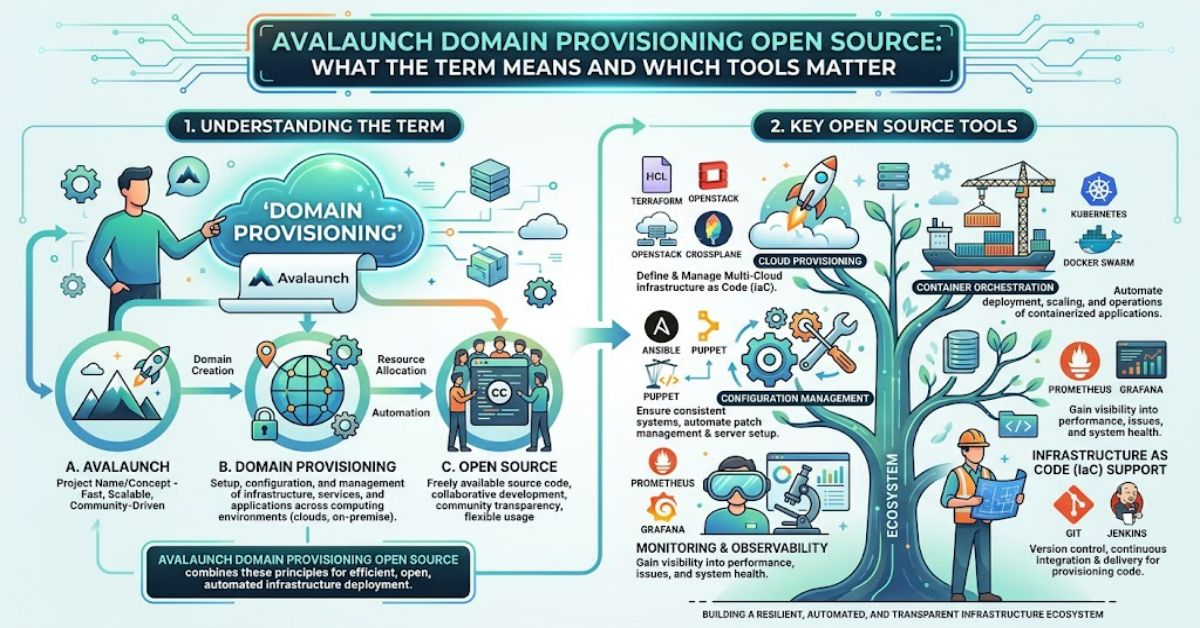
If you are searching for avalaunch domain provisioning open source, the first challenge is understanding what the phrase actually refers to. Avalaunch is a blockchain launchpad associated with the Avalanche ecosystem, while domain provisioning is the technical process of registering, renewing, transferring and configuring internet domain names.
These are not normally the same system.
Avalaunch was created as an Avalanche-native launchpad for blockchain projects. Its purpose is connected with token launches, community participation and blockchain-based fundraising rather than operating a conventional domain registrar. Avalanche itself, meanwhile, is an open-source blockchain platform with publicly available development infrastructure.
Domain provisioning belongs to a different part of the internet stack. It involves registrars, registries, the Extensible Provisioning Protocol (EPP), Registration Data Access Protocol (RDAP), DNS infrastructure and automated domain lifecycle processes.
That distinction matters for developers. Someone looking for an open-source way to provision domains may actually need registrar software, a registry platform or DNS automation rather than an Avalanche application.
The good news is that genuine open-source options exist. Namingo provides registrar and registry software, while Google’s Nomulus offers an open-source platform for operating top-level-domain registries. Other projects address narrower parts of the provisioning workflow.
Understanding where each tool fits is the key to avoiding an expensive architectural mistake.
What Is Avalaunch?
Avalaunch is a launchpad built on the Avalanche blockchain. It was designed to help blockchain projects prepare and conduct launches while connecting projects with participants in the Avalanche ecosystem.
Its infrastructure is therefore fundamentally different from a traditional domain registrar.
A domain registrar handles assets such as example.com. It communicates with a domain registry, manages customer accounts and processes operations including registration, renewal and transfer.
Avalaunch instead operates within the blockchain and decentralised-finance environment.
This creates an important distinction:
| Technology | Primary Purpose | Typical Infrastructure |
| Avalaunch | Blockchain project launches | Avalanche blockchain |
| Domain registrar | Domain registration services | EPP, billing, RDAP |
| Domain registry | Operates a TLD | Registry database, EPP, DNS |
| DNS platform | Resolves domain names | Authoritative DNS servers |
| Domain manager | Internal domain administration | APIs, DNS, SSL automation |
Confusing these layers can result in choosing software that solves the wrong problem.
What Does Domain Provisioning Mean?
Domain provisioning is the automated management of domain names throughout their lifecycle.
A basic workflow can include:
- Checking whether a domain is available.
- Creating a registration request.
- Sending the appropriate command to a registry.
- Recording ownership and expiry information.
- Configuring nameservers.
- Updating DNS records.
- Renewing the domain.
- Processing transfers.
- Handling registration data.
- Monitoring expiry and operational status.
EPP is particularly important because it provides a standardised method for communication between registrars and registries.
Google’s open-source Nomulus project, for example, supports EPP operations for registering, renewing, checking, updating and transferring domains. It is designed for operators running top-level-domain registries rather than ordinary customers wanting to register one domain.
That distinction is one of the most useful pieces of information for developers evaluating open-source software.
Open-Source Options for Domain Provisioning
There is no single open-source project that fits every provisioning requirement.
Namingo Registrar is designed around registrar operations and supports domain registration, renewals, transfers and payments. It also supports EPP connectivity and RDAP-related functionality.
Namingo Registry addresses another layer. It is intended for organisations operating ccTLD, gTLD, brand or private registries and includes EPP, RDAP, DNS interfaces and registry automation.
Nomulus occupies the registry side of the architecture. Google describes it as a scalable, cloud-based open-source service for operating TLDs.
These projects should not be treated as interchangeable.
| Open-Source Project | Main Role | EPP | RDAP | Best Fit |
| Namingo Registrar | Registrar management | Yes | Yes | Domain sellers |
| Namingo Registry | Registry platform | Yes | Yes | TLD operators |
| Nomulus | TLD registry | Yes | Yes | Large-scale registry infrastructure |
| PyRar | Registrar/registry software | Yes | Partial | Experimental or specialised deployments |
| DNS software | DNS management | Not usually | No | Authoritative DNS operations |
The Architecture Behind Open Domain Provisioning
A reliable system normally contains several layers rather than one application.
At the top is the customer or administrative interface. This is where users search for names, create accounts and request registrations.
The application then communicates with registrar infrastructure. The registrar communicates with the appropriate registry using EPP.
Behind that sits the registry database, which maintains domain objects, contacts, hosts and lifecycle information.
DNS is another layer. Registering a domain does not automatically mean that its website or mail service works. Nameservers and DNS records still need to be configured correctly.
This separation produces an important insight: domain provisioning is not the same thing as DNS management.
A platform may successfully register a domain but still require separate DNS infrastructure.
Why Open Source Can Be Attractive
Open-source provisioning software gives organisations greater control over the underlying architecture.
Instead of depending entirely on a proprietary registrar platform, a technical team can inspect the code, modify integrations and connect the system to its own billing, authentication or infrastructure.
There can also be operational advantages.
For example, Namingo Registrar supports integrations with established billing systems and registrar workflows. Nomulus provides a foundation for organisations that need to operate registry infrastructure at TLD scale.
However, open source does not mean zero cost.
The software may be free to obtain, but production infrastructure still requires servers, monitoring, backups, security controls, engineering expertise and operational support.
The Hidden Cost of Self-Hosted Provisioning
The largest mistake is often calculating only software cost.
A production registrar needs much more than an application server. It needs reliable databases, monitoring, disaster recovery, DNS infrastructure, secure credential management and processes for abuse handling and registration data.
Open-source infrastructure therefore changes the cost model rather than eliminating costs.
| Area | Commercial Platform | Open-Source Deployment |
| Software licence | Often recurring | Often free |
| Customisation | Limited to vendor options | High |
| Infrastructure | Usually bundled | Customer responsibility |
| Maintenance | Vendor-led | Internal team |
| Security updates | Vendor-managed | Operator-managed |
| Data control | Provider-dependent | Greater control |
| Integration | Pre-built | Often requires engineering |
For a small project, paying for an established registrar service can therefore be cheaper than operating a complete open-source stack.
Where Avalanche Fits
Avalanche becomes relevant if the project needs blockchain functionality alongside domain infrastructure.
For example, a developer could theoretically build an application that uses Avalanche for blockchain operations while using conventional registrar infrastructure for internet domains.
The two systems could communicate through APIs.
That architecture is very different from replacing EPP-based domain provisioning with blockchain technology.
Blockchain does not remove the need for DNS, registry policies, registrar accreditation or domain lifecycle management.
This is another useful distinction: a blockchain can complement domain infrastructure without becoming the domain registry itself.
Risks and Trade-Offs
Self-hosting introduces several risks.
Security is one of the most important. Registrar infrastructure handles valuable accounts and domain assets, making authentication, access control and credential protection critical.
Operational reliability is another concern. Domain services can become business-critical, so database failure or incorrect DNS changes can have immediate consequences.
Compliance also matters. Organisations operating registrar or registry infrastructure may have contractual, technical and data-management obligations that do not disappear because the software is open source.
Finally, customisation can become a liability. Modifying core provisioning code may make future upgrades harder and introduce compatibility problems.
The Future of Domain Provisioning in 2027
By 2027, open-source domain infrastructure is likely to become more modular rather than replacing commercial registrar services altogether.
EPP, RDAP, DNSSEC and automated lifecycle processing will remain important because these standards solve different problems within the domain ecosystem.
Automation is likely to expand around APIs, monitoring, security and DNS management. Open-source projects can benefit from this trend because developers can connect individual components rather than building every system from scratch.
The strongest architecture will probably be the one that separates registrar, registry, DNS and application responsibilities cleanly.
For blockchain projects, that means Avalanche-based infrastructure can coexist with conventional domain provisioning rather than attempting to replace it.
Key Takeaways
- Avalaunch and domain provisioning serve fundamentally different technical purposes.
- Avalanche is an open-source blockchain platform, while Avalaunch is an Avalanche ecosystem launchpad.
- Domain provisioning depends heavily on registrar, registry, EPP and DNS infrastructure.
- Namingo provides open-source registrar and registry options.
- Nomulus is designed for operating TLD registry infrastructure.
- Open source reduces software licensing restrictions but does not remove operational costs.
- Blockchain and domain infrastructure can be integrated without being treated as the same technology.
Conclusion
The phrase avalaunch domain provisioning open source can be confusing because it combines blockchain terminology with conventional internet infrastructure. Avalaunch belongs to the Avalanche ecosystem and focuses on blockchain project launches, whereas domain provisioning involves registration, renewal, transfer, DNS and registry operations.
For developers looking for open-source domain infrastructure, the more relevant projects include Namingo Registrar, Namingo Registry and Nomulus. Each operates at a different point in the domain ecosystem, so the right choice depends on whether the goal is running a registrar, operating a registry or managing domains internally.
The most practical approach is to treat blockchain and domain infrastructure as separate layers. Avalanche can provide blockchain functionality, while established open standards such as EPP and RDAP continue to handle domain lifecycle operations.
FAQ
What is Avalaunch?
Avalaunch is a blockchain launchpad associated with the Avalanche ecosystem. It supports project launches and community participation rather than functioning as a conventional internet domain registrar.
Is Avalaunch an open-source domain registrar?
No. Avalaunch is not a conventional domain registrar. Developers looking for open-source domain provisioning should examine registrar and registry projects instead.
What is open-source domain provisioning?
It is the use of publicly available software to automate domain registration, renewal, transfer, DNS configuration and related lifecycle operations.
Is Namingo Registrar open source?
Yes. Namingo Registrar is an open-source registrar management platform designed to support domain registration, renewals, transfers and related registrar operations.
What is Nomulus used for?
Nomulus is an open-source platform for operating top-level-domain registries. It is aimed at registry operators rather than ordinary domain customers.
Can Avalanche be used with domain provisioning?
Yes. A blockchain application can use Avalanche for decentralised functionality while relying on conventional registrar, registry and DNS infrastructure for internet domains.
Methodology
This article Avalaunch domain provisioning open source separates the ambiguous search phrase into its two relevant technical concepts: Avalaunch/Avalanche infrastructure and open-source domain provisioning. Open-source registrar and registry projects were reviewed to establish the roles of EPP, RDAP, DNS and domain lifecycle management.
No firsthand testing or personal deployment experience has been claimed. Technical capabilities should be checked against current project documentation before production implementation because open-source software changes over time.
Editorial disclosure: This article was drafted with AI assistance and should be reviewed by a human editor before publication. Technical claims and project capabilities should be independently verified against current primary documentation.
References
Ava Labs. (2026). Ava Labs open-source repositories and Avalanche development infrastructure. GitHub.
Google. (2026). Nomulus: Top-level domain name registry service on Google Cloud Platform. GitHub.
Namingo. (2026). Namingo Registrar: Open-source ICANN-accredited domain registrar management system. GitHub.
Namingo. (2026). Namingo Registry: Open-source domain registry platform. GitHub.
Internet Corporation for Assigned Names and Numbers. (2024). Registration Data Policy. ICANN.
Internet Engineering Task Force. (2015). Extensible Provisioning Protocol (EPP). RFC 5730.