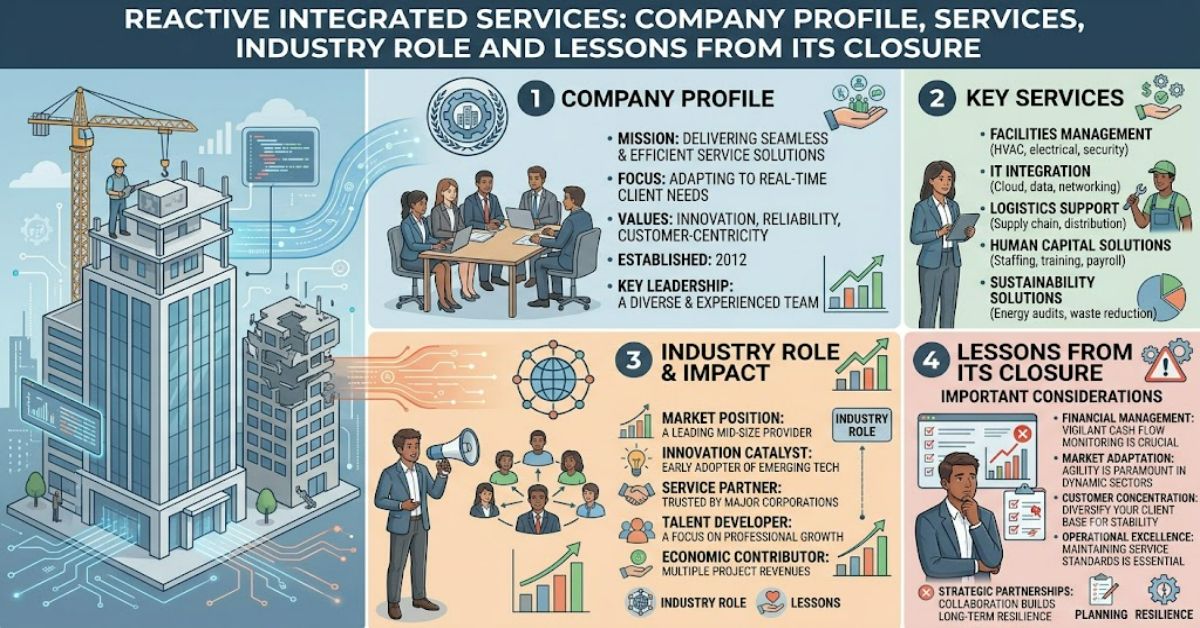
Reactive Integrated Services was a UK specialist contracting company operating within the construction and built environment sector. The business was known for providing integrated technical services across multiple disciplines, supporting commercial and infrastructure projects throughout the country.
The term reactive integrated services refers to a model where specialist contractors respond to operational requirements, maintenance demands, refurbishment needs, and technical building challenges through coordinated service delivery. Companies operating in this area typically combine expertise across several trades rather than focusing on a single construction discipline.
Reactive Integrated Services Ltd (RIS) became notable within the UK contracting market as a multi-disciplinary provider. However, according to official UK Companies House records, the company entered voluntary liquidation and filed for winding up in July 2024.
The closure provides an opportunity to examine not only the company itself but also the broader pressures affecting specialist contractors. Construction businesses operate within complex ecosystems involving clients, subcontractors, suppliers, payment schedules, and regulatory obligations. Even established contractors can face difficulties when financial pressures accumulate.
This article explores RIS’s business model, industry position, challenges, and the lessons its closure offers for the wider construction sector.
Understanding the Reactive Integrated Services Business Model
Specialist contractors play an important role in modern construction because many projects require expertise beyond traditional building work.
A company offering integrated services may combine areas such as:
- Building maintenance
- Mechanical and electrical services
- Refurbishment works
- Facilities support
- Compliance-related services
- Reactive repair solutions
The advantage of this model is coordination. Instead of hiring multiple independent contractors, clients can work with one provider responsible for managing several technical requirements.
This approach can improve project efficiency, reduce communication problems, and simplify contract management.
However, it also creates operational complexity. Managing different disciplines requires strong project controls, skilled personnel, accurate estimating, and effective supply-chain management.
Reactive Integrated Services Ltd: Company Context
Reactive Integrated Services Ltd operated within the competitive UK specialist contracting market. Companies in this sector often serve commercial property owners, public sector organisations, facilities managers, and main contractors.
The construction industry relies heavily on specialist contractors because modern buildings require increasingly complex systems. Electrical infrastructure, mechanical installations, compliance requirements, and maintenance obligations all require dedicated expertise.
RIS represented this broader movement towards integrated service providers.
However, the UK construction sector has experienced significant financial pressures in recent years. Factors affecting contractors include:
- Rising material costs
- Labour shortages
- Increased energy expenses
- Delayed payments
- Fixed-price contract pressures
- Higher compliance requirements
These pressures can affect companies even when demand for their services remains strong.
Comparison: Integrated Contractors vs Traditional Specialist Models
| Area | Integrated Contractor Model | Traditional Specialist Model |
| Service approach | Multiple disciplines under one provider | Single specialist trade |
| Client relationship | One main point of contact | Multiple contractors |
| Project coordination | Centralised management | Distributed responsibility |
| Operational complexity | Higher internal coordination needs | Lower organisational complexity |
| Risk exposure | Wider responsibility across services | Narrower service responsibility |
Why Specialist Contractors Face Financial Pressure
The closure of a contractor does not necessarily indicate a lack of market demand. Many construction businesses fail because of financial structure rather than insufficient work.
Cash Flow Management
Construction operates differently from many industries. Companies often complete work before receiving full payment, creating pressure on working capital.
A contractor may have to pay:
- Employees
- Suppliers
- Subcontractors
- Equipment providers
before receiving payment from clients.
Contract Risk
Fixed-price agreements can become difficult when costs rise unexpectedly. If material prices increase after a contract has been agreed, the contractor may absorb additional expenses.
Supply Chain Exposure
Specialist contractors are connected to multiple suppliers and subcontractors. Problems within one part of the chain can affect the entire project.
Data Insight: Key Risks Facing UK Specialist Contractors
| Risk Factor | Impact on Businesses |
| Inflation | Increases operational costs |
| Payment delays | Creates cash-flow challenges |
| Labour shortages | Raises recruitment costs |
| Contract disputes | Reduces profitability |
| Economic uncertainty | Slows construction investment |
The Importance of Due Diligence in Construction Partnerships
The case of Reactive Integrated Services highlights why clients and contractors must carefully evaluate business partners.
Important checks include:
Financial Stability:
Reviewing company accounts, payment history, and corporate records can help identify potential risks.
Operational Capability:
Businesses should assess whether contractors have sufficient workforce, technical expertise, and management systems.
Contract Structure:
Clear agreements covering payment terms, responsibilities, and variations can reduce disputes.
One wider industry lesson is that technical capability alone is not enough. A contractor requires strong financial controls and effective governance to survive challenging market conditions.
Construction Industry Lessons from the RIS Closure
The experience of Reactive Integrated Services reflects several broader lessons for specialist contractors.
Strong Financial Controls Are Essential
Businesses must monitor cash flow, margins, and project profitability continuously. Revenue growth does not always equal financial health.
Diversification Can Reduce Risk
Contractors dependent on a limited number of clients or sectors may face greater vulnerability when market conditions change.
Digital Management Tools Are Becoming More Important
Construction companies increasingly use digital platforms for:
- Project tracking
- Cost management
- Compliance records
- Resource planning
These tools can improve visibility and support better decision-making.
The Future of Reactive Integrated Services in 2027
By 2027, the demand for integrated building services is likely to remain significant. Modern buildings require more complex maintenance, energy efficiency upgrades, and compliance management.
The UK government’s focus on improving building standards and reducing carbon emissions is expected to influence construction services. Regulations surrounding building safety, energy performance, and sustainability will continue shaping contractor requirements.
Future specialist contractors will likely need stronger capabilities in:
- Digital project management
- Sustainable building systems
- Energy efficiency solutions
- Compliance reporting
However, financial resilience will remain equally important. Companies that combine technical expertise with disciplined financial management will be better positioned to compete.
The market opportunity for integrated services remains strong, but businesses must manage operational risks carefully.
Key Takeaways
- Reactive Integrated Services Ltd operated within the UK specialist contracting sector.
- Integrated service providers offer convenience but face greater operational complexity.
- The company’s 2024 liquidation highlights wider financial pressures affecting contractors.
- Strong cash-flow management is essential in construction.
- Future contractors will need both technical expertise and digital capability.
- Sustainable building requirements will shape future service demand.
Conclusion
Reactive Integrated Services represents both the opportunities and challenges found within the UK specialist contracting industry. Integrated service models can provide valuable solutions for complex construction and maintenance requirements, but they also require careful management of financial, operational, and contractual risks.
The company’s voluntary liquidation in 2024 demonstrates how difficult market conditions can affect businesses operating in demanding sectors. Rising costs, payment pressures, and contract complexity continue to influence contractor performance across the industry.
The future of integrated building services remains promising, particularly as demand grows for maintenance, sustainability improvements, and technically advanced facilities. However, long-term success will depend on more than technical ability. Financial discipline, strong governance, and effective risk management will determine which contractors remain resilient in a competitive environment.
Frequently Asked Questions
What was Reactive Integrated Services?
Reactive Integrated Services Ltd was a UK specialist contractor providing multi-disciplinary building and technical services before entering liquidation proceedings in 2024.
Why did Reactive Integrated Services close?
Official Companies House records show that the company entered voluntary liquidation and filed for winding up in July 2024. Specific financial reasons should be confirmed through formal company documents.
What services did integrated contractors provide?
Integrated contractors typically provide combined building, maintenance, mechanical, electrical, and technical support services.
Are specialist contractors important in construction?
Yes. Specialist contractors provide technical expertise required for modern buildings, infrastructure projects, and maintenance operations.
What risks do construction contractors face?
Common risks include rising costs, payment delays, labour shortages, contract disputes, and supply-chain pressures.
Will integrated construction services grow in the future?
Demand is expected to continue as buildings become more complex and require greater maintenance, compliance, and sustainability support.
Methodology
This article was prepared using publicly available company information, UK corporate records, and broader construction industry analysis. Company status information was based on official Companies House records regarding Reactive Integrated Services Ltd’s liquidation proceedings.
The article does not include private company documents, internal financial records, or interviews with former employees. Broader industry observations are based on recognised construction sector trends and publicly available economic information.
Readers should consult official filings and professional advisers for detailed financial or legal analysis.
References (APA Style)
Companies House. (2024). Reactive Integrated Services Ltd company filing information. UK Government.
Department for Business and Trade. (2024). UK construction sector overview and business environment reports. UK Government.
Office for National Statistics. (2024). Construction output and economic indicators. UK Government.
Royal Institution of Chartered Surveyors. (2024). Construction market insights and industry analysis. RICS.