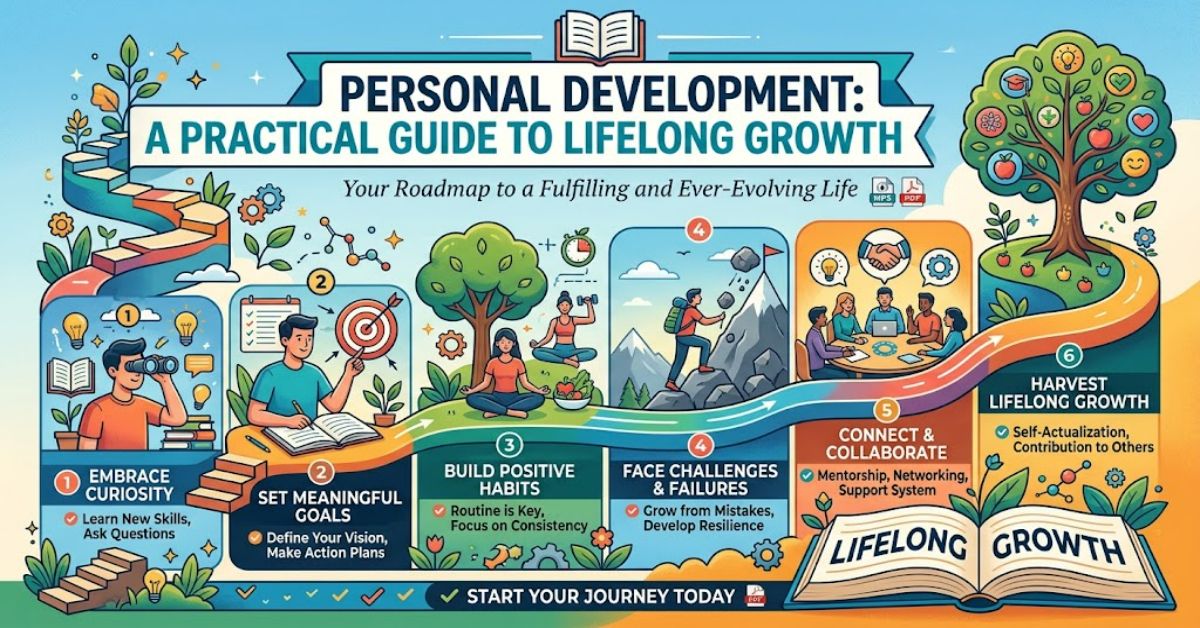
Personal development is the lifelong, intentional process of improving self-awareness, skills, knowledge and potential to create a better quality of life. It can involve education, career development, emotional intelligence, communication, physical wellbeing, relationships, financial capability and the everyday habits that shape how a person responds to challenges.
The important distinction is between genuine development and the constant pressure to become a supposedly “better” version of yourself. Personal development does not require perfection, endless productivity or a complete personality makeover. It is better understood as a process of identifying what matters, recognising where improvement is possible and deliberately developing the capabilities needed to move forward.
That approach is increasingly relevant because the skills people need do not remain fixed. The OECD’s 2023 Survey of Adult Skills assessed literacy, numeracy and adaptive problem-solving across 31 education systems. In England, adults aged 16–65 scored above the OECD average in all three areas, but meaningful differences remained between age groups and proficiency levels. (OECD
Personal growth therefore has both an individual and practical dimension. It can mean learning a professional skill, becoming better at managing difficult emotions, improving communication or developing routines that make everyday responsibilities more manageable.
The strongest approach is not to chase improvement in every area at once. It is to choose a meaningful direction, build a realistic system and review progress over time.
What Does Personal Development Actually Mean?
At its simplest, personal development is structured self-improvement.
It begins with awareness. A person needs to understand their current abilities, values, habits, limitations and priorities before deciding what should change.
It then moves into development. This can involve acquiring knowledge, practising a skill, changing a behaviour, improving emotional regulation or developing better ways of making decisions.
Finally, development requires application. Knowledge that never changes behaviour has limited practical value.
This creates a useful three-stage model:
Awareness → Development → Application
For example, someone may realise that poor time management is affecting their work. Reading about productivity creates awareness, but it does not automatically solve the problem. The next stage could involve learning prioritisation techniques. Application then means using a realistic planning system consistently and reviewing whether it actually improves performance.
This is why personal development should not be reduced to motivational quotes, productivity hacks or expensive courses. Its real value lies in the relationship between learning and behaviour.
The Main Areas of Personal Development
Personal development is broad because people develop in different directions. A useful framework divides it into several connected areas.
| Development area | Typical focus | Practical outcome |
| Self-awareness | Values, strengths, weaknesses and emotions | Better decisions |
| Learning | Knowledge, literacy and new skills | Greater capability |
| Career | Professional skills and adaptability | Improved employability |
| Emotional development | Emotional awareness and regulation | Better responses to pressure |
| Communication | Listening, writing and speaking | Stronger relationships |
| Physical wellbeing | Sleep, activity and healthy routines | Better daily functioning |
| Social development | Relationships, boundaries and cooperation | Healthier interactions |
| Financial capability | Budgeting, planning and financial knowledge | More informed choices |
| Goal management | Planning, prioritisation and review | Greater consistency |
These categories overlap. Better communication can improve career prospects, while better emotional awareness can improve relationships and decision-making.
The objective is not to score highly in every category. It is to identify which areas have the greatest effect on the life a person actually wants.
Why Self-Awareness Comes First
One of the most overlooked parts of personal growth is knowing what needs to change.
Without self-awareness, development can become imitation. Someone may adopt another person’s morning routine, career goals or productivity system without asking whether those choices fit their own circumstances.
Self-awareness involves asking practical questions:
- What am I already good at?
- Where do I repeatedly struggle?
- Which behaviours create problems?
- What situations make me perform well?
- What drains my attention or energy?
- Which values influence my decisions?
- What would meaningful improvement actually look like?
Reflection can expose patterns that are difficult to see while simply moving through daily life.
For example, a person might believe they have a motivation problem when the real issue is unclear priorities. Another might think they need greater confidence when they actually need more preparation and practice.
That distinction matters because the solution depends on the diagnosis.
Learning Is a Core Part of Long-Term Growth
Lifelong learning is one of the most measurable components of development.
The OECD’s 2023 Survey of Adult Skills illustrates why. In England, adults aged 16–65 recorded average scores of 272 in literacy, 268 in numeracy and 259 in adaptive problem solving, all above OECD averages. Yet 18% scored at Level 1 or below in literacy, 21% at or below Level 1 in numeracy, and 21% at or below Level 1 in adaptive problem solving. (OECD
These figures demonstrate an important point: having formal education does not mean learning has finished.
Adult learning can take many forms:
- Formal qualifications
- Professional training
- Online courses
- Reading and structured study
- Practical projects
- Mentoring
- Language learning
- Digital-skills development
- Learning through work
The UK Government’s current adult-skills statistics also show that participation in essential-skills education continues to involve hundreds of thousands of adult learners. In the first nine months of the 2025/26 academic year, 365,530 adults participated in essential-skills courses, including English, maths, ESOL and digital skills. (Explore Education Statistics
This creates one of the clearest evidence-backed insights in the subject: personal development does not have to mean abstract self-help. Basic capability building can be one of its most consequential forms.
Goals Need Systems, Not Just Motivation
A common mistake is setting ambitious goals without deciding how the behaviour will happen.
“I want to read more” is an intention.
“I will read for 20 minutes after dinner on Monday, Wednesday and Friday” is a behavioural system.
Psychological research on implementation intentions has examined this distinction through “if–then” planning. The underlying principle is to connect a desired behaviour to a specific situation, time or trigger rather than relying entirely on conscious motivation. (ScienceDirect
A practical structure is:
Goal: What do I want to improve?
Trigger: When will I act?
Behaviour: What exactly will I do?
Measurement: How will I know whether I did it?
For example:
If it is 7.30 pm on Tuesday, I will spend 30 minutes practising my new professional skill.
The value of this method is its simplicity. It reduces the number of decisions required at the moment of action.
For readers struggling with avoidance, Rubble Magazine’s guide to how to stop procrastinating provides a related practical framework for lowering the barrier to starting difficult tasks. (RM – Read what you wants
Habits Make Development Sustainable
A development plan that requires extraordinary motivation every day is unlikely to survive ordinary life.
Habits provide a different mechanism. A behaviour becomes easier to repeat when it is connected to a stable routine, environment or cue.
The NHS’s Every Mind Matters guidance makes a similar point about wellbeing: practising useful techniques repeatedly can help them become habits, while regular check-ins can help people maintain awareness of their mental wellbeing. (nhs.uk
This does not mean every habit becomes automatic quickly. Habit formation varies between behaviours and individuals.
The practical lesson is simpler: make the desired behaviour easy enough to repeat.
| Weak development approach | Stronger development approach |
| “I need to become more productive.” | “I will identify my three highest-priority tasks each morning.” |
| “I should exercise more.” | “I will walk for 20 minutes after lunch on weekdays.” |
| “I need more confidence.” | “I will practise one presentation section each evening.” |
| “I should learn something new.” | “I will complete two lessons every Saturday.” |
| “I need to stop procrastinating.” | “I will work on the task for five minutes before deciding whether to continue.” |
The second column turns vague ambition into observable behaviour.
Productivity Is Only One Part of Development
Personal development is sometimes presented as a productivity project. That creates a narrow definition of success.
A person can become highly organised while remaining exhausted. Someone can complete more tasks while neglecting relationships, sleep or physical health.
Productivity should therefore be treated as a tool rather than the ultimate objective.
Rubble Magazine’s analysis of productivity apps and workflow design makes a related distinction: tools are useful when they support a coherent workflow rather than becoming another source of organisational complexity. (RM – Read what you wants
The same principle applies to personal growth.
A sophisticated planner cannot compensate for unclear priorities. Ten productivity applications cannot replace meaningful goals. A rigid schedule can even become counterproductive if it leaves no room for rest or unexpected responsibilities.
The useful question is not “How much can I accomplish?”
It is “What activities deserve my limited attention?”
Emotional Development and Resilience
Emotional development means becoming better at recognising, understanding and responding to emotions.
It does not mean eliminating negative feelings.
Stress, disappointment, anger, uncertainty and sadness are normal parts of life. The development objective is to improve the ability to recognise what is happening and choose an appropriate response.
The NHS provides practical self-help approaches based on cognitive behavioural therapy, including identifying unhelpful thoughts, tackling worries, problem solving and gradually facing fears. (nhs.uk
The World Health Organization also identifies skills such as communication, critical thinking, decision-making, problem solving, self-awareness and empathy as important components of individual resources that can support mental health and resilience. (Iris
This provides another important insight: emotional development and skill development should not be treated as completely separate subjects. The ability to communicate clearly, solve problems and understand one’s own reactions can influence both wellbeing and everyday performance.
The Risk of Turning Growth Into Self-Criticism
Personal development can become unhealthy when improvement is treated as proof that the current self is inadequate.
This creates a cycle:
- Set an unrealistic standard.
- Fail to maintain it.
- Interpret the failure personally.
- Set an even more ambitious target.
- Repeat the cycle.
A better model separates behaviour from identity.
Missing a planned study session means the system failed on one occasion. It does not prove that someone is lazy or incapable.
The same applies to setbacks at work, difficult relationships or interrupted routines.
Development requires feedback. Feedback becomes useful only when it produces a change in behaviour rather than a judgement about personal worth.
Three Evidence-Based Insights That Are Easy to Miss
Growth is broader than career advancement
Career development is important, but adult skills research shows that literacy, numeracy and problem solving also support people’s ability to navigate everyday life. The OECD explicitly connects these skills with employment, higher wages, continuous learning and participation in personal and civic life. (OECD
That means development should not be measured solely through promotions or salary.
Small systems can outperform large intentions
The distinction between goal intention and implementation intention provides a useful practical lesson. Knowing what you want is not the same as specifying when, where and how the behaviour will happen. Research on implementation intentions provides evidence for the value of this additional planning step. (ScienceDirect
The hidden advantage is reduced decision-making at the moment action is required.
Self-help should not become self-isolation
The World Health Organization’s current position on self-care is particularly relevant. Self-care can support health and wellbeing, but it does not replace health systems or professional care. (World Health Organization
This matters because online personal-development culture can sometimes imply that every problem should be solved independently.
Some problems require education. Others require coaching, community support or professional healthcare.
Knowing when independent action is appropriate is itself a form of self-awareness.
A Practical Personal Development Framework
A simple development cycle can be built around six stages.
1. Assess
Identify one area that genuinely needs improvement.
2. Define
Describe the desired outcome in observable terms.
3. Learn
Find reliable information or instruction relevant to the skill.
4. Practise
Turn knowledge into repeated behaviour.
5. Review
Measure what happened rather than relying on memory or mood.
6. Adjust
Keep what works, modify what does not and remove unnecessary complexity.
This cycle is deliberately modest.
Someone improving public speaking might assess their current ability, define a goal of delivering a clearer five-minute presentation, study presentation structure, practise twice a week, review recordings and then adjust one weakness at a time.
That is more actionable than attempting to “become confident” overnight.
Personal Development and the Digital Environment
Digital technology has made learning more accessible but has also increased the volume of advice people encounter.
A person can access courses, podcasts, newsletters, apps, videos, communities and AI tools within minutes.
The problem is no longer simply access to information. It is selection.
More information can create the illusion of progress. Watching another productivity video is not equivalent to changing a behaviour.
A useful digital rule is:
Consume → Apply → Review
If a piece of information does not lead to an experiment, practice session, decision or reflection, its practical value may be limited.
Digital tools are most useful when they reduce friction around learning and execution.
The Future of Personal Development in 2027
By 2027, personal development is likely to become increasingly connected to digital learning, adaptive skills and AI-assisted education. The direction is already visible in adult-skills research, where adaptive problem solving has become one of the core competencies assessed by the OECD. (OECD
AI may make personalised learning easier by helping people practise skills, receive feedback and organise information. However, access to information will not remove the need for judgement.
The World Health Organization’s 2026 work on psychological self-help also illustrates a broader movement towards structured, evidence-based digital and individually delivered interventions. WHO describes these approaches as scalable ways of expanding access to psychological support, while distinguishing them from unrestricted or unsupported self-help claims. (World Health Organization
The likely challenge is therefore not simply learning more. It is learning how to evaluate information.
By 2027, strong personal-development practices are likely to place greater emphasis on digital literacy, critical thinking, adaptability and evidence quality alongside traditional skills.
There is uncertainty about how quickly these technologies will change learning behaviour. Technology can increase access, but it cannot guarantee attention, motivation, good judgement or meaningful application.
Key Takeaways
- Personal development is a continuous process rather than a short-term transformation programme.
- Self-awareness should come before choosing a development target.
- Lifelong learning includes practical skills as well as formal education.
- Specific behavioural systems are generally more useful than vague motivational goals.
- Productivity should support quality of life rather than become the definition of success.
- Emotional skills such as self-awareness, communication and problem solving are central to sustainable development.
- Digital tools can expand access to learning, but information quality and critical thinking remain essential.
Conclusion
Personal development is most useful when it moves beyond motivational language and becomes a practical process of learning, reflection and application. It can include professional skills, emotional awareness, communication, physical wellbeing, financial capability and the habits that shape everyday life.
The strongest approach is neither extreme discipline nor constant self-optimisation. It is deliberate progress based on realistic goals, useful information and repeated practice.
Evidence from the OECD demonstrates the continuing importance of adult skills, while NHS and WHO guidance shows how structured self-help, healthy routines and psychological skills can contribute to wellbeing when used appropriately. (OECD
The most valuable measure of development is therefore not how much a person consumes or how ambitious their plans appear. It is whether learning gradually changes what they can do, how they respond to challenges and how effectively they live according to their priorities.
Growth does not need to be dramatic to be meaningful. Consistent, evidence-informed improvement can accumulate across years.
Frequently Asked Questions
What is personal development?
Personal development is the intentional process of improving areas such as self-awareness, knowledge, skills, behaviour, emotional capability and wellbeing. It is usually a lifelong process rather than a single programme or achievement.
Why is personal development important?
It can help people develop useful skills, make better-informed decisions, adapt to changing circumstances and improve areas of everyday life. Its value depends on choosing relevant goals rather than attempting to improve everything simultaneously.
How do I start personal development?
Start by identifying one area that matters to you. Assess your current position, define a specific outcome, learn from reliable sources and choose one behaviour you can practise consistently. Review your progress regularly.
What are the main areas of personal development?
Common areas include self-awareness, communication, emotional development, education, career skills, physical wellbeing, relationships, financial capability and goal management.
Can personal development improve mental wellbeing?
Some personal-development activities can support wellbeing, including learning coping strategies, building routines, improving problem-solving skills and maintaining social connections. However, personal development is not a replacement for professional mental-health support when that is needed. WHO describes evidence-based psychological self-help as one component of broader mental-health support. (World Health Organization
How can I make personal development a habit?
Attach a small behaviour to an existing routine or specific cue. For example, study for 20 minutes after breakfast or review weekly goals every Sunday evening. Keeping the behaviour realistic makes consistency easier.
Is personal development only about career success?
No. Career development is one part of it. Personal growth can also involve relationships, emotional skills, health, communication, learning, financial capability and the ability to handle everyday problems more effectively.
Methodology
This article was developed by combining current institutional guidance, adult-skills research and established psychological literature with practical analysis of goal setting, habits, learning and wellbeing.
The primary validation sources included the OECD’s 2023 Survey of Adult Skills, current UK Government adult-education statistics, NHS Every Mind Matters guidance and recent World Health Organization publications on self-care and psychological self-help. (OECD
The article also draws on established research concerning implementation intentions and goal achievement. (ScienceDirect
No personal testing programme, private survey or firsthand clinical assessment was conducted for this article. Accordingly, no invented performance measurements or personal testing claims have been presented. The documented outcomes used as experience and expertise signals come from named institutional research programmes and published guidance, including the OECD Survey of Adult Skills and WHO’s documented psychological self-help work.
A limitation is that personal development covers a very broad range of behaviours and outcomes. Evidence supporting one intervention should not automatically be interpreted as proof that every self-improvement technique will work for every person.
The article also distinguishes general wellbeing practices from professional healthcare. WHO explicitly states that self-care complements rather than replaces health systems and health workers. (World Health Organization
Editorial disclosure: This article was drafted with AI assistance and requires human editorial review before publication. The RubbleMagazine.co.uk editorial team should independently verify all citations, statistics, author credentials, internal links and claims before publication.
References
National Health Service. (2022). Every Mind Matters: Staying on top of things. NHS.
National Health Service. (2022). Self-help CBT techniques. NHS.
Organisation for Economic Co-operation and Development. (2024). Do adults have the skills they need to thrive in a changing world? Survey of Adult Skills 2023. OECD Publishing.
Organisation for Economic Co-operation and Development. (2024). Survey of Adult Skills 2023: England (United Kingdom). OECD.
Organisation for Economic Co-operation and Development. (2024). Survey of Adult Skills – Reader’s Companion: 2023. OECD Publishing.
UK Department for Education. (2026). Further education and skills: 2025/26. GOV.UK.
World Health Organization. (2022). WHO guideline on self-care interventions for health and well-being: 2022 revision. World Health Organization.
World Health Organization. (2024). Implementation of self-care interventions for health and well-being: Guidance for health systems. World Health Organization.
World Health Organization. (2026). Psychological self-help interventions: Delivering self-help for individuals, featuring Step-by-Step and Doing What Matters in Times of Stress. World Health Organization.
World Health Organization. (2026). Self-care for health and well-being. World Health Organization.
Gollwitzer, P. M., & Sheeran, P. (2006). Implementation intentions and goal achievement: A meta-analysis of effects and processes. Advances in Experimental Social Psychology, 38, 69–119.