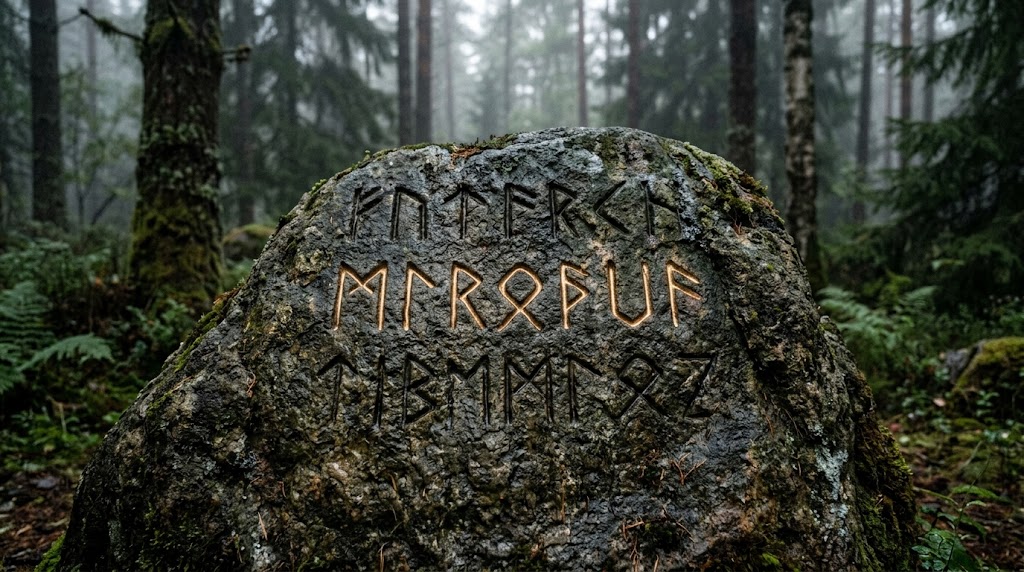
Nordic runes are the characters of ancient Germanic and Scandinavian writing systems used from the early centuries AD through the Middle Ages. The earliest Scandinavian runes date to around the 2nd century AD, while the Viking Age saw the widespread use of a shorter 16-character alphabet known as the Younger Futhark.
The word “Futhark” comes from the first six rune names in the traditional sequence: F, U, Þ, A, R and K. Unlike a modern alphabet, the number and form of runes changed over time. The oldest widely recognised Scandinavian runic alphabet contained 24 characters, but by the Viking Age it had been reduced to 16.
Runes are often presented today as mystical symbols connected with Norse gods, fate and divination. Some historical evidence does support magical or protective uses in particular contexts. However, most surviving inscriptions demonstrate something more straightforward: people used runes to write names, messages, memorials and practical statements.
That distinction is important. The historical rune tradition is more varied—and in many ways more interesting—than the modern image of runes as a fixed set of fortune-telling symbols.
What Are Nordic Runes?
Runes were a Germanic writing system that developed from Mediterranean alphabetic traditions during the centuries after the birth of Christ. The National Museum of Denmark describes them as a Germanic method of writing based on Mediterranean alphabets.
Their angular appearance was particularly suitable for carving. The Swedish History Museum explains that the shapes were designed for inscription and were especially practical when carving into materials such as wood.
This helps explain why runes appear on such a wide range of archaeological objects. Inscriptions have been found on stones, weapons, jewellery, tools, bone objects and wooden artefacts.
A particularly useful example is a 10th-century Viking comb-case now held by the British Museum. Its inscription translates as “Thorfast made a good comb”, showing that runic writing could be used for an ordinary statement connected with craftsmanship and ownership.
The evidence challenges the idea that runes were exclusively religious.
The Elder Futhark
The Elder Futhark is the earliest major runic alphabet. It consisted of 24 characters and was used during the early Germanic period.
The earliest runic traditions are associated with Scandinavia, although the script later appeared across other parts of the Germanic-speaking world. The National Museum of Denmark records inscriptions from objects including weapons and jewellery and notes that early inscriptions often consisted of names, including ownership or maker’s inscriptions.
The 24-rune system remained important for centuries, but linguistic changes eventually made its structure less suitable for Scandinavian languages.
This produced one of the most important developments in runic history.
The Younger Futhark and the Viking Age
By the Viking Age, the Scandinavian rune row had been reduced from 24 characters to 16. This version is known as the Younger Futhark.
At first glance, reducing an alphabet while a language is changing may seem counterproductive. In practice, the system relied heavily on context. Some runes represented more than one sound, meaning readers had to interpret inscriptions according to the language and surrounding letters.
The system was used throughout Scandinavia and travelled with Viking activity. Runic inscriptions made by Scandinavians have been found not only in Denmark, Sweden and Norway but also in places including England, Russia and Greenland.
This makes runes valuable historical evidence for understanding Scandinavian movement, communication and cultural contact.
| Runic system | Approximate period | Number of characters | Main context |
| Elder Futhark | Early centuries AD–early Viking Age | 24 | Early Germanic inscriptions |
| Younger Futhark | Viking Age | 16 | Scandinavian Viking Age writing |
| Medieval runes | Middle Ages | Variable developments | Everyday and religious writing |
Rune Stones and Public Memory
Runestones are among the most recognisable surviving examples of Nordic runes.
During the Viking Age, people in Scandinavia erected stones bearing inscriptions to commemorate individuals, record relationships or communicate messages. Denmark has around 260 recorded Viking Age runestones, although not all survive intact today.
The Jelling stones are particularly important. The National Museum of Denmark notes that Harald Bluetooth’s large Jelling rune stone, dating to around 965 AD, names Denmark.
The stone therefore demonstrates that runes could function as political communication as well as personal memorials.
This is one of the clearest ways runes differ from their modern popular image. A runestone could be a public statement of family, authority, memory or political identity.
Did Runes Have Magical Meanings?
The answer requires some caution.
There is evidence that runic inscriptions could have magical or protective associations. The British Museum, for example, notes that a runic inscription on an Anglo-Saxon weapon may have had a magical or protective function, although its precise significance is no longer known.
However, this does not mean every rune possessed one universal magical meaning.
Modern books and websites sometimes assign fixed interpretations such as “wealth”, “protection”, “love” or “victory” to individual runes. Some of these associations draw from later literary or occult traditions rather than directly from Viking Age inscriptions.
The historical evidence is more complicated. Meaning depended on the rune, language, inscription, object and cultural context.
Practical Insight: Symbol Is Not the Same as Translation
A rune can have a linguistic sound value without functioning as an independent symbol with a universal spiritual meaning.
That distinction prevents a common mistake in popular rune discussions: treating a historical writing character as though it were equivalent to a modern tarot card.
Runes in the Middle Ages
The arrival and spread of the Latin alphabet did not immediately eliminate runic writing.
The National Museum of Denmark explains that runes and the Latin alphabet existed alongside one another well into the medieval period. During this period, “stung” runes—characters marked with dots or similar modifications—were introduced to distinguish additional sounds.
This is an important reminder that runic writing was not simply a Viking Age phenomenon.
The script adapted as language changed. Medieval Scandinavians continued to use runes for practical writing even after Latin letters became increasingly important in religious, administrative and literary contexts.
Nordic Runes in Archaeological Research
Runic inscriptions are valuable because they provide direct evidence of language and social activity.
Museums and researchers can examine letter forms, linguistic features, carving techniques, archaeological context and object materials to establish when and where an inscription was produced.
The National Museum of Denmark maintains a database containing more than 900 Danish runic inscriptions and provides specialist runological advice.
This makes runology an interdisciplinary field involving archaeology, historical linguistics, epigraphy and cultural history.
One useful connection is with the history of Germanic languages. Understanding how Germanic languages developed helps explain why rune forms and sound values changed over time. For a broader introduction to language evolution, RubbleMagazine.co.uk’s article on the development of language families provides useful context.
Three Insights Often Missed in Discussions of Runes
1. Runes were not exclusively Scandinavian
Although runes became strongly associated with Scandinavia, their use extended across the wider Germanic world. Anglo-Saxon communities, for example, developed their own expanded runic system known as the futhorc. The British Museum records numerous runic inscriptions in England dating from the fifth to eleventh centuries.
2. A smaller alphabet did not mean less writing
The Younger Futhark contained only 16 characters, compared with 24 in the Elder Futhark. Yet it remained practical because individual characters could represent related sounds and readers relied on context.
3. Medieval runes survived alongside Latin writing
The transition from runes to Latin letters was not an overnight replacement. Medieval Scandinavian communities continued to use both systems, demonstrating that writing traditions can overlap for generations.
Structured Insight Table
| Question | Evidence-based answer |
| When did Scandinavian runes appear? | By around the 2nd century AD in Denmark, with broader early evidence from the following centuries. |
| What does Futhark mean? | It refers to the sequence named from the first six rune characters. |
| How many Elder Futhark runes were there? | 24 |
| How many Younger Futhark runes were there? | 16 |
| Were runes used only for religion? | No. They were also used for names, ownership, memorials and everyday messages. |
| Did runes survive the Viking Age? | Yes. Runic writing continued into the medieval period. |
The Future of Nordic Runes in 2027
The future of runic research is likely to be shaped less by new mythology and more by better preservation, digitisation and archaeological analysis.
Museums are already building searchable databases of inscriptions, while specialist runologists continue to document newly discovered material. The National Museum of Denmark describes ongoing scientific examination, registration and communication of new rune finds.
Digital cataloguing could make dispersed inscriptions easier to compare, while advances in imaging may help researchers examine worn or damaged characters without physically altering fragile objects.
The biggest opportunity is therefore informational: more accessible evidence could help distinguish historical rune usage from later interpretations.
Key Takeaways
- Nordic runes originated as a Germanic writing system rather than as a purely mystical alphabet.
- The Elder Futhark contained 24 characters.
- Viking Age Scandinavians generally used the 16-character Younger Futhark.
- Runestones could preserve names, family relationships, political statements and memorial messages.
- Runes were used on everyday objects as well as religious or ceremonial material.
- Some inscriptions have possible magical associations, but not every rune had a fixed spiritual meaning.
- Runic writing continued into the medieval period alongside the Latin alphabet.
Conclusion
Nordic runes are best understood first as a writing technology and only then as a symbolic tradition. Their angular forms allowed people to carve language into wood, stone, bone and metal, while their changing alphabets reflect the development of Germanic and Scandinavian languages.
The Elder Futhark’s 24 characters eventually gave way to the 16-character Younger Futhark during the Viking Age. Runes travelled with Scandinavian communities and appeared on everything from monumental stones to small household objects.
Their cultural significance is equally important. Runestones could preserve memory and communicate status, while certain inscriptions may have carried protective or magical associations. Yet the surviving evidence does not support treating every rune as a universal mystical symbol.
The enduring appeal of Nordic runes comes partly from this combination of practicality and symbolism. They were letters, but they were also part of the material culture through which Scandinavian people recorded identity, relationships, belief and memory.
Frequently Asked Questions
What are Nordic runes?
Nordic runes are characters from the runic writing traditions used by Germanic and Scandinavian peoples. They were used for inscriptions on stones, objects, weapons, jewellery and other materials.
What is the Futhark?
Futhark is the name commonly given to the runic alphabet sequence, derived from the first six characters: F, U, Þ, A, R and K.
How many Nordic runes are there?
It depends on the period. The Elder Futhark had 24 characters, while the Viking Age Younger Futhark had 16. Medieval runic forms developed further.
Were Nordic runes used for magic?
Some inscriptions may have had magical or protective functions, but runes were primarily a writing system. It is inaccurate to assume that every rune had a fixed magical meaning.
What did Vikings write with runes?
They wrote names, memorial inscriptions, ownership marks and everyday messages. Archaeological objects show that runes were used well beyond monumental religious contexts.
When did people stop using runes?
There was no single date when runic writing stopped. Runes continued alongside the Latin alphabet well into the medieval period.
Methodology
This article was researched using museum and heritage sources, with particular emphasis on the National Museum of Denmark, the Swedish History Museum and the British Museum. These sources were selected because they provide documented archaeological, runological and curatorial information rather than modern occult interpretations.
The main limitation is that surviving inscriptions represent only a fraction of historical rune use. Interpretations of individual inscriptions can also vary according to linguistic and archaeological context. Where the historical evidence for magical or spiritual meanings is uncertain, the article distinguishes documented evidence from later interpretation.
The historical framework was cross-checked against museum records covering the Elder Futhark, Younger Futhark, Viking Age inscriptions and medieval runes.
References
British Museum. (n.d.). Comb-case. The British Museum Collection.
British Museum. (n.d.). Seax. The British Museum Collection.
Historiska museet. (2025). The first runes. Swedish History Museum.
National Museum of Denmark. (n.d.). Runes. Nationalmuseet.
National Museum of Denmark. (n.d.). Runes in the Iron Age. Nationalmuseet.
National Museum of Denmark. (n.d.). Runes in the Viking Age. Nationalmuseet.
National Museum of Denmark. (n.d.). Medieval runes. Nationalmuseet.
National Museum of Denmark. (n.d.). The Viking Age. Nationalmuseet.