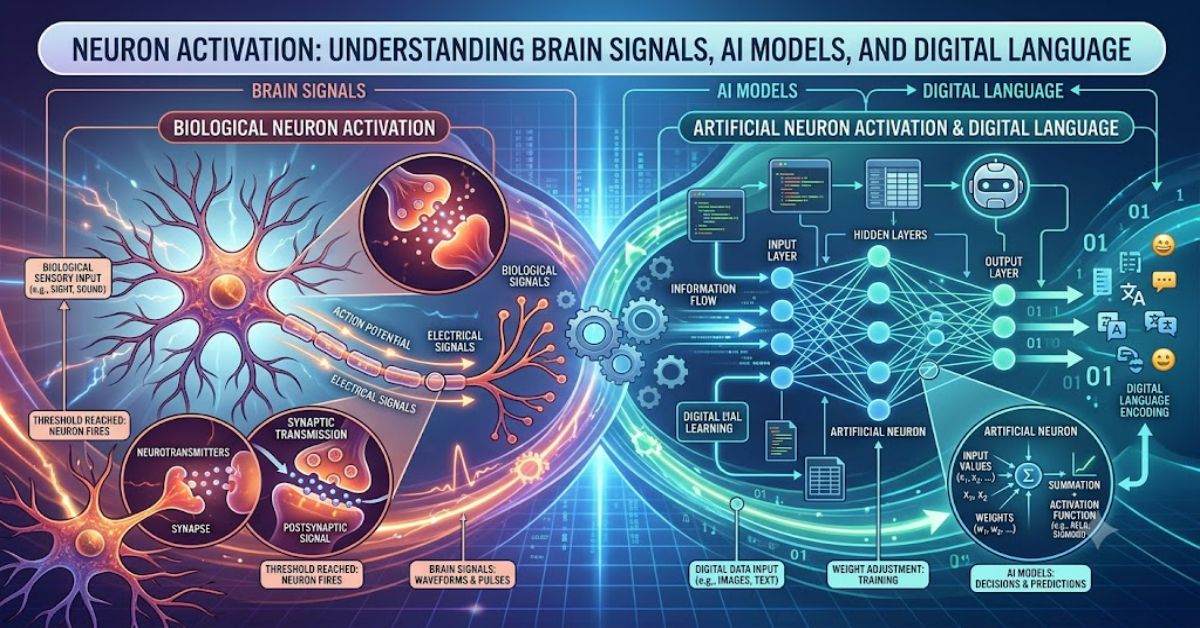
The term neuron activation carries completely different meanings depending on whether it refers to human biology, artificial intelligence, or internet culture. In neuroscience, it describes the process where nerve cells become active and transmit signals through electrical impulses and chemical communication. In artificial intelligence, it refers to mathematical functions that determine how artificial neurons respond to input data.
The concept has become increasingly common as AI systems become part of everyday technology. Machine learning models, image recognition tools, and language systems all rely on activation functions to transform information into useful outputs.
Although the wording is similar, biological neurons and artificial neurons operate in very different ways. A human brain contains billions of living cells connected through complex networks, while an AI model uses computational structures designed to imitate certain aspects of information processing.
Understanding neuron activation provides insight into both human cognition and the engineering principles behind modern AI. It also highlights an important limitation: artificial systems can replicate patterns of intelligence without actually functioning like biological brains.
What Is Neuron Activation in Biology?
In human biology, neuron activation occurs when a nerve cell receives enough stimulation to generate an electrical signal. Neurons communicate through a process involving changes in electrical charge across their membranes.
When a neuron reaches its activation threshold, it produces an action potential. This electrical impulse travels along the neuron’s axon and triggers communication with other cells through synapses.
The process supports essential functions including:
- Movement and muscle control
- Memory formation
- Sensory processing
- Emotional responses
- Decision-making
A simplified view of biological activation:
| Stage | Biological Process | Purpose |
| Signal reception | Dendrites receive information | Collect incoming signals |
| Threshold reached | Electrical charge changes | Creates activation |
| Signal transmission | Action potential travels | Sends information |
| Synaptic communication | Chemicals released | Connects neurons |
Neuroscience research has shown that activation is not simply an “on” or “off” state. Neurons vary in firing patterns, timing, and strength depending on the information being processed.
Neuron Activation in Artificial Intelligence
In artificial intelligence, neuron activation refers to how artificial neural networks process numerical inputs.
An artificial neuron receives values, applies mathematical weights, and produces an output. The activation function determines whether and how strongly the artificial neuron responds.
Common activation functions include:
| Activation Function | Common Use | Characteristics |
| ReLU | Deep learning models | Efficient and widely used |
| Sigmoid | Binary classification | Produces values between 0 and 1 |
| Tanh | Neural networks | Handles positive and negative values |
| Softmax | Classification tasks | Converts outputs into probabilities |
For example, a computer vision model analysing an image does not “see” an object in the human sense. Instead, layers of artificial neurons activate in response to numerical patterns such as edges, colours, and shapes.
This distinction is important because AI activation is a computational method, not a biological experience.
Comparing Biological and Artificial Activation
The similarity in terminology can create confusion. Both systems involve signals and responses, but their mechanisms are fundamentally different.
| Feature | Biological Neurons | Artificial Neurons |
| Structure | Living cells | Mathematical units |
| Signal type | Electrical and chemical | Numerical calculations |
| Learning process | Biological adaptation | Algorithmic training |
| Energy source | Cellular metabolism | Computer hardware |
| Speed | Slower individual signals | Faster calculations |
A key insight is that artificial activation is inspired by biology but does not reproduce the full complexity of the brain.
Why Activation Functions Matter in AI Development
Activation functions are central to neural network performance. Without them, many models would behave like simple linear calculators and would struggle with complex tasks.
They introduce non-linearity, allowing systems to identify complicated relationships within large datasets.
Modern AI applications depend on effective activation behaviour, including:
- Speech recognition
- Medical image analysis
- Autonomous systems
- Recommendation engines
- Generative AI platforms
However, activation choices involve trade-offs. A function that improves training speed may create problems with accuracy, stability, or computational efficiency.
Risks and Limitations of Understanding Activation
The popularity of AI has created misconceptions around the idea of artificial neurons.
One common misunderstanding is assuming that activated AI systems think like humans. In reality, neural networks identify statistical patterns rather than possessing awareness or understanding.
Another limitation is explainability. Large AI models may contain millions or billions of parameters, making it difficult to determine exactly why certain internal activations produce specific outputs.
This creates challenges in areas where transparency matters, including healthcare, finance, and public services.
Real-World Impact of Neuron Activation Research
Research into activation mechanisms has influenced both medicine and technology.
In neuroscience, understanding abnormal neural activity contributes to research into conditions such as epilepsy, Parkinson’s disease, and neurological injuries.
In technology, artificial activation methods have helped create systems capable of processing language, images, and complex data.
The connection between these fields has also encouraged new research areas such as brain-computer interfaces, where scientists explore communication between biological systems and machines.
The Future of Neuron Activation in 2027
By 2027, research into neuron activation is expected to continue developing across both neuroscience and artificial intelligence.
AI researchers are exploring more efficient neural architectures that require less computing power while maintaining performance. At the same time, neuroscience continues investigating how real brains process information through complex networks.
Regulation will also influence AI development. Organisations such as the European Union, through the EU Artificial Intelligence Act adopted in 2024, are placing greater emphasis on transparency, safety, and responsible AI deployment.
The future challenge is not simply creating more powerful models but understanding how these systems operate and ensuring they are used responsibly.
Key Insights
- Biological and artificial neurons share similar terminology but operate through different mechanisms.
- Activation functions are essential because they allow AI systems to process complex patterns.
- Better understanding of neural processes may improve both medical research and computing technology.
- AI activation does not represent human-like consciousness.
- Transparency remains a major challenge as neural networks become more complex.
Conclusion
Neuron activation connects two important areas of modern science: the biology of the human brain and the engineering of artificial intelligence. While both involve signals, responses, and networks, their underlying processes are fundamentally different.
Biological neurons operate through living systems shaped by evolution, while artificial neurons rely on mathematical models created by developers. Understanding this difference helps prevent exaggerated claims about AI while recognising the remarkable achievements of modern computing.
As research progresses, studying activation mechanisms will remain important for improving medical knowledge, developing smarter technologies, and creating more responsible artificial intelligence systems.
Frequently Asked Questions
What does neuron activation mean?
Neuron activation refers to the process where biological neurons become active and send signals or where artificial neurons respond to data through mathematical calculations.
How does neuron activation work in AI?
AI neuron activation uses mathematical functions to determine how strongly an artificial neuron responds to input information.
Are artificial neurons the same as brain neurons?
No. Artificial neurons are simplified computational models inspired by biological neurons but do not operate like living brain cells.
Why are activation functions important?
Activation functions allow neural networks to handle complex patterns and perform tasks such as image recognition and language processing.
Can AI neurons think like humans?
No. AI systems process patterns and data but do not have human awareness, emotions, or consciousness.
Methodology
This article was prepared using established neuroscience and artificial intelligence concepts from academic research, technology documentation, and recognised scientific sources.
The analysis separates biological neuron activity from artificial neural network terminology to avoid confusion. Limitations include the complexity of both fields and the fact that neuroscience and AI research continue to develop rapidly.
References
Bear, M. F., Connors, B. W., & Paradiso, M. A. (2020). Neuroscience: Exploring the Brain. Wolters Kluwer.
Goodfellow, I., Bengio, Y., & Courville, A. (2016). Deep Learning. MIT Press.
European Union. (2024). Artificial Intelligence Act. European Commission.
IBM Research. (2024). Neural networks and machine learning concepts. IBM.