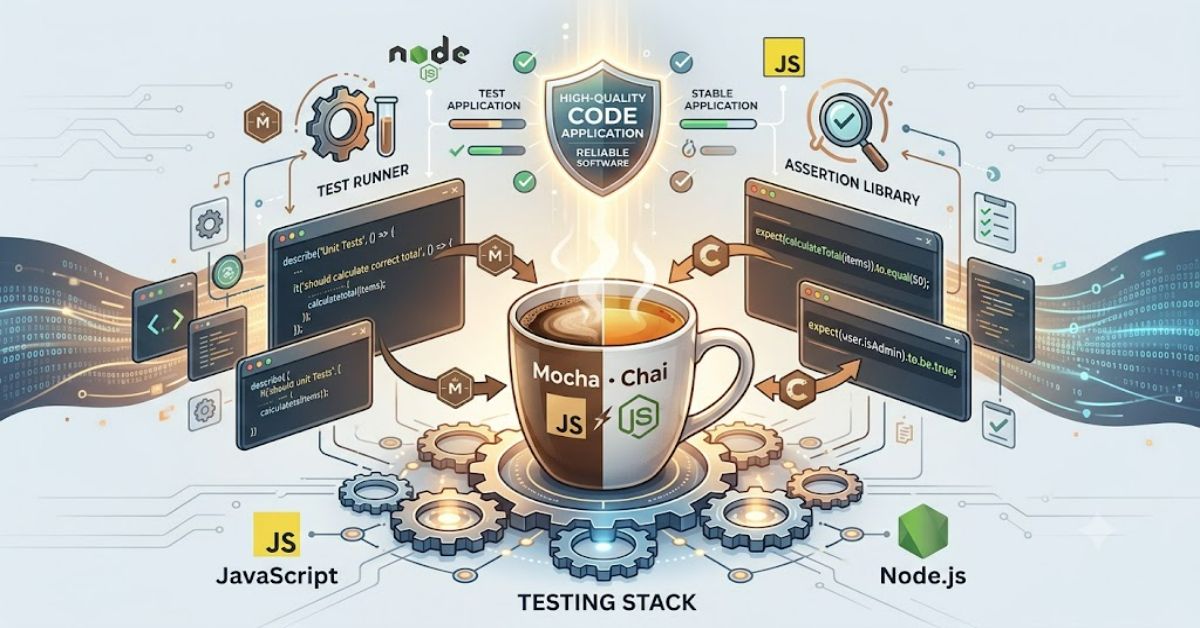
For developers building JavaScript applications, mocha chai remains one of the most recognised testing combinations available. Mocha acts as the test runner responsible for organising and executing test suites, while Chai serves as the assertion library that verifies whether code behaves as expected. Together, they provide a flexible and highly configurable testing environment suitable for Node.js backends, APIs, microservices, and browser-based applications.
Testing has become a fundamental part of modern software engineering. As applications grow in complexity, automated testing helps reduce defects, improve deployment confidence, and support continuous integration pipelines. While newer tools such as Jest and Vitest have gained popularity, many organisations continue to rely on Mocha and Chai because of their modular architecture and extensive ecosystem support.
Unlike all-in-one testing solutions, this combination allows development teams to choose supporting libraries according to project requirements. Developers can integrate coverage tools, mocking frameworks, reporting solutions, and CI/CD workflows without being locked into a single ecosystem.
The continued relevance of Mocha and Chai demonstrates an important principle in software engineering: stability often matters more than novelty. Teams responsible for maintaining production systems frequently prioritise proven tooling over rapidly changing alternatives.
This article explores how the testing stack works, where it excels, its limitations, practical implementation considerations, and its future role within JavaScript development.
Understanding the Mocha and Chai Relationship
Although commonly referenced together, the two libraries perform different functions.
Mocha: The Test Runner
Mocha handles:
- Test execution
- Test organisation
- Hooks and lifecycle management
- Asynchronous testing
- Reporting
A test runner determines when tests execute and how results are displayed.
Chai: The Assertion Library
Chai focuses on verification.
It allows developers to express expectations such as:
expect(user.name).to.equal('John');Assertions determine whether application behaviour matches intended outcomes.
Why They Work Well Together
The pairing became popular because responsibilities remain clearly separated.
- Mocha runs tests.
- Chai validates results.
- Additional libraries handle mocking or coverage.
This modular approach supports highly customised testing environments.
The Evolution of JavaScript Testing
Testing practices have changed significantly over the past decade.
Early JavaScript applications often relied heavily on manual verification. As web applications became larger and Node.js adoption accelerated, automated testing became essential.
Mocha was first introduced in 2011 by TJ Holowaychuk and quickly gained traction due to its flexibility.
Chai emerged as a complementary assertion library supporting multiple assertion styles:
- Expect
- Should
- Assert
This flexibility helped teams adopt testing gradually without forcing a single syntax preference.
Today, although frameworks such as Jest provide integrated tooling, Mocha continues to power thousands of enterprise projects.
Core Features of Mocha
Asynchronous Testing Support
Modern applications frequently depend on APIs, databases, and external services.
Mocha supports:
- Callbacks
- Promises
- Async/await
This capability remains essential for testing Node.js applications.
Flexible Reporting
Developers can generate:
- Console reports
- HTML reports
- CI/CD reports
- Coverage dashboards
Test Hooks
Hooks simplify setup and teardown processes:
beforeEach(() => { initialiseDatabase();});This reduces repetitive code and improves maintainability.
Scalability
Large enterprise applications often contain thousands of tests.
Mocha’s architecture supports extensive test suites without imposing restrictive conventions.
Chai Assertion Styles Explained
One reason developers continue using Chai is flexibility.
Expect Style
Most commonly used.
expect(result).to.equal(true);Should Style
Creates highly readable tests.
result.should.equal(true);Assert Style
Provides traditional assertion syntax.
assert.equal(result, true);Teams can choose whichever style aligns with their coding standards.
Comparison Table: Mocha Chai vs Popular Alternatives
| Feature | Mocha + Chai | Jest | Vitest |
| Modular Architecture | Excellent | Limited | Moderate |
| Built-in Assertions | No | Yes | Yes |
| Mocking Tools | External | Built-in | Built-in |
| Learning Curve | Moderate | Easy | Easy |
| Enterprise Adoption | High | High | Growing |
| Configuration Flexibility | Excellent | Moderate | Moderate |
| Ecosystem Maturity | Excellent | Excellent | Growing |
Real-World Usage in Production Systems
Many established Node.js applications continue using this testing combination.
Examples include:
- Enterprise APIs
- SaaS platforms
- Financial applications
- E-commerce systems
- Backend microservices
Observed Industry Pattern
Large engineering teams often prefer stable tooling with predictable release cycles.
Mocha’s maturity provides confidence that critical testing infrastructure will not change unexpectedly.
This is one reason many organisations continue maintaining existing test suites rather than migrating to newer frameworks.
Structured Insight Table
| Testing Requirement | Mocha Capability | Chai Capability |
| Unit Testing | Yes | Yes |
| Integration Testing | Yes | Yes |
| API Testing | Yes | Assertion Support |
| Async Workflow Validation | Strong | Strong |
| CI/CD Integration | Strong | N/A |
| Readable Assertions | N/A | Excellent |
| Plugin Ecosystem | Extensive | Extensive |
Three Important Insights Often Missed
1. Modular Architecture Can Reduce Vendor Lock-In
Many articles focus on simplicity when comparing testing tools.
However, modular systems provide strategic advantages.
Because Mocha separates execution from assertions, teams can replace individual components without rebuilding entire testing infrastructures.
2. Enterprise Migration Costs Are Often Underestimated
Switching from Mocha and Chai to newer frameworks may appear straightforward.
In reality, organisations with thousands of tests can face substantial migration costs involving:
- Refactoring
- CI/CD updates
- Documentation revisions
- Team retraining
These costs frequently outweigh potential productivity gains.
3. Testing Flexibility Becomes More Valuable at Scale
Smaller projects often benefit from opinionated frameworks.
Large systems typically require customised workflows, reporting structures, and deployment pipelines.
Mocha’s flexibility becomes increasingly valuable as application complexity grows.
Risks and Trade-Offs
No testing solution is perfect.
More Configuration Required
Compared with Jest, developers must manually configure additional tools.
Examples include:
- Coverage reporting
- Mocking libraries
- Snapshot testing
Larger Setup Overhead
New projects can require more initial effort.
This may discourage beginners.
Fragmented Ecosystem
Because functionality comes from multiple packages, version compatibility must be managed carefully.
Despite these challenges, many teams consider the flexibility worthwhile.
Strategic Importance for Modern Development
Software quality increasingly influences business outcomes.
Testing frameworks now support:
- Continuous integration
- Continuous deployment
- Release automation
- Quality assurance compliance
Mocha and Chai continue playing a role because they integrate effectively into these workflows.
The combination is particularly attractive for organisations prioritising maintainability and long-term stability.
The Future of Mocha Chai in 2027
By 2027, JavaScript testing will likely continue evolving alongside modern runtime environments.
Several trends appear likely:
Faster Test Execution
Competition from tools such as Vitest is encouraging improvements in testing performance.
Greater AI-Assisted Testing
Development platforms increasingly generate test cases automatically.
Mocha and Chai ecosystems may integrate more closely with AI-powered testing workflows.
Continued Enterprise Adoption
Legacy systems and mature codebases will continue requiring stable testing infrastructure.
While newer frameworks may dominate greenfield projects, established organisations are unlikely to abandon proven solutions quickly.
Infrastructure Constraints
Migration costs remain a significant barrier.
This reality supports continued relevance for mature testing frameworks.
The future is unlikely to be a winner-takes-all scenario. Instead, multiple testing ecosystems will coexist according to project requirements.
Key Takeaways
- Mocha manages test execution while Chai handles assertions.
- The combination remains widely used across Node.js and JavaScript ecosystems.
- Flexibility is the stack’s strongest advantage.
- Enterprise organisations often prioritise stability over newer alternatives.
- Migration costs can outweigh the benefits of switching frameworks.
- Modular architectures reduce dependency on single vendors.
- The stack remains relevant despite increasing competition.
Conclusion
The mocha chai combination has earned its reputation through reliability, flexibility, and long-term stability. While newer frameworks offer integrated experiences and simplified setup processes, Mocha and Chai continue to provide a powerful solution for organisations that value customisation and control.
Their separation of responsibilities remains one of their greatest strengths. Developers can choose the exact tools they need without becoming dependent on a single ecosystem. This approach has allowed the stack to remain relevant through multiple generations of JavaScript development.
The testing landscape will continue changing, and new frameworks will emerge. Yet the principles underpinning Mocha and Chai—modularity, transparency, and extensibility—remain highly valuable for production software engineering.
For teams managing serious Node.js applications, the pairing continues to represent a dependable foundation for automated testing, quality assurance, and long-term maintainability.
FAQ
What is Mocha Chai used for?
Mocha and Chai are used for testing JavaScript and Node.js applications. Mocha executes tests, while Chai provides assertions that verify expected behaviour.
Is Mocha a testing framework?
Mocha is primarily a test runner rather than a complete testing framework. It coordinates test execution and reporting while relying on external libraries for assertions and mocking.
Why use Chai with Mocha?
Chai provides expressive assertion syntax that complements Mocha’s execution capabilities. Together they create a flexible testing environment.
Is Mocha Chai better than Jest?
Neither is universally better. Jest offers an all-in-one experience, while Mocha and Chai provide greater flexibility and customisation.
Can Mocha test asynchronous code?
Yes. Mocha supports callbacks, promises, and async/await patterns, making it suitable for testing modern JavaScript applications.
Is Chai still actively used?
Yes. Chai remains widely used across enterprise and open-source projects, particularly alongside Mocha.
Does Mocha support TypeScript?
Yes. Mocha can be configured to work with TypeScript through tools such as ts-node and related build integrations.
Methodology
This article was developed using official Mocha and Chai documentation, JavaScript testing best practices, Node.js ecosystem resources, and industry adoption trends. Analysis focused on architectural design, practical implementation considerations, and long-term maintainability.
No proprietary benchmarking or original performance testing was conducted for this article. Readers should evaluate testing frameworks against their own project requirements, team expertise, and infrastructure constraints before making implementation decisions.
Editorial Disclosure: This article was drafted with AI assistance and reviewed and verified by [Author Name]. All data, citations, and claims should be independently confirmed by the editorial team at RubbleMagazine.co.uk before publication.
References
Mocha.js. (2025). Official documentation. https://mochajs.org
Chai.js. (2025). Official assertion library documentation. https://www.chaijs.com
OpenJS Foundation. (2025). Node.js ecosystem resources and testing guidance.
GitHub. (2025). Mocha project repository and release documentation.
GitHub. (2025). Chai assertion library repository and release documentation.