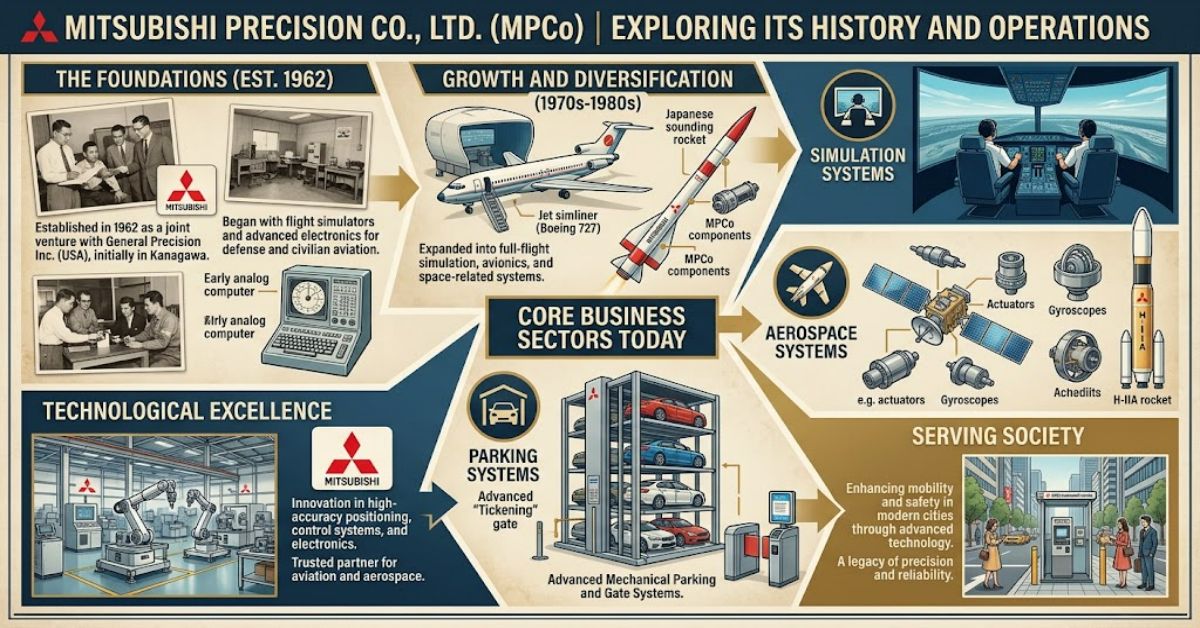
Mitsubishi Precision is a Japanese mechatronics and engineering company with roots in flight simulation and navigation technology. The company was founded on 11 May 1962 and originally focused on designing and manufacturing flight simulators and navigation equipment. Today, Mitsubishi Precision operates across simulation systems, aerospace equipment and parking systems.
For readers searching for Mitsubishi Precision, one important clarification is necessary: the supplied brief describes the company as part of the Mitsubishi Group and associates it with advanced electronics, simulator technology and aerospace navigation. Those descriptions broadly match its documented activities, but its current official company profile identifies Kenji Wakana as President and CEO.
The company’s development is notable because it has retained its original technical foundations while expanding into applications far beyond aircraft training. Its systems now support aircraft, railway and automobile simulation, satellite and launch-vehicle equipment, and sophisticated parking infrastructure.
From a 1962 Joint Venture to a Diversified Technology Company
Mitsubishi Precision began as a Japan-US joint venture between four Mitsubishi Group companies and General Precision, Inc. The purpose was to introduce and develop advanced electronics technology in Japan. The company later became entirely Japanese-owned after General Precision’s corporate ownership changed.
Its early history shows a strong connection with defence and aerospace. In 1963, the company delivered its first F-104J flight simulator to Japan’s Defence Agency and supplied an attitude and heading reference system for the aircraft. By 1968, it had begun deliveries of Doppler navigation equipment for the P-2J aircraft.
| Period | Development | Strategic significance |
| 1962 | Company established | Created a specialist electronics and simulation business |
| 1963 | F-104J flight simulator delivered | Established early aerospace simulation capability |
| 1968 | Doppler navigation equipment delivered | Expanded navigation technology |
| 1970s onward | Broader simulation and infrastructure activities | Reduced reliance on one technical application |
| Present | Three major business areas | Combines simulation, aerospace and mobility systems |
This history helps explain why the company is better understood as an engineering specialist than simply a conventional electronics manufacturer.
Mitsubishi Precision’s Three Core Business Areas
The company’s current structure centres on three fields: simulation systems, aerospace and space equipment, and parking systems.
| Business area | Main applications | Technical focus |
| Simulation Systems | Aircraft, railways, automobiles and training | Simulation, visual systems and operational environments |
| Aerospace Equipment | Satellites, rockets and defence aviation | Inertial sensors, navigation and control |
| Parking Systems | Car parks and traffic management | Vehicle recognition, payment and access control |
Simulation Systems
Simulation is the company’s longest-established specialism. Mitsubishi Precision states that it has supplied more than 4,000 simulators to organisations including driving schools, railway operators, police-related organisations, medical facilities and other users.
The importance of this technology is practical. Training on a simulator can reproduce operating conditions without exposing trainees to the cost and risk associated with using actual vehicles or aircraft. This makes simulation useful for driver education, railway operations, aviation training and research.
The company has also moved into emerging mobility applications. Its work on autonomous-driving safety evaluation uses simulation to reproduce sensor environments involving cameras, radar and LiDAR.
Aerospace and Space Equipment
The second major area is more specialised. Mitsubishi Precision supplies equipment for aircraft, satellites, rockets and defence applications, drawing on inertial sensing, inertial navigation and radio-frequency technologies.
Its documented capabilities include satellite attitude-reference systems, gyroscopes and launch-vehicle guidance systems. These applications demand high reliability because equipment may have to operate under vibration, temperature variation and other demanding conditions where maintenance or replacement is impossible.
This creates a significant technical barrier to entry. Aerospace electronics cannot be evaluated solely on purchase price or processing capability. Reliability, verification, quality control and long operational life are central considerations.
Parking Systems
Parking technology may initially appear unrelated to aerospace engineering, but the connection becomes clearer when the underlying systems are considered. Both fields require sensors, control systems, accurate identification and dependable operation.
Mitsubishi Precision has developed parking management systems covering automated payment, vehicle-number recognition, cashless payment, access control and traffic management.
The company says its parking business dates back to 1971, when it delivered parking fee-calculation equipment. Its present systems reflect the shift from simple payment equipment towards integrated mobility infrastructure.
What Makes Mitsubishi Precision Different?
One of the strongest insights from the company’s history is the value of technology transfer between sectors.
Simulation expertise can be applied to transport training and autonomous-driving evaluation. Sensor and control knowledge developed for demanding aerospace applications can support other precision systems. Parking infrastructure, meanwhile, provides a direct connection between digital systems and everyday urban mobility.
A second distinction is longevity. Mitsubishi Precision has maintained its core technical identity for more than six decades while adapting the applications around it.
A third is the balance between specialist engineering and infrastructure. Its products are often not consumer-facing. Their value is measured through reliability, training effectiveness, operational safety and system performance rather than brand visibility.
The Future of Mitsubishi Precision in 2027
Mitsubishi Precision’s 2027 outlook is closely connected to three trends: autonomous mobility, space technology and increasingly digital transport infrastructure.
The company’s autonomous-driving work is particularly relevant because simulation allows manufacturers and researchers to test scenarios before deploying systems in public environments. Its involvement in sensor simulation and safety evaluation indicates that this is already an active technical direction rather than a purely speculative one.
Railway simulation is another growth area. Mitsubishi Precision has reported more than 400 railway simulators delivered in Japan and has expanded into overseas markets, including Qatar, the Philippines and India.
The main constraint is that safety-critical technology requires lengthy validation. New artificial intelligence, sensor and cloud technologies may accelerate development, but they do not remove the need for verification, reliability engineering and regulatory compliance.
Key Insights
- The company’s foundation was directly tied to simulation and navigation technology.
- Its 1963 F-104J delivery demonstrates how early its aerospace simulation capability was established.
- Simulation has expanded from aviation into railways, automobiles and autonomous-driving research.
- Aerospace products rely on specialised inertial and guidance technologies.
- Parking systems show how precision engineering can be transferred into everyday infrastructure.
- Overseas railway projects provide one route for Mitsubishi Precision to extend its established simulation expertise internationally.
Conclusion
Mitsubishi Precision has developed from a 1962 joint venture focused on flight simulators and navigation equipment into a diversified Japanese technology company. Its current structure rests on three connected areas: simulation systems, aerospace and space equipment, and parking systems.
The company remains distinctive because these activities share an underlying emphasis on precision, sensing, control and reliable system operation. Its history also demonstrates how specialised engineering capabilities can be adapted to new markets without abandoning the technical foundations that created them.
For 2027, simulation for autonomous mobility, railway training and aerospace applications offers meaningful areas of opportunity. Yet the company’s strongest advantage may remain less visible: decades of accumulated engineering experience in applications where accuracy and reliability matter more than consumer recognition.
FAQ
What is Mitsubishi Precision known for?
Mitsubishi Precision is known for simulation systems, aerospace and space equipment, navigation technology and parking systems.
When was Mitsubishi Precision founded?
Mitsubishi Precision was founded on 11 May 1962 as a joint venture involving four Mitsubishi Group companies and General Precision, Inc.
Who is the current President and CEO of Mitsubishi Precision?
The company’s current official profile identifies Kenji Wakana as President and CEO.
What does Mitsubishi Precision manufacture?
Its products and systems include aircraft, railway and vehicle simulators, aerospace equipment, navigation and inertial systems, and parking-management equipment.
Is Mitsubishi Precision part of the Mitsubishi Group?
The company was established by Mitsubishi Group companies and General Precision. Its current major shareholders listed by the company include Mitsubishi Electric, Mitsubishi Heavy Industries and MUFG Bank.
What is Mitsubishi Precision’s aerospace business?
It supplies equipment for aircraft, satellites, rockets and defence applications, including inertial sensors, guidance and navigation systems.
Methodology
This article was based on the supplied keyword brief and checked against Mitsubishi Precision’s current official company information, business descriptions, historical records and Mitsubishi Group publications. Current leadership, founding date, business divisions and technical activities were prioritised from primary company sources.
No firsthand product testing or interview was conducted for this article. Documented company examples have therefore been attributed to published corporate material rather than presented as independent observations. A limitation is that private-company information does not provide the same level of financial disclosure as a listed corporation.
References
Mitsubishi Precision Co., Ltd. (2026). Company profile.
Mitsubishi Precision Co., Ltd. (2026). Business fields and company information.
Mitsubishi Precision Co., Ltd. (2026). Company history.
Mitsubishi Precision Co., Ltd. (2026). Simulation systems.
Mitsubishi Precision Co., Ltd. (2026). Parking systems.
Mitsubishi Corporation. (2025). Mitsubishi Precision’s train simulation system and driver training technology.
Mitsubishi Corporation. (2023). Simulation technology for autonomous-driving safety assurance.