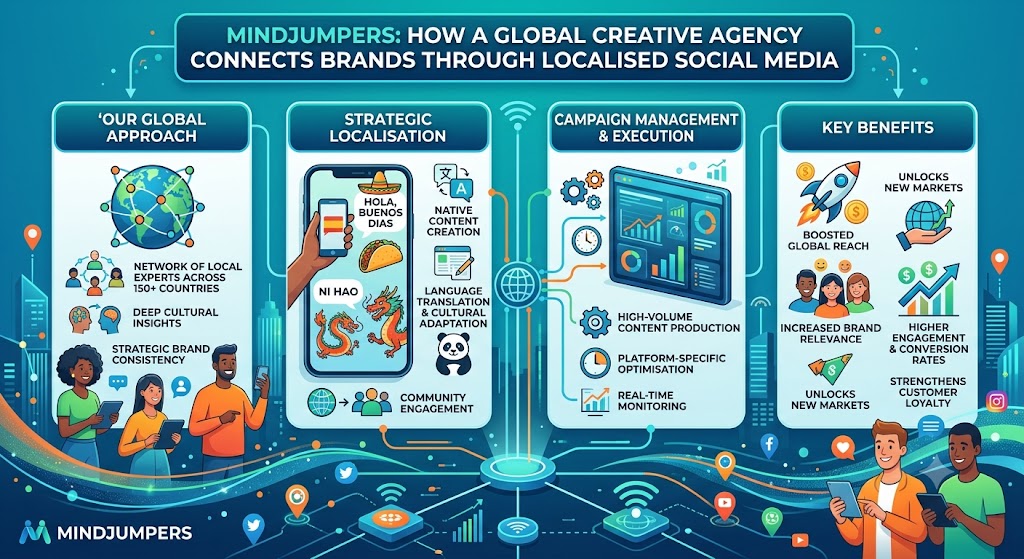
Mindjumpers is a creative and social media agency founded in Copenhagen, Denmark, in 2008, with operations extending to London and international markets. The company focuses on helping brands communicate consistently across multiple regions through content production, social media management, and locally adapted marketing strategies.
For companies expanding internationally, maintaining a recognisable identity while respecting local cultures is a major challenge. Global campaigns often fail when messaging is translated directly without considering regional behaviour, language, or consumer expectations. Agencies with international networks attempt to solve this problem by combining central brand direction with local market knowledge.
The agency’s model centres on a network of local managers operating across more than 25 countries. This structure allows brands to coordinate worldwide campaigns while adapting content for specific audiences. Rather than treating social media as a single global channel, the approach recognises that communities interact differently depending on geography, culture, and digital habits.
The rise of platforms such as Instagram, TikTok, LinkedIn, and other social channels has increased demand for specialised communication partners. Businesses now require faster content cycles, stronger community engagement, and consistent brand storytelling.
This article examines how Mindjumpers operates, the advantages of its distributed model, potential challenges, and what the future may hold for global creative agencies.
The Role of a Global Creative Agency in Modern Marketing
Creative agencies have traditionally focused on advertising campaigns, brand identity, and visual communication. However, digital transformation has expanded their responsibilities. Modern agencies must manage continuous content creation, online communities, influencer relationships, and real-time audience feedback.
A global social media partner must handle several complex areas:
| Area | Business Requirement |
| Brand strategy | Maintaining consistent messaging worldwide |
| Content production | Creating engaging digital assets regularly |
| Local adaptation | Adjusting campaigns for cultural differences |
| Community management | Responding to audiences in regional markets |
| Performance analysis | Measuring engagement and campaign results |
Mindjumpers reflects this broader agency evolution by focusing on communication systems rather than individual campaigns. Its network-based approach allows brands to maintain operational consistency while giving regional teams flexibility.
How Mindjumpers’ International Network Creates Value
One of the biggest difficulties for multinational companies is balancing global efficiency with local authenticity. A campaign designed in one country may not produce the same results elsewhere.
For example, humour, visual styles, consumer priorities, and purchasing behaviours can vary significantly between markets. A message that performs well in Scandinavia may require adjustment before being introduced to audiences in Asia, Europe, or North America.
A localised approach provides several benefits:
- Cultural understanding: Regional specialists understand language and audience expectations.
- Faster execution: Local teams can respond quickly to market trends.
- Consistent brand control: Central strategy remains aligned across countries.
This operating model has become increasingly important as brands move from occasional advertising campaigns towards always-on digital communication.
Comparing Traditional and Network-Based Agency Models
| Feature | Traditional Agency Model | Network-Based Creative Model |
| Market coverage | Usually concentrated in one location | Distributed across multiple regions |
| Local knowledge | Often limited to research | Provided by regional specialists |
| Content workflow | Central production process | Combination of global and local creation |
| Campaign adaptation | Additional localisation steps | Built into execution process |
| Scalability | Requires new partnerships | Existing network supports expansion |
The network model reduces some barriers associated with international marketing. However, it also requires strong coordination systems to ensure that local adaptations do not weaken the overall brand identity.
Strategic Advantages and Business Implications
For international companies, outsourcing social media operations can reduce internal workload and provide access to specialised expertise. Instead of creating separate teams in every market, organisations can use external partners with established processes.
Three important strategic insights emerge from this model.
First, localisation has become a competitive advantage. Consumers increasingly expect brands to understand their local context rather than deliver generic global messages.
Second, content operations require infrastructure. Successful social media management depends on workflows, approval systems, analytics tools, and communication between teams.
Third, human expertise remains important despite automation. Artificial intelligence can assist with content generation and analysis, but cultural interpretation still requires experienced professionals.
Risks and Challenges of Distributed Creative Operations
Although international networks offer benefits, they also create operational challenges.
| Challenge | Potential Impact |
| Brand inconsistency | Different regions may interpret messaging differently |
| Communication complexity | Multiple teams require strong coordination |
| Quality control | Content standards must remain consistent |
| Data management | Global campaigns require secure information handling |
A distributed agency must maintain clear guidelines, reporting structures, and approval processes. Without these systems, localisation can become fragmentation.
Another challenge is measuring success across different markets. Engagement rates, audience behaviour, and platform preferences may vary widely. A campaign cannot always be judged using identical benchmarks.
The Market Impact of Global Social Media Agencies
The growth of international digital agencies reflects wider changes in marketing. Businesses no longer compete only through products and pricing; they compete through visibility, trust, and community relationships.
Brands entering new markets often need partners that understand both technology platforms and cultural differences. This demand has increased opportunities for agencies that combine creative services with international networks.
The development of creator economies and short-form video platforms has further accelerated this trend. Companies now require continuous streams of relevant content rather than occasional advertisements.
The Future of Mindjumpers and Global Creative Services in 2027
By 2027, creative agencies are expected to operate with stronger integration between human creativity, automation tools, and data analytics.
Artificial intelligence will likely support tasks such as audience analysis, content testing, and workflow optimisation. However, strategic decisions around brand personality and cultural relevance will continue to depend on human expertise.
Regulatory developments, including stricter privacy requirements in regions such as the European Union, may also influence how agencies collect audience insights and manage digital campaigns.
The strongest agencies will likely be those that combine three capabilities: global coordination, local understanding, and responsible use of technology.
Key Takeaways
- Global brands increasingly need localised communication strategies.
- Distributed agency networks can improve international campaign execution.
- Cultural knowledge remains essential in digital marketing.
- Technology can improve efficiency but cannot fully replace creative judgement.
- Strong workflows are necessary to manage international teams.
- The future of marketing agencies will involve greater collaboration between automation and human expertise.
Conclusion
Mindjumpers represents a modern approach to creative services by combining global brand strategy with local market execution. Its Copenhagen roots and international network reflect the changing needs of businesses operating across borders.
The agency model demonstrates how marketing has moved beyond traditional advertising into continuous digital communication. Brands now require partners capable of producing content, managing communities, and adapting messages for different audiences.
While distributed creative operations create challenges around consistency and coordination, they also provide significant advantages in a world where consumer expectations vary between markets. The future success of agencies like Mindjumpers will depend on maintaining the balance between technological efficiency and genuine cultural understanding.
Frequently Asked Questions
What is Mindjumpers?
Mindjumpers is a creative and social media agency founded in Copenhagen in 2008. It provides brand communication, content production, and social media management services for international companies.
Where is Mindjumpers based?
The company is headquartered in Copenhagen, Denmark, and also has a presence in London.
What services does Mindjumpers provide?
Its services include social media management, content creation, brand communication strategy, and international campaign execution.
How does a global creative agency help businesses?
Such agencies help companies maintain consistent branding while adapting communication for different cultural and regional audiences.
Why is localisation important in social media marketing?
Localisation helps brands create content that matches regional language, culture, and consumer behaviour, improving audience connection.
Will AI replace creative agencies?
AI may improve efficiency in marketing workflows, but human expertise remains important for strategy, creativity, and cultural interpretation.
Methodology
This article was prepared using publicly available company information, industry marketing research, and general analysis of global creative agency practices. Sources were reviewed for accuracy, but specific operational details not publicly disclosed by the organisation were not assumed. The analysis considers both the advantages and limitations of international agency networks.
References
Mindjumpers. (2024). Company information and service overview. Mindjumpers official resources.
DataReportal. (2024). Digital 2024: Global Overview Report.
European Commission. (2024). Digital privacy and data protection regulations.
HubSpot. (2024). State of Marketing Report.