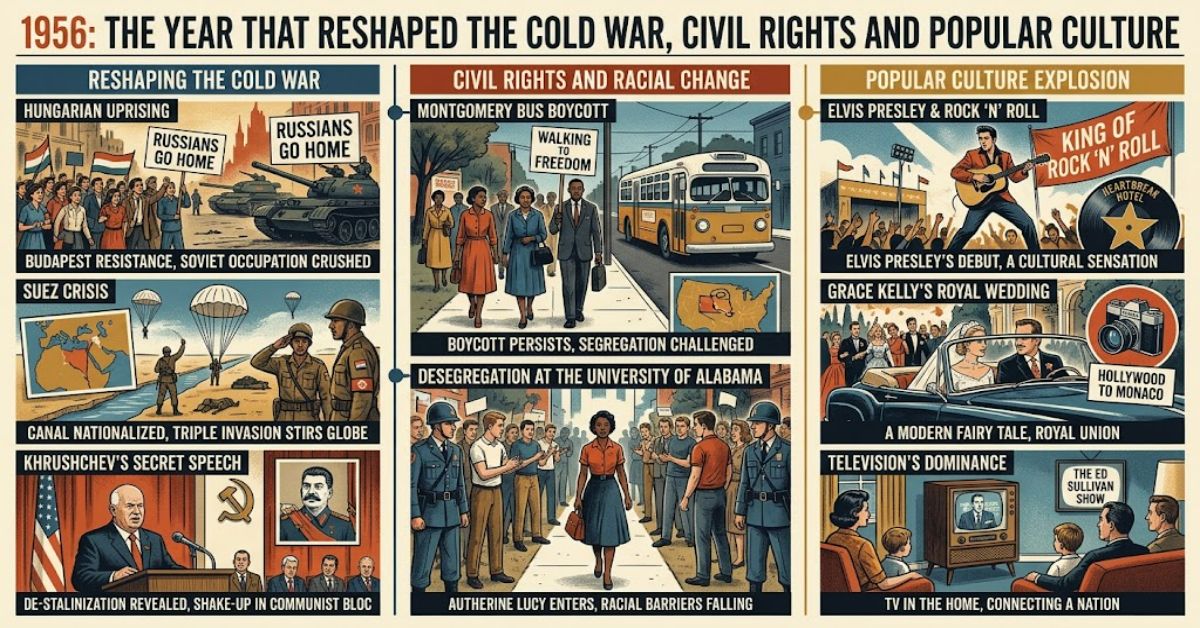
In 1956, the world stood between two very different eras. The Second World War was only a little more than a decade in the past, yet the political order it had created was already changing. The United States and Soviet Union remained locked in a Cold War, European empires were losing influence, and new social movements were challenging established systems of power.
The year produced several events that still influence how modern history is understood. In February, Soviet leader Nikita Khrushchev delivered his famous Secret Speech, criticising Joseph Stalin and the cult surrounding his rule. Later that year, the Suez Crisis demonstrated the limits of British and French power, while the Hungarian Revolution exposed the Soviet Union’s determination to retain control over Eastern Europe.
At the same time, the civil rights movement in the United States was gaining strength. The Montgomery bus boycott, which began after Rosa Parks’ arrest in December 1955, continued through 1956 and helped establish Martin Luther King Jr. as a national figure. A US federal court ruled against bus segregation in June, with the Supreme Court upholding the decision in November.
The significance of the year therefore goes beyond a list of historical events. It was a period when old political structures were being tested while new cultural and social forces were emerging.
What Made 1956 Such an Important Year?
The importance of 1956 lies in the way several developments happened at once. The year did not produce a single event that changed everything. Instead, different pressures reinforced one another.
| Area | Major development | Wider significance |
| Cold War | Khrushchev’s Secret Speech | Weakened Stalin’s political legacy |
| Middle East | Suez Crisis | Exposed limits of British and French power |
| Eastern Europe | Hungarian Revolution | Revealed Soviet control over its satellite states |
| Civil rights | Montgomery bus boycott | Strengthened organised non-violent protest |
| European integration | Spaak Report and negotiations | Helped prepare the ground for the 1957 Rome Treaties |
| Culture | Expansion of television and popular music | Accelerated changes in mass entertainment |
The combination is what makes the year especially revealing. Political authority was being questioned at the same time as technology, media and popular culture were reaching wider audiences.
The Cold War Takes a New Turn
One of the year’s most consequential developments occurred on 25 February 1956, when Khrushchev addressed the 20th Congress of the Communist Party of the Soviet Union.
His speech criticised Stalin’s dictatorship, including the cult of personality and political repression associated with the Stalin era. Although initially delivered privately, its contents spread beyond the Soviet leadership and became an important part of the process later known as de-Stalinisation. US diplomatic records also show that American officials obtained and assessed versions of the speech during 1956.
The change created a difficult contradiction. Khrushchev’s criticism suggested that Soviet communism could reform itself, but it did not mean Moscow was willing to surrender political control over Eastern Europe.
That contradiction became visible later in the year.
The Hungarian Revolution
On 23 October 1956, protests began in Hungary. Students and other demonstrators demanded political and economic reforms and challenged Soviet influence.
The uprising developed rapidly, but Soviet forces eventually intervened. The revolution was crushed in November, demonstrating that Moscow’s willingness to criticise Stalin’s methods did not extend to abandoning Soviet dominance in Eastern Europe.
The event also created a major humanitarian consequence. Large numbers of Hungarians fled the country, while the uprising became an enduring symbol of resistance to Soviet rule.
This was one of the defining contradictions of 1956: political liberalisation was being discussed inside the Soviet system while military force was used to preserve the wider Soviet sphere.
The Suez Crisis and Britain’s Changing Role
For Britain, 1956 became particularly important because of the Suez Crisis.
On 26 July, Egyptian President Gamal Abdel Nasser announced the nationalisation of the Suez Canal Company. The canal was strategically vital because it connected the Mediterranean with the Red Sea and provided an important route for oil and international trade.
British Prime Minister Anthony Eden regarded Nasser’s action as a serious threat to British interests. Britain subsequently worked with France and Israel on a military strategy. Israel attacked Egypt on 29 October, followed by Anglo-French intervention in early November.
The operation quickly became a diplomatic disaster. The United States opposed the intervention, while the Soviet Union threatened serious consequences. Financial pressure also placed Britain in a vulnerable position because sterling was under strain.
British and French forces withdrew, and the episode badly damaged Britain’s international standing. Eden resigned in January 1957. GOV.UK describes Suez as the controversial event that ultimately brought his premiership to an end.
Why Suez Mattered Beyond 1956
| Before Suez | After Suez |
| Britain sought to maintain major-power influence | Britain’s limitations became more obvious |
| European empires still carried substantial political weight | Decolonisation gained further momentum |
| Military power was central to foreign policy | Economic and diplomatic dependence became clearer |
| Britain could act with France independently | US support became increasingly important |
The deeper lesson was that military capability alone could not guarantee geopolitical influence.
Civil Rights and Social Change
Across the Atlantic, 1956 was another important year for the American civil rights movement.
The Montgomery bus boycott continued after Rosa Parks’ arrest in December 1955. Martin Luther King Jr. emerged as a major leader during the campaign, which eventually lasted 381 days.
On 4 June 1956, a federal court ruled that segregation on Montgomery buses was unconstitutional. The US Supreme Court upheld that decision on 13 November.
The significance extended beyond public transport. The boycott demonstrated how organised community action, legal challenges and non-violent protest could work together.
This became an important model for later civil rights campaigns.
Culture and Everyday Life in 1956
Political history dominates discussions of the year, but everyday culture was changing too.
Television was becoming increasingly important in Britain. BBC schedules from 1956 show a mixture of news, drama, sport, music, children’s programming and imported American entertainment. Programmes such as This Is Your Life, Panorama and televised theatre demonstrate how television was becoming part of ordinary cultural life.
Music was also becoming more youth-oriented. The growth of rock and roll helped create a cultural identity that differed from the tastes of older generations. Popular entertainment was no longer simply something consumed passively; it was increasingly tied to youth identity, fashion and social attitudes.
This cultural shift mattered because the teenagers of 1956 would become the adults who shaped the social movements of the 1960s.
A Structured View of 1956
Three broader insights stand out from the year’s events:
1. Political authority was becoming less secure.
Khrushchev challenged Stalin’s legacy, Hungarians challenged Soviet control and Nasser challenged Western influence over the Suez Canal.
2. Grassroots organisation was gaining power.
The Montgomery boycott demonstrated that sustained community action could produce legal and political change.
3. Old power structures were being replaced gradually.
Suez showed Britain’s declining ability to act independently, while European states were simultaneously exploring deeper economic cooperation.
European integration was also progressing. The Spaak Report in 1956 helped provide the groundwork for negotiations that eventually produced the Treaties of Rome in 1957.
The Future of 1956 in 2027
Looking at 1956 from 2027, its significance is increasingly visible through long-term consequences rather than isolated events.
The year helped expose the limits of imperial power, the complexity of Soviet reform and the growing importance of organised civil rights activism. It also belongs to the period when television and mass entertainment were transforming how political and cultural ideas reached ordinary households.
One useful correction is that 1956 should not be treated as the beginning of every trend associated with the post-war period. The Montgomery boycott began in 1955, while Sputnik and the space race became defining developments in 1957. NASA’s historical record confirms that the Soviet satellite programme was formally approved in January 1956, but Sputnik itself was not launched until October 1957.
That distinction matters because history is usually built through connected developments rather than single-year revolutions.
Key Takeaways
- 1956 was a major turning point in Cold War politics.
- Khrushchev’s Secret Speech challenged the political legacy of Stalin.
- The Hungarian Revolution showed the limits of Soviet liberalisation.
- The Suez Crisis exposed Britain’s declining strategic independence.
- The Montgomery campaign strengthened the American civil rights movement.
- Television and popular entertainment were becoming powerful forces in everyday culture.
- European economic cooperation was moving towards the institutions created in 1957.
Conclusion
1956 deserves its reputation as a pivotal year because several major historical forces collided within twelve months. The Cold War became more complicated after Khrushchev’s criticism of Stalin, yet the Hungarian Revolution demonstrated that Soviet control remained firmly enforced. The Suez Crisis exposed the weakening position of Britain and showed how economic and diplomatic pressure could constrain military ambitions.
At the same time, the civil rights movement was proving that organised non-violent protest could challenge established discrimination. In Britain and elsewhere, television and popular culture were changing how people experienced news, entertainment and public life.
The importance of 1956 therefore rests less on one defining event than on the direction of change. Empires were losing authority, citizens were demanding greater rights, and political alliances were being reorganised. Many of the developments that shaped the following decade were already visible.
Frequently Asked Questions
What happened in 1956?
Major events included Khrushchev’s Secret Speech, the Suez Crisis, the Hungarian Revolution and important developments in the American civil rights movement.
Why was 1956 important in the Cold War?
It exposed tensions within the Soviet system while also showing that Moscow remained determined to maintain control over Eastern Europe.
What was the Suez Crisis of 1956?
The Suez Crisis began after Egyptian President Gamal Abdel Nasser nationalised the Suez Canal Company. Britain, France and Israel subsequently became involved in military action against Egypt.
What happened to the civil rights movement in 1956?
The Montgomery bus boycott continued, while a federal ruling against bus segregation was upheld by the US Supreme Court in November 1956.
Did Sputnik launch in 1956?
No. Soviet officials formally approved the satellite programme in January 1956, but Sputnik 1 was launched on 4 October 1957.
How did 1956 affect Britain?
The Suez Crisis severely damaged Britain’s international position and contributed to a broader recognition that the country could no longer exercise global power in the same way as before.
Methodology
This article was prepared using historical records and institutional sources, with particular attention to the UK National Archives, GOV.UK, US National Archives, US State Department historical documents, NASA historical records and BBC archival programme information. These sources were used to distinguish events that occurred during 1956 from developments that were already under way or occurred shortly afterwards.
No firsthand reporting, interviews or personal observations were used, so none have been presented as such. The article provides a concise historical interpretation rather than an exhaustive academic history. A human editor should independently verify dates, quotations, statistics and references before publication.
Editorial disclosure: This article was drafted with AI assistance and should be reviewed and fact-checked by the publication’s editorial team before publication.
References
National Archives. (2026). Spotlight on: Suez Crisis. The National Archives.
National Archives. (2026). An Act of Courage: The arrest records of Rosa Parks. US National Archives.
National Aeronautics and Space Administration. (2022). 65 years ago: Sputnik ushers in the Space Age. NASA.
National Aeronautics and Space Administration. (2026). Synopsis of report on development of conceptual design of an artificial Earth satellite. NASA History Office.
Office of the Historian. (1956). Foreign Relations of the United States, 1955–1957: Soviet Union, Eastern Mediterranean, Volume XXIV. U.S. Department of State.
GOV.UK. (2026). History of Sir Anthony Eden. UK Government.