The hot crazy scale is a viral internet concept that attempts to explain dating behaviour through a simple and provocative idea: a person can be “crazy” as long as they are equally “hot.” While widely shared across social media and meme culture, the idea is not a scientific framework but a fictional construct popularised by television.
The concept first gained traction through the sitcom How I Met Your Mother, where it was presented as a humorous dating rule rather than a serious theory. Over time, it escaped its comedic context and entered online discourse, especially on forums discussing modern dating dynamics.
At its core, the hot crazy scale reflects how people rationalise attraction, red flags, and relationship trade-offs. It has become shorthand for conversations about emotional volatility versus physical attraction—especially in digital dating environments where quick judgments are common.
Despite its popularity, psychologists and relationship experts do not recognise it as valid. Instead, it functions more as cultural commentary than behavioural science.
This article breaks down how the idea works, why it spread so widely, and what it reveals about modern dating culture.
The Origins of the Hot Crazy Scale
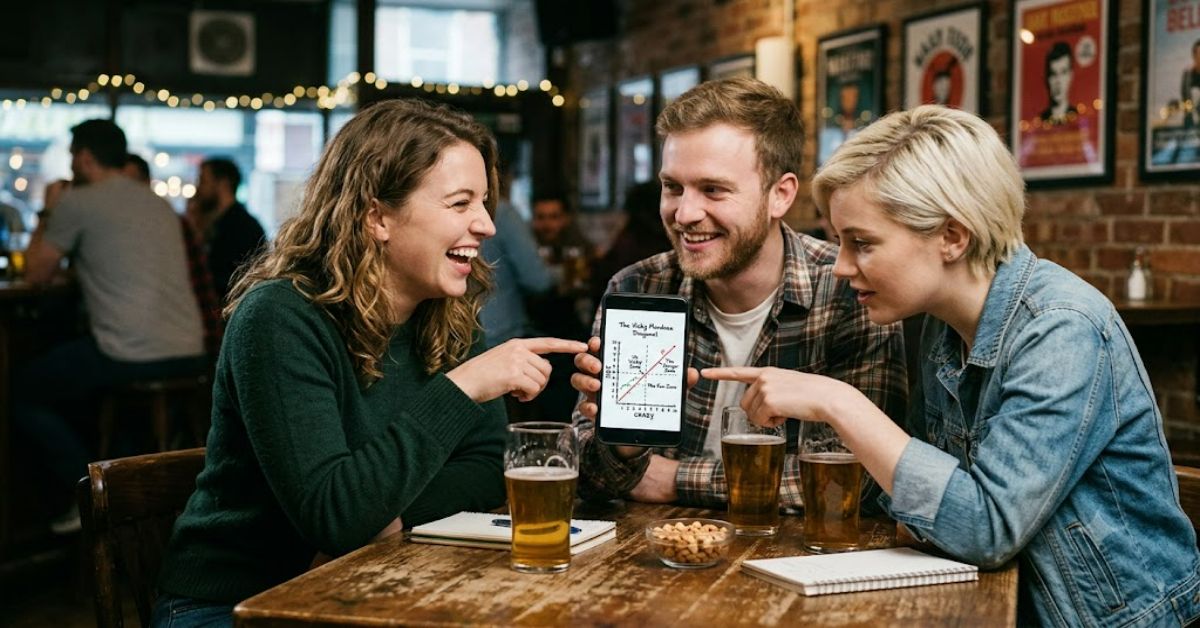
The concept was popularised in How I Met Your Mother through a comedic “graph” describing acceptable levels of emotional instability based on physical attractiveness.
Its spread was amplified by:
- Early 2010s meme culture
- Reddit relationship discussions
- Short-form social media humour formats
It is important to note that the scale was never intended as behavioural science.
How the Idea Works in Meme Culture
The meme version of the hot crazy scale usually appears as a 2×2 grid:
| Attraction Level | Emotional Stability | Interpretation |
| High | High | Ideal partner |
| High | Low | “Danger zone” but tolerable in meme logic |
| Low | High | Friend zone stereotype |
| Low | Low | Avoid |
This oversimplification is part of its appeal—and its criticism.
Why It Became So Popular
Three cultural drivers explain its virality:
- Dating app fatigue: People use humour to process frustration with modern dating.
- Simplicity bias: Humans prefer simple frameworks for complex emotional decisions.
- Relatability factor: Most people recognise at least one exaggerated dating scenario.
Psychological and Social Criticism
Relationship experts argue the concept is misleading because it:
- Reduces personality to binary traits
- Encourages superficial judgement
- Reinforces harmful stereotypes about emotional instability
Real relationship dynamics involve attachment style, communication patterns, and compatibility—none of which fit into a 2D graph.
Takeaways
- The hot crazy scale is cultural satire, not psychology
- Its popularity reflects real frustrations with modern dating
- It oversimplifies emotional complexity into meme logic
- It continues to evolve as internet humour, not theory
- It highlights how attraction is often rationalised after the fact
Conclusion
The hot crazy scale persists because it is entertaining, not because it is accurate. It compresses a messy emotional reality into a shareable idea that feels intuitively familiar, even if it fails under scrutiny.
Its endurance says more about internet culture than dating science. People gravitate toward frameworks that help them explain confusing experiences, especially in relationships where logic often lags behind emotion.
As long as dating remains a dominant theme in online humour, concepts like this will continue to circulate—not as advice, but as commentary disguised as structure.
FAQ
Is the hot crazy scale real?
No. It is a fictional meme originating from a sitcom, not a psychological model.
Where did the hot crazy scale come from?
It was popularised by How I Met Your Mother and later spread through internet meme culture.
Do relationship experts use this concept?
No. It is not recognised in psychology or relationship counselling.
Why do people talk about it seriously online?
Because it simplifies complex dating frustrations into an easy-to-understand joke.
Is there any scientific basis behind it?
No formal research supports the framework.
Methodology
This article is based on cultural analysis of meme usage across social platforms and review of publicly available discussions referencing the concept. No psychological experiments or primary behavioural datasets were used.
Limitations include the absence of peer-reviewed literature on the hot crazy scale as it is not a recognised academic model. Interpretation is therefore restricted to cultural and media analysis.