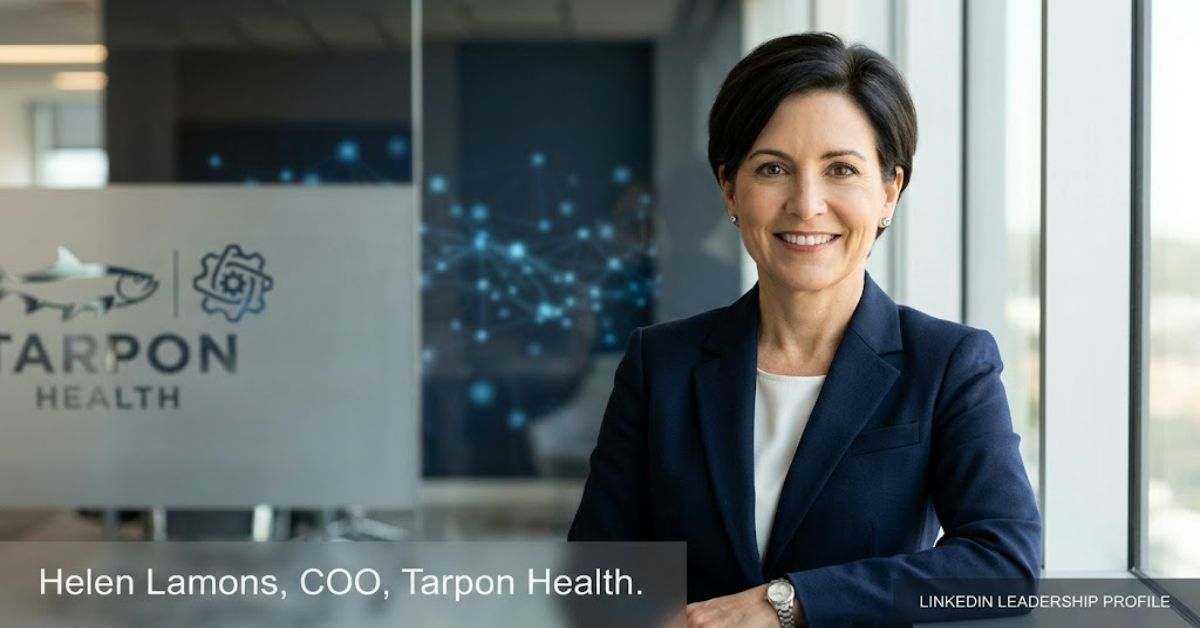
The search term helen lamons tarpon health linkedin coo points to Helen Richards Lamons and her executive leadership role at Tarpon Health. According to the information provided, Lamons serves as the company’s Chief Operating Officer, placing her in a senior position within an organisation working at the intersection of healthcare technology, Revenue Cycle Management, commonly known as RCM, and automation programmes.
The role of a Chief Operating Officer is particularly important in technology-led healthcare businesses. While a company may develop innovative systems and services, operational leadership determines how effectively those solutions are implemented, scaled and managed. A COO may oversee internal processes, support business growth and help ensure that strategic decisions translate into practical results.
Tarpon Health’s focus on RCM and automation places it within an area of healthcare where efficiency, workflow management and financial processes can have a direct effect on provider organisations. Revenue Cycle Management covers the administrative and financial processes involved in healthcare services, from patient and billing information through to claims and payment activities.
This makes operational leadership essential. Technology can improve a process, but successful implementation also depends on organisational coordination, customer requirements and the ability to manage change.
Who Is Helen Richards Lamons?
Helen Richards Lamons is identified in the supplied information as the Chief Operating Officer at Tarpon Health. Her position places her within the executive leadership structure of a healthcare technology company focused on improving aspects of revenue cycle management through technology and automation.
The COO position generally involves turning organisational strategy into operational action. Depending on the company structure, this can include responsibility for internal operations, service delivery, growth planning, process development and cross-functional coordination.
For a healthcare technology organisation, operational leadership can be especially complex. Healthcare businesses often operate within environments where efficiency must be balanced against accuracy, privacy, customer expectations and changing industry requirements.
Understanding the COO Role
A Chief Operating Officer is commonly responsible for ensuring that an organisation functions effectively on a day-to-day basis while supporting its wider strategic direction.
The exact responsibilities vary between companies, but several areas are often associated with the role.
| Operational Area | Typical Strategic Focus |
| Business operations | Improving processes and organisational efficiency |
| Service delivery | Ensuring services meet operational expectations |
| Growth | Preparing systems and teams for expansion |
| Technology implementation | Supporting the practical adoption of new tools |
| Cross-functional leadership | Coordinating teams across different business areas |
In a company focused on healthcare technology, these responsibilities may become closely connected to how customers adopt new systems and how operational processes develop as the organisation grows.
Tarpon Health and Revenue Cycle Management
Tarpon Health operates in the healthcare technology sector with a stated focus on Revenue Cycle Management and automation programmes.
RCM is an important part of the financial infrastructure of healthcare organisations. It generally involves the processes associated with managing financial interactions connected to patient services.
These processes can include information management, billing, claims administration and payment workflows. When processes become inefficient, organisations may experience delays, additional administrative workloads and greater operational complexity.
Automation is therefore becoming increasingly relevant. Automated workflows may help reduce repetitive tasks and improve consistency, although technology alone does not guarantee successful outcomes. Systems must be integrated carefully into existing processes, and organisations must ensure that employees understand how new workflows affect their responsibilities.
Why Operational Leadership Matters in Healthcare Technology
Healthcare technology businesses face a challenge that differs from many standard software companies. Their products may operate within highly complex environments involving providers, administrative teams, patients and financial systems.
A strong operational strategy can help ensure that growth does not create unnecessary complexity.
For a COO, this may involve balancing several competing priorities:
- Scaling the organisation while maintaining service quality.
- Supporting innovation without disrupting essential workflows.
- Coordinating technology and operational teams.
- Understanding customer requirements.
- Identifying inefficiencies that may affect delivery.
The position held by Helen Richards Lamons at Tarpon Health therefore sits within an area where business operations and healthcare technology intersect.
Leadership and Automation
Automation is often discussed as a technical issue, but its success depends heavily on operational planning.
A company can introduce advanced software, yet the expected benefits may not appear if the technology does not fit existing workflows. Employees may require training, customers may need implementation support and organisations may need to redesign processes around the new system.
This creates an important leadership challenge. The objective is not simply to automate as many tasks as possible. The stronger approach is to identify which processes benefit from automation and where human judgement remains necessary.
For healthcare organisations, this distinction can be particularly important because financial and administrative processes often involve complex exceptions that may not fit a single automated workflow.
Key Operational Considerations
| Consideration | Why It Matters |
| Workflow design | Technology must fit practical working processes |
| Scalability | Systems should support future organisational growth |
| Customer adoption | New technology must be usable and understandable |
| Process consistency | Automation can reduce unnecessary variation |
| Human oversight | Complex decisions may still require professional judgement |
These factors demonstrate why operational leadership is closely connected to technology adoption.
The Growing Importance of Healthcare RCM Technology
Healthcare organisations continue to face pressure to improve administrative efficiency. Revenue Cycle Management is one area where technology and automation can potentially reduce manual workloads and improve process visibility.
However, the sector also presents trade-offs. Automation can increase efficiency, but poorly designed systems may create new complications. Integration problems, inconsistent data and inadequate process design can limit the benefits of new technology.
This means healthcare technology companies need more than strong products. They also need effective implementation strategies and operational leadership.
Tarpon Health’s focus on RCM and automation positions the company within this broader business challenge. The operational role held by Helen Richards Lamons is relevant because company growth and technology adoption require coordination across multiple areas.
The Future of Helen Lamons and Tarpon Health in 2027
By 2027, automation is likely to play an even greater role in healthcare administration. Organisations will continue looking for ways to improve efficiency while maintaining appropriate oversight of critical processes.
For healthcare technology leaders, the main challenge may be balancing automation with reliability and practical usability. Companies that introduce technology without understanding customer workflows may struggle to achieve sustained adoption.
Operational leaders will therefore remain important. The COO function can help connect high-level business strategy with the everyday processes required to deliver products and services effectively.
For Helen Richards Lamons and Tarpon Health, future developments will depend on factors including company strategy, customer adoption, technology development and the wider evolution of healthcare administration. Specific future outcomes cannot be confirmed from the information provided, but the importance of RCM and automation suggests that operational efficiency will remain a significant area of focus.
Key Takeaways
- Helen Richards Lamons is identified as the Chief Operating Officer at Tarpon Health.
- Tarpon Health works in healthcare technology with a focus on RCM and automation programmes.
- The COO role can connect organisational strategy with operational delivery.
- Revenue Cycle Management involves important administrative and financial healthcare processes.
- Automation requires effective workflow design and human oversight.
- Technology adoption depends on operational planning as well as software capability.
- Healthcare technology companies must balance efficiency with reliability and practical implementation.
Conclusion
The keyword helen lamons tarpon health linkedin coo reflects interest in Helen Richards Lamons and her leadership position at Tarpon Health. As Chief Operating Officer, she occupies a role associated with the operational side of an organisation working in healthcare technology, Revenue Cycle Management and automation.
The broader significance of this position lies in the growing demand for efficient healthcare administration. Technology can support improved workflows, but successful implementation requires careful planning, coordination and an understanding of how systems operate in real working environments.
Tarpon Health’s focus on RCM and automation places it within a sector where operational performance can be closely connected to technology adoption. The role of a COO is therefore relevant not only to internal business management but also to the practical delivery and scaling of technology-driven services.
As healthcare organisations continue to explore automation, leadership that connects strategy, operations and implementation is likely to remain essential.
FAQs
Who is Helen Richards Lamons?
Helen Richards Lamons is identified as the Chief Operating Officer of Tarpon Health, a healthcare technology company focused on Revenue Cycle Management and automation programmes.
What is Helen Lamons’ role at Tarpon Health?
She serves as Helen Lamons Tarpon Health LinkedIn COO. The role is generally associated with overseeing operational strategy, business processes and the effective delivery of organisational objectives.
What does Tarpon Health do?
Based on the supplied information, Tarpon Health is a healthcare technology company focused on Revenue Cycle Management and automation programmes.
What is Revenue Cycle Management?
Revenue Cycle Management refers to the administrative and financial processes associated with healthcare services, including workflows connected with billing, claims and payments.
Why is automation important in healthcare RCM?
Automation may help organisations reduce repetitive administrative work, improve process consistency and manage workflows more efficiently. Its effectiveness depends on proper implementation and operational planning.
Is Helen Lamons associated with Tarpon Health?
Yes. The information provided identifies Helen Richards Lamons as the Chief Operating Officer at Tarpon Health.
Methodology
This article is based on the supplied editorial brief, which identifies Helen Richards Lamons as Chief Operating Officer at Tarpon Health and describes the company as a healthcare technology business focused on Revenue Cycle Management and automation programmes. The broader explanations of COO responsibilities, RCM and automation are contextual analysis. No unverified personal biography, performance statistics or firsthand experience has been added.