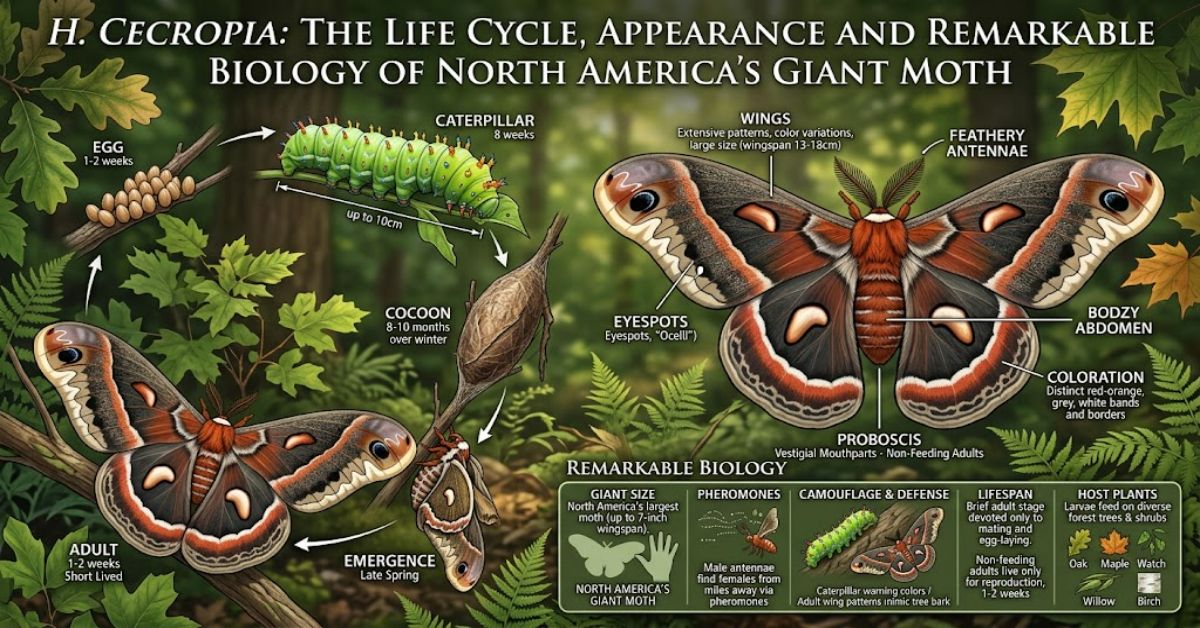
H. cecropia refers to Hyalophora cecropia, commonly called the cecropia moth. It is one of the most recognisable giant silk moths in North America and is regarded as the continent’s largest native moth by wingspan. Adults can measure approximately 110 to 180 millimetres across, giving them an imposing presence when they rest with their wings spread.
The species belongs to the family Saturniidae, a group known for large bodies, elaborate wing patterns and unusual life histories. The adult cecropia moth is particularly distinctive because of its reddish-brown, black, white and red markings, prominent eyespots and feathery antennae in males.
Yet its size is only part of the story. The adult stage is remarkably short. Adults do not feed because they lack functional mouthparts. Instead, they rely on energy accumulated during their caterpillar stage. Their brief adult existence is focused primarily on reproduction. Documented observations place the typical adult lifespan at around 10 days, with reported variation from approximately five to 12 days.
That contrast explains much about the species. Most of its life is spent developing rather than flying. A caterpillar eats, grows through several moults and eventually forms a protective cocoon before entering diapause. The adult that emerges is essentially the reproductive phase of a much longer annual cycle.
Understanding that cycle makes the cecropia moth more than an impressive garden sighting. It reveals how a large insect can survive through seasonal change, avoid predators and reproduce within a remarkably compressed adult window.
What Is H. cecropia?
The name Hyalophora cecropia identifies a species of giant silk moth belonging to the order Lepidoptera and family Saturniidae. Its natural range covers much of eastern North America, extending through large areas of the United States and southern Canada.
The species is associated with temperate environments but is not restricted to remote woodland. Documented habitats include forests, agricultural areas, orchards, suburban spaces, back gardens and younger hardwood growth. This flexibility helps explain why people occasionally encounter the caterpillar or adult moth close to human settlements.
Its common name, cecropia moth, is generally more familiar outside scientific contexts. The scientific name is particularly useful because it distinguishes the animal from other large silk moths with similar appearances.
A quick biological profile
| Characteristic | H. cecropia |
| Scientific name | Hyalophora cecropia |
| Family | Saturniidae |
| Order | Lepidoptera |
| Adult wingspan | About 110–180 mm |
| Adult feeding | Does not feed |
| Adult lifespan | Typically about 10 days |
| Generations | One per year |
| Larval diet | Leaves of many deciduous trees and shrubs |
| Winter stage | Pupa inside cocoon |
| Main adult purpose | Reproduction |
The figures demonstrate an unusual allocation of time. The species spends roughly a year progressing through its developmental stages, yet its final adult phase can last only days.
Why the Cecropia Moth Is So Large
Size is one of the first features people notice. Adult wingspans commonly fall within the range of 110 to 180 millimetres, although individual measurements vary.
The large wings are accompanied by a heavy, hairy body. The overall effect can make the moth appear more like a small bird or bat than a typical garden moth, particularly when seen unexpectedly at night.
Its wing pattern is equally distinctive. The wings contain dark areas alongside white and reddish markings, while crescent-shaped eyespots provide strong visual contrast. The hindwings and forewings carry bands and patches that break up the outline of the insect.
These markings have a practical biological function. Eyespots and sudden displays can contribute to predator deterrence, making the moth appear less like an easy insect meal. Animal Diversity Web records the eyespots as part of a startle or defensive display.
The spectacular appearance therefore has an ecological purpose rather than being merely decorative.
The Cecropia Caterpillar
The adult moth attracts attention, but the caterpillar is responsible for most of the animal’s growth.
Cecropia larvae begin as very small, dark caterpillars and change appearance as they pass through successive instars. Later stages become predominantly green and develop conspicuous coloured structures called scoli. These structures may appear blue, yellow, orange or reddish depending on their position on the body.
A fully developed caterpillar can reach roughly 100 millimetres in length. The University of Minnesota Extension records mature larvae at up to about 102 millimetres.
This stage is essentially a biological growth engine. The caterpillar eats leaves, increases dramatically in size and stores the energy required for metamorphosis and adult reproduction.
What does the caterpillar eat?
The species is a polyphagous folivore, meaning its larvae consume leaves from a relatively broad selection of plants. Recorded host plants include maple, birch, cherry, willow, poplar, ash, beech, apple and several other deciduous trees and shrubs.
This broad host range is strategically useful. A species dependent on one plant would be particularly vulnerable to local changes in vegetation. The cecropia caterpillar instead has access to numerous potential food sources across its range.
For gardeners, however, there is an important distinction between feeding and serious damage. The University of Minnesota Extension notes that cecropia caterpillars rarely occur in numbers high enough to cause significant damage to trees.
That makes the species very different from many common garden pests.
The Cocoon and Winter Strategy
After completing its larval development, the caterpillar stops feeding and begins constructing a silk cocoon.
The cocoon provides protection during the pupal stage, when the insect undergoes the profound physiological changes associated with metamorphosis. Cecropia moths overwinter in this state rather than remaining active as adults.
Research has documented two broad cocoon forms, described as baggy and tight. Guerra and Reppert’s 2017 study found that the two forms contain similar amounts of silk, while their precise adaptive significance remains uncertain. The authors considered the possibility that variation could represent a strategy for dealing with unpredictable winter conditions.
This is an important example of where biological evidence needs to be separated from attractive speculation. The two cocoon forms are documented. Their exact evolutionary advantage, however, has not been definitively established.
A Life Built Around Timing
One of the most interesting characteristics of H. cecropia is the extreme imbalance between its developmental and adult stages.
| Life stage | Main function | Approximate timing |
| Egg | Beginning of development | Spring or early summer |
| Caterpillar | Feeding and growth | Summer into autumn |
| Pupa | Metamorphosis and overwintering | Autumn through spring |
| Adult | Mating and egg laying | Usually around one to two weeks |
Animal Diversity Web reports that individuals generally require about 11 to 13 months to reach adulthood, while the adult phase itself normally lasts around 10 days.
That creates one of the species’ central biological trade-offs: enormous investment in development produces an adult stage that is highly specialised but extremely short.
The adult therefore does not need a conventional feeding system. Its energy requirements are met by reserves accumulated earlier.
Why Adult Cecropia Moths Cannot Eat
Adult cecropia moths lack functional mouthparts. This is not an accident or developmental defect. It is an evolutionary feature associated with their reproductive strategy.
Instead of spending their limited adult time searching for food, adults rely on stored energy. Their behaviour is centred on finding mates and, in females, laying eggs on appropriate host plants.
Male moths have particularly elaborate, feather-like antennae. These structures are highly sensitive to chemical signals released by females.
After a female releases pheromones, a male can detect the chemical signal and orient towards its source. This is an efficient solution to a major problem: finding another individual of the same species during a very short adult window.
The contrast is striking. The adult has enormous wings and sophisticated sensory structures, yet no functional feeding apparatus.
Reproduction and the Adult Stage
The reproductive strategy of the species is tightly linked to its short lifespan.
Females emerge from their cocoons carrying mature eggs. After mating, they begin depositing eggs on suitable host plants. Animal Diversity Web reports an average of approximately 300 eggs per female, with documented seasonal totals ranging from about 80 to 400.
Males, meanwhile, use their enlarged antennae to locate females by following pheromone trails.
This creates a useful biological division of labour. The caterpillar stage concentrates on biomass accumulation, while adulthood concentrates on reproduction.
The adult moth’s lack of feeding also means that its success depends heavily on what happened months earlier. Poor larval nutrition, environmental stress or failure to accumulate sufficient reserves can affect the quality of the eventual adult.
Predators and Ecological Importance
Being large and colourful does not make the cecropia moth immune to predators.
Caterpillars are consumed by spiders, wasps, true bugs and other predators. Pupae can also be attacked by birds and mammals. Animal Diversity Web reports particularly notable predation on cocoons, including attacks by downy and hairy woodpeckers.
The species therefore occupies several positions in the food web.
| Stage | Ecological role |
| Egg | Food source for small predators and parasitoids |
| Caterpillar | Herbivore and prey |
| Pupa | Protected but vulnerable prey |
| Adult | Reproductive moth and prey for some predators |
This leads to an important insight: protecting the species does not require treating it as a pest-free ornamental curiosity. Its value comes partly from its participation in ordinary ecological processes.
Threats Facing the Species
Cecropia moths do not currently have special federal conservation status, according to the species account reviewed for this article. However, that does not mean every local population is free from pressure.
Potential pressures include habitat alteration, pesticide use and parasitoids.
Urban development can reduce the availability of suitable host plants. Broad-spectrum pest-control practices can also affect non-target insects, including caterpillars that are not responsible for meaningful tree damage.
This creates a practical management issue. A homeowner may apply insecticide to protect ornamental vegetation without realising that a harmless native caterpillar is present.
The University of Minnesota Extension’s observation that cecropia caterpillars rarely reach damaging densities provides useful context: eliminating every caterpillar is not generally necessary to protect a healthy tree.
Three Evidence-Based Insights Often Missed
The adult’s short life is not the whole story
The commonly repeated statement that cecropia moths “live for only a few days” can be misleading without context. The adult stage is short, but the complete biological life cycle lasts roughly a year. The apparent contradiction disappears when lifespan is separated into developmental and adult phases.
A giant caterpillar does not automatically mean a serious tree pest
Large size can make a caterpillar look destructive. However, documented extension guidance indicates that cecropia larvae generally occur at densities too low to cause serious tree damage.
Cocoon location can affect survival
Documented research and species observations indicate that cocoons are not equally exposed to predators. The location and concealment of a cocoon can therefore influence survival, demonstrating that the seemingly passive pupal stage still involves important ecological pressures.
The Future of H. cecropia in 2027
There is no strong basis for predicting a dramatic population change for cecropia moths specifically by 2027. The more defensible outlook is local and habitat-focused.
The species can use forests, orchards, suburban landscapes and other areas containing suitable deciduous host plants. This means future outcomes will depend partly on whether those environments retain diverse vegetation and avoid unnecessary insecticide use.
Climate conditions may also influence seasonal emergence because the pupal stage is sensitive to temperature. Research summarised in the species literature shows that temperature affects post-diapause development and the timing of adult emergence.
For 2027, the most sensible expectation is therefore not a sweeping population forecast but continued sensitivity to local habitat quality, seasonal temperatures, pesticide exposure and availability of host plants.
Key Takeaways
- Identification: H. cecropia is the scientific name of the cecropia moth, a giant silk moth native to North America.
- Size: Its wingspan can reach approximately 180 millimetres.
- Adult biology: Adults lack functional mouthparts and depend on stored energy.
- Life cycle: Most of the species’ life is spent as a caterpillar or pupa.
- Reproduction: Adults have a narrow window for finding mates and producing the next generation.
- Garden impact: Caterpillars generally do not reach densities that cause serious tree damage.
- Ecological role: The species serves as both herbivore and prey within terrestrial food webs.
Conclusion
H. cecropia is remarkable not simply because it is large, but because almost every part of its biology is built around a tightly timed annual cycle. Its caterpillar stage is devoted to feeding and growth. Its cocoon provides a protected environment for metamorphosis and seasonal survival. Its adult stage is brief, specialised and centred on reproduction.
The species also demonstrates why appearance can distort our understanding of insects. A huge caterpillar may look threatening to a garden tree, yet documented extension guidance indicates that cecropia larvae rarely cause serious damage. Likewise, the adult’s spectacular wings do not signal a long-lived flying insect; they belong to an animal that normally survives only around 10 days as an adult.
For anyone interested in North American moths, H. cecropia offers a particularly clear example of how anatomy, behaviour, seasonal timing and ecological relationships work together.
Frequently Asked Questions
What is H. cecropia?
H. cecropia is the abbreviation for Hyalophora cecropia, the scientific name of the cecropia moth. It is a member of the Saturniidae family and is one of North America’s largest native moths.
How big does H. cecropia get?
Adult cecropia moths generally have wingspans of about 110 to 180 millimetres, or approximately 4.3 to 7.1 inches. Individual size varies.
Can a cecropia moth eat?
No. Adult cecropia moths lack functional mouthparts and do not feed. They rely on energy reserves accumulated during their caterpillar stage.
How long does a cecropia moth live?
The adult stage normally lasts around 10 days, although documented lifespans range from approximately five to 12 days. The complete life cycle is much longer, generally taking around 11 to 13 months.
What do cecropia caterpillars eat?
They feed on the leaves of many deciduous trees and shrubs, including maple, birch, cherry, willow, poplar and apple.
Are cecropia caterpillars dangerous?
No. Their colourful spines and tubercles can look intimidating, but the University of Minnesota Extension states that these structures do not harm people. The caterpillars also rarely occur in numbers large enough to cause serious tree damage.
Methodology
This article was prepared using established biological sources, including the Animal Diversity Web species account and University of Minnesota Extension guidance. The species account was used to validate taxonomy, geographic range, morphology, development, reproduction, lifespan, predators and ecological relationships. Extension material was used to cross-check larval appearance, host plants, annual development and the practical significance of caterpillar feeding.
No firsthand laboratory testing, field collection or direct observation was conducted for this article. Accordingly, documented observations from named academic and extension sources are presented as evidence rather than as personal experience. Where scientific literature leaves uncertainty, particularly around the adaptive significance of different cocoon forms, that uncertainty has been retained rather than replaced with speculation.
The article was also written without internal or external hyperlinks, as requested.
References
Animal Diversity Web. (2023). Vance, E. Hyalophora cecropia. University of Michigan Museum of Zoology.
Guerra, P. A., & Reppert, S. M. (2017). Dimorphic cocoons of the cecropia moth (Hyalophora cecropia): Morphological, behavioural, and biophysical differences. PLoS ONE, 12(3), e0174023.
University of Minnesota Extension. (n.d.). Caterpillars on ornamental plants. University of Minnesota.
Editorial Disclosure
This article was drafted with AI assistance. All factual claims and cited sources should be independently checked by the RubbleMagazine.co.uk editorial team before publication, including verification of the reference details and any claims retained during final editing.