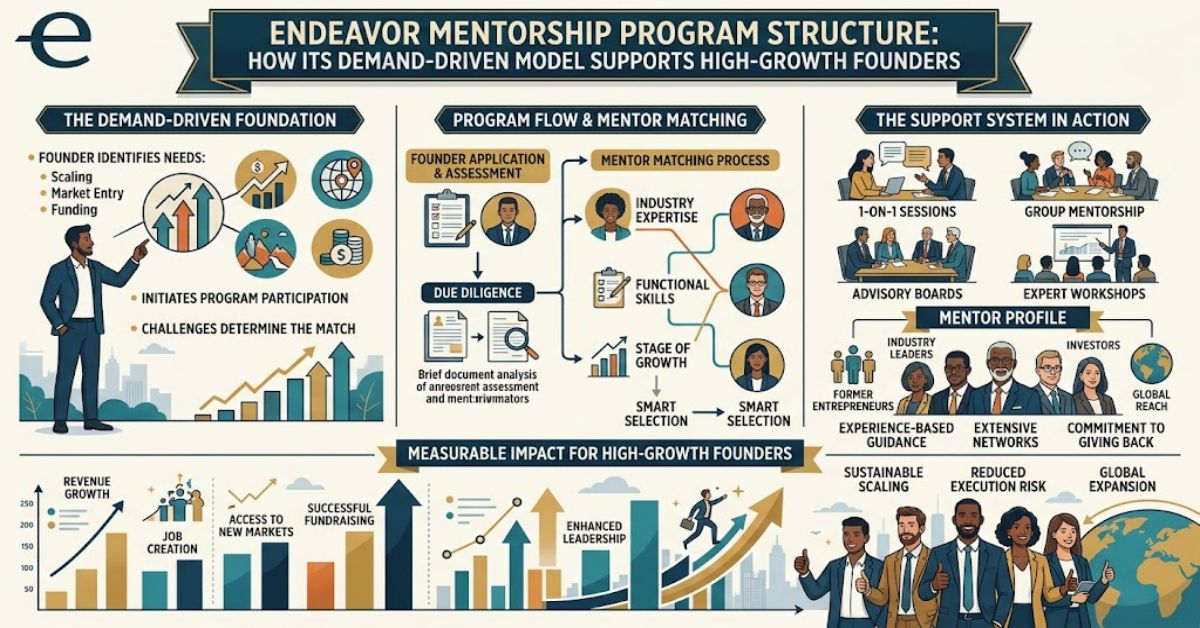
The Endeavor mentorship program structure differs from the traditional accelerator model because it is designed around entrepreneurs’ individual growth challenges rather than a fixed sequence of lessons. Endeavor describes itself as a global network that selects, supports and invests in high-growth entrepreneurs, with mentorship forming a central part of that support system.
The organisation was founded in 1997 and has developed a network spanning dozens of markets. Its current model focuses on founders who have already demonstrated product-market fit and reached an important point in their growth journey. Rather than treating every company as if it needs the same training, Endeavor connects entrepreneurs with people whose experience matches the problem they are trying to solve.
This distinction is important. A founder preparing for international expansion needs different advice from one dealing with executive recruitment, fundraising or organisational design. Endeavor’s model is therefore closer to an on-demand advisory network than a conventional business course.
The organisation says its entrepreneurs typically reach an inflection point where the business has potential for substantial regional or global scale. Its application criteria also indicate that many candidates have annual revenue between $500,000 and $10 million, although these figures are not an absolute requirement for every entrepreneur.
What Makes the Endeavor Model Different?
Traditional accelerator programmes often operate through a defined timetable. Founders attend workshops, complete assignments, meet mentors and eventually graduate.
Endeavor takes a different approach. It explicitly states that it is not an accelerator with a graduation date. Its services are demand-driven and designed to evolve according to what entrepreneurs need as their businesses grow.
| Feature | Endeavor approach | Traditional accelerator |
| Programme structure | Demand-driven | Usually fixed |
| Mentorship | Curated around challenges | Often cohort-based |
| Duration | Ongoing network relationship | Usually fixed-term |
| Peer network | Global and sector-based | Primarily cohort-based |
| Support | Strategic and practical | Often educational |
| Main focus | Scaling existing businesses | Building or validating businesses |
This structure makes the programme particularly relevant to founders who have moved beyond the earliest startup stage.
How Curated Mentorship Works
The central feature of the model is matching entrepreneurs with relevant expertise.
Endeavor’s mentor network includes founders, chief executives, investors, academics and senior business operators. The objective is not simply to give an entrepreneur access to a famous businessperson. The more useful question is whether the mentor has dealt with a comparable problem.
For example, an entrepreneur struggling with international hiring may benefit from an executive who has built distributed teams. A founder preparing for a major funding round may need someone with fundraising and investor experience.
Endeavor describes several forms of structured interaction, including one-to-one mentoring, Advisory Boards and Braintrust Panels. An Advisory Board can involve three mentors working with an entrepreneur on a strategic challenge over a defined period, while a Braintrust Panel can be used for a specific issue or one-off discussion.
This creates a practical advantage: the mentor relationship can be connected to an actual business decision rather than remaining general career advice.
A Demand-Driven Support System
The demand-driven nature of the programme is one of its most important characteristics.
Instead of asking founders to complete the same curriculum, the system starts with the company’s current situation. The entrepreneur may identify a challenge involving pricing, leadership, fundraising, technology, market entry or organisational structure.
A dedicated Endeavor contact can then help curate relevant connections.
This approach reduces one common problem with generic mentorship: advice that sounds useful but has little relevance to the founder’s immediate situation.
Why Timing Matters
Advice is most valuable when it arrives close to a real decision.
A founder considering a new country, for example, may benefit from speaking to someone who has already managed international expansion. The value is not simply the mentor’s knowledge. It is the ability to discuss assumptions, identify blind spots and understand trade-offs before committing significant resources.
That makes timing an important part of the mentorship structure.
Peer-to-Peer Learning
Mentorship is only one component of the Endeavor system. Peer learning also plays a major role.
Endeavor entrepreneurs are connected through local, regional and international communities. Sector-specific networks can bring founders together with people facing similar challenges in technology, finance, consumer businesses and other industries.
This creates a second source of knowledge.
A mentor may provide specialised expertise, while another founder can provide practical experience from having recently faced the same operational problem. Peer conversations can also be less formal, allowing entrepreneurs to discuss mistakes, hiring difficulties and management challenges openly.
The model therefore combines expert advice with founder-to-founder learning.
Data and Structured Insights
Endeavor’s current global network demonstrates the scale of the system. The organisation reports more than 2,900 entrepreneurs across more than 45 markets, with its entrepreneurs collectively generating substantial revenue and employment.
| Insight | Reported figure |
| Founded | 1997 |
| Entrepreneurs in network | 2,900+ |
| Markets | 45+ |
| Jobs created | 4 million+ |
| Revenue generated by entrepreneurs | $88.5 billion |
| Typical candidate revenue range | $500,000–$10 million |
These figures describe the broader Endeavor network rather than proving that mentorship alone caused the reported economic outcomes. That distinction matters when evaluating programme effectiveness.
The Multiplier Effect
A distinctive element of Endeavor’s structure is that mentorship is not intended to move in only one direction.
Founders who benefit from the network are encouraged to give back as their businesses and careers develop. They may later become mentors, investors, selection-panel members or role models for other entrepreneurs.
This creates what Endeavor calls the Multiplier Effect.
The idea is straightforward: supporting one high-growth entrepreneur can eventually produce benefits for other founders and the wider entrepreneurial ecosystem.
It also helps explain why the organisation treats mentorship as a long-term relationship rather than a service that ends when a programme finishes.
Risks and Trade-Offs
The model has clear advantages, but it is not suitable for every entrepreneur.
First, access depends on selection. Endeavor is designed for high-potential scale-ups rather than businesses at the idea stage. Entrepreneurs who are still searching for product-market fit may need a different type of accelerator, incubator or educational programme.
Second, personalised mentorship can produce inconsistent experiences. The value of a session depends heavily on the quality of the match between entrepreneur and mentor.
Third, experienced mentors may provide strong opinions without knowing every detail of a company. Founders still need to evaluate advice against their own data, customers, finances and operating realities.
The best mentorship therefore supports decision-making rather than replacing it.
Real-World Example: AI-Assisted Mentor Matching
Endeavor has also experimented with technology to improve the process of finding appropriate mentors.
In 2024, the organisation described work on an AI-powered system for mentor matching after recognising how much staff time was spent identifying the right person within its large network.
The example reveals a hidden operational challenge in personalised programmes: as the network grows, simply having more mentors does not automatically make matching easier.
Technology can help identify potential connections, but human judgement remains important because mentor suitability depends on context, trust and the specific challenge facing the entrepreneur.
The Future of Endeavor Mentorship Program Structure in 2027
By 2027, the programme is likely to continue combining human expertise with better digital matching and network management.
The direction is already visible. Endeavor has been exploring AI-assisted mentor matching, while its broader model continues to emphasise specialised expertise and international connections.
However, technology is unlikely to eliminate the human element. Mentorship involves judgement, confidentiality and trust. A database can identify people with similar experience, but it cannot fully determine whether two individuals will have a productive strategic relationship.
The strongest future model is therefore likely to be hybrid: technology helps discover relevant expertise while experienced programme teams and entrepreneurs determine how that expertise should be used.
Key Takeaways
- Endeavor is designed for entrepreneurs who have already reached meaningful scale.
- Its mentorship model is demand-driven rather than curriculum-led.
- Mentor matching focuses on specific business challenges.
- Peer-to-peer learning adds another layer of practical knowledge.
- Advisory Boards and Braintrust Panels provide structured strategic input.
- Founders are encouraged to become mentors and investors themselves.
- Technology may improve mentor matching, but human judgement remains essential.
Conclusion
The Endeavor mentorship program structure is best understood as a flexible support network rather than a conventional business course. Its focus is on entrepreneurs who have already demonstrated potential and are facing the more complex problems associated with scaling.
Curated mentorship gives founders access to experienced operators, investors and business leaders, while peer networks provide practical insight from people navigating comparable challenges. The demand-driven model also means that support can change as a company’s needs change.
Its limitations are equally important. Selection is highly focused, mentorship quality depends on the relevance of individual matches, and advice cannot replace the founder’s own judgement.
What makes the model distinctive is its long-term emphasis on the multiplier effect. Entrepreneurs are not only expected to receive support; successful founders can eventually become mentors and investors themselves. That creates a cycle in which experience is passed from one generation of entrepreneurs to another.
FAQ
What is the Endeavor mentorship programme structure?
It is a demand-driven model that connects selected high-growth entrepreneurs with experienced mentors and relevant experts based on their specific business challenges.
Is Endeavor a traditional accelerator?
No. Endeavor states that it is not an accelerator with a fixed graduation date. Its support evolves according to the needs of its entrepreneurs.
Who are Endeavor mentors?
Mentors can include experienced founders, chief executives, investors, academics and senior business operators with expertise relevant to scaling companies.
Does Endeavor provide a fixed curriculum?
The core Endeavor model is not based on a single fixed curriculum. Support is tailored to the entrepreneur’s priorities and growth challenges.
How does peer mentoring work at Endeavor?
Entrepreneurs can connect with other founders through local, regional and international networks, including sector-focused communities.
Is Endeavor suitable for early-stage startups?
The main Endeavor Entrepreneur selection process targets scale-ups that have achieved product-market fit and reached an important growth inflection point. Earlier-stage founders may be better suited to other programmes.
Methodology
This article Endeavor Mentorship Program Structure was developed using Endeavor’s official organisational information, including its published descriptions of the Entrepreneur Experience, selection criteria, mentor network and operating model. Current information published by Endeavor was prioritised to verify how the mentorship system operates and to distinguish the main Endeavor Entrepreneur model from separate regional Scale Up programmes.
The article Endeavor Mentorship Program Structure does not claim that mentorship alone produced Endeavor’s reported economic outcomes. Network-level figures describe the performance of participating entrepreneurs and should not be interpreted as controlled evidence of programme causation. The discussion of AI-assisted mentor matching is based on Endeavor’s own published account of its technology work. Regional programmes can have different structures, so their specific requirements should be checked separately.