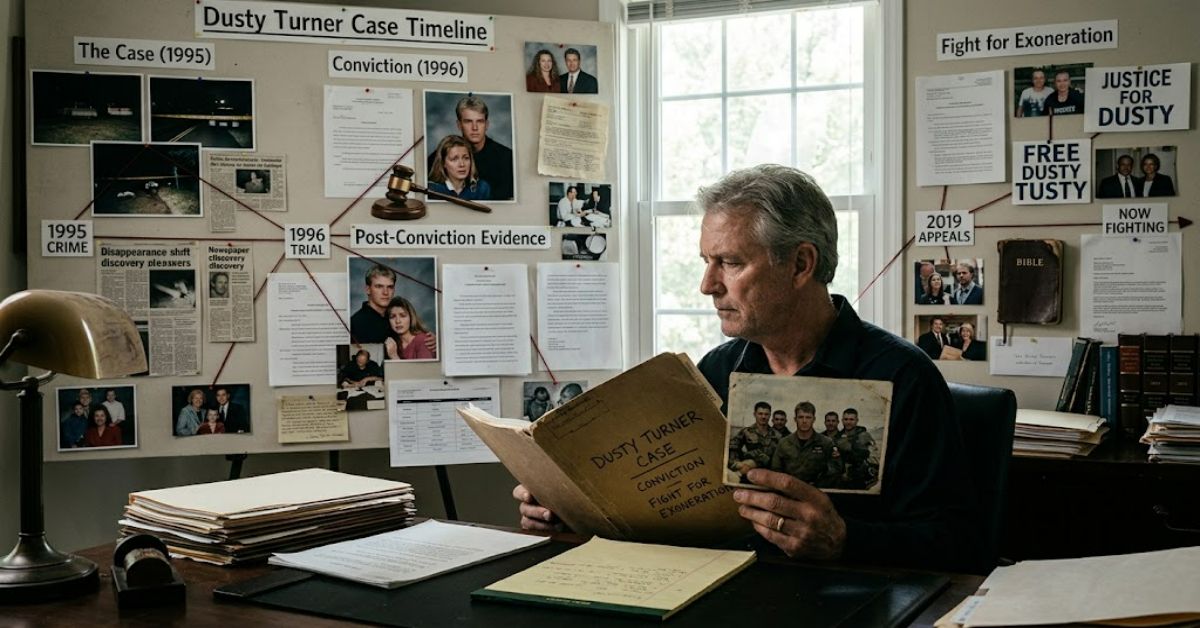
Dusty Turner, formally Dustin Allen Turner, was a young Navy SEAL trainee when his life changed during the summer of 1995. Turner and fellow trainee Billy Joe Brown were connected to the death of Jennifer L. Evans, a 21-year-old pre-med student who disappeared after visiting a Virginia Beach nightclub.
Turner was subsequently convicted of first-degree murder and abduction with intent to defile. He received an 82-year prison sentence. Brown was separately convicted of murder and other offences.
The case became complicated because the two men gave different accounts of what happened. Brown initially implicated Turner, while Turner maintained that Brown killed Evans and that his own involvement was limited to helping dispose of her body. Contemporary reporting shows that prosecutors presented a substantially different version to the jury.
That disagreement became the foundation of a legal battle that lasted for decades.
What Happened in the 1995 Case?
On 18 June 1995, Turner and Brown went to The Bayou, a Virginia Beach nightclub. Evans was also at the venue. According to the later court record, the three became connected during the evening before Evans was killed in the early hours of 19 June.
Brown’s accounts changed during the investigation. At different stages, he blamed Turner, described Turner as responsible for the killing and later offered a different account in which he accepted sole responsibility.
The Virginia Court of Appeals record confirms that Brown later gave a taped confession saying he had acted alone. Turner relied heavily on that confession in seeking a writ of actual innocence.
This is an important distinction when discussing the case: Turner’s conviction is a historical legal fact, while his claim that he was wrongfully convicted remains a contested legal and factual question unless and until the relevant conviction is formally overturned.
The Brown Confession and Legal Fight
Brown’s later statements became one of the most significant developments in the Turner case.
In 2002, Brown gave a taped interview in which he confessed to killing Evans alone. He subsequently signed an affidavit documenting his account. Turner used this new evidence in an effort to obtain a Virginia writ of actual innocence.
Virginia courts considered the evidence, but the litigation did not produce the complete exoneration Turner sought. The legal history illustrates a difficult feature of post-conviction cases: evidence that may appear powerful from a factual perspective does not automatically satisfy the statutory requirements for overturning a conviction.
The distinction between factual innocence claims and legal remedies is central to understanding why Turner could remain convicted despite the later developments surrounding Brown.
| Key event | Date | Significance |
| Jennifer Evans killed | 19 June 1995 | Case begins |
| Turner convicted | 5 September 1996 | Received 82-year sentence |
| Brown gives confession | 2002 | Claims he acted alone |
| Virginia litigation continues | 2009–2011 | Courts examine innocence claims |
| Parole granted | January 2026 | Turner becomes eligible for release |
| Released from prison | 5 March 2026 | After more than 30 years incarcerated |
Why Dusty Turner’s Case Remains Contested
Dusty Turner’s case cannot be understood simply as a conviction followed by parole. The central dispute concerns what Turner actually did on the night Evans died.
Contemporary reporting records Turner’s defence position that Brown killed Evans and that Turner subsequently helped dispose of the body. Prosecutors argued that Turner had a greater role in the crime. The jury ultimately convicted Turner of first-degree murder.
The later Brown confession changed the public and legal discussion, but it did not erase the original conviction.
That difference matters because parole and exoneration are separate legal outcomes. Parole permits release under supervision; it does not itself declare that a conviction was factually or legally wrong.
| Issue | What is established | What remains disputed |
| 1995 death | Jennifer Evans was killed in Virginia Beach | Exact responsibility attributed to Turner |
| 1996 conviction | Turner was convicted and sentenced to 82 years | Whether the conviction accurately reflected his role |
| Brown’s later account | Brown claimed sole responsibility | Weight and legal effect of that account |
| Parole | Granted in 2026 | Does not itself constitute exoneration |
| Current objective | Turner continues seeking to clear his name | Final legal resolution |
Release in 2026
After more than three decades behind bars, Turner was granted parole in January 2026. Reporting described the decision as a 3–2 vote by the Virginia Parole Board. He was released on 5 March 2026.
The release was not the end of the story. Turner subsequently faced a parole violation allegation connected to requirements surrounding significant relationships and his registered-offender status. He was taken back into custody in April and released again on 20 May, after which his parole supervision was transferred to Indiana.
By September 2026, Turner was again appearing publicly to discuss his experience and the long-term impact of the case. A September interview described him as continuing to tell his story after more than 30 years in prison.
His situation demonstrates another practical distinction: physical release does not necessarily mean legal restoration.
The Human and Legal Impact
The Turner case also illustrates how a conviction can continue shaping a person’s life long after the original trial.
For Turner, the consequences included decades in prison, loss of ordinary adult experiences and continued restrictions after release. His supporters have also maintained that he should receive full exoneration rather than parole.
At the same time, the historical record contains the original prosecution case, jury verdict and subsequent appeals. A responsible account therefore needs to separate documented procedural events from claims made by Turner, his supporters, prosecutors and other participants.
That distinction is especially important in high-profile wrongful-conviction cases, where advocacy, media coverage and legal records may present different interpretations of the same evidence.
The Future of Dusty Turner in 2027
The key question heading into 2027 is whether Turner can achieve the full legal clearing of his name that parole did not provide.
His story is likely to remain relevant because it sits at the intersection of wrongful-conviction advocacy, post-conviction law, parole policy and the treatment of people rebuilding their lives after long imprisonment.
Future developments will depend on legal proceedings rather than public attention alone. Any further court decision, prosecutorial action or statutory remedy could materially change the legal position.
For now, the clearest distinction is simple: Turner has been released from prison, but release and exoneration are not the same outcome.
Key Insights
- Turner was convicted in 1996 following the 1995 death of Jennifer Evans.
- The prosecution and defence presented sharply different accounts of his involvement.
- Brown’s later confession became central to Turner’s innocence campaign.
- Courts considered the later evidence without providing the complete exoneration Turner sought.
- Parole was granted in January 2026 and Turner was released in March.
- A subsequent parole violation allegation temporarily returned him to custody.
- Turner continues to seek a formal clearing of his convictions.
Methodology
This article was prepared using the supplied editorial brief alongside court records and contemporary reporting on the Turner case. Primary legal material, including Virginia appellate decisions, was used to distinguish established procedural facts from later claims and advocacy positions.
The principal limitation is that public reporting does not necessarily contain every current procedural development in a post-conviction case. Statements about innocence, responsibility and the interpretation of later evidence are therefore attributed rather than presented as independently established conclusions.
Conclusion
Dusty Turner’s story is a long-running example of the difference between conviction, incarceration, parole and exoneration. His 1996 conviction followed a deeply disputed account of what happened to Jennifer Evans in Virginia Beach in 1995. Later developments, particularly Billy Joe Brown’s claim that he acted alone, transformed the case into a prolonged dispute over evidence and legal responsibility.
Turner’s parole in 2026 brought an end to more than three decades of imprisonment, but it did not automatically erase the convictions attached to his name. His subsequent parole difficulties also demonstrated that release from prison can involve a complicated transition rather than an immediate return to unrestricted life.
As Turner continues to pursue full exoneration, the case remains relevant not only because of its extraordinary duration but because it raises broader questions about post-conviction evidence, legal standards and the practical meaning of justice after a conviction has stood for decades.
FAQ
Who is Dusty Turner?
Dusty Turner, whose full name is Dustin Allen Turner, is a former Navy SEAL trainee who was convicted in Virginia in connection with the 1995 killing of Jennifer Evans.
Why was Dusty Turner imprisoned?
He was convicted in 1996 of first-degree murder and abduction with intent to defile and received an 82-year sentence.
Did Billy Joe Brown confess to the murder?
Brown later gave a taped confession claiming that he acted alone in killing Evans. Turner relied on that account in his post-conviction legal efforts.
When was Dusty Turner released?
Turner was released on parole on 5 March 2026 after spending more than 30 years in Virginia prisons.
Is Dusty Turner fully exonerated?
No. Parole and exoneration are legally different. Turner has continued to seek a full clearing of his name.
Where is Dusty Turner now?
After his 2026 release and a subsequent parole-related detention, his parole was transferred to Indiana. Later 2026 reporting described him as publicly discussing his experience.
References
FindLaw. (1998). Brown v. Commonwealth.
Virginia Court of Appeals. (2009). Turner v. Commonwealth, 54 Va. App. 458.
Supreme Court of Virginia. (2011). Turner v. Commonwealth, Record No. 101457.
The Virginian-Pilot. (1995–1996). Contemporary reporting on the Jennifer Evans murder investigation and Dustin Turner trial.
WAVY-TV 10. (2026). Reporting on Dustin Turner’s parole and subsequent release.
The Herald-Times. (2026). Reporting on Dusty Turner’s release and return to Bloomington.
Locked In with Ian Bick. (2026, 10 September). I Was a Navy Seal – Then I Survived 30+ Years In Prison | Dusty Turner.