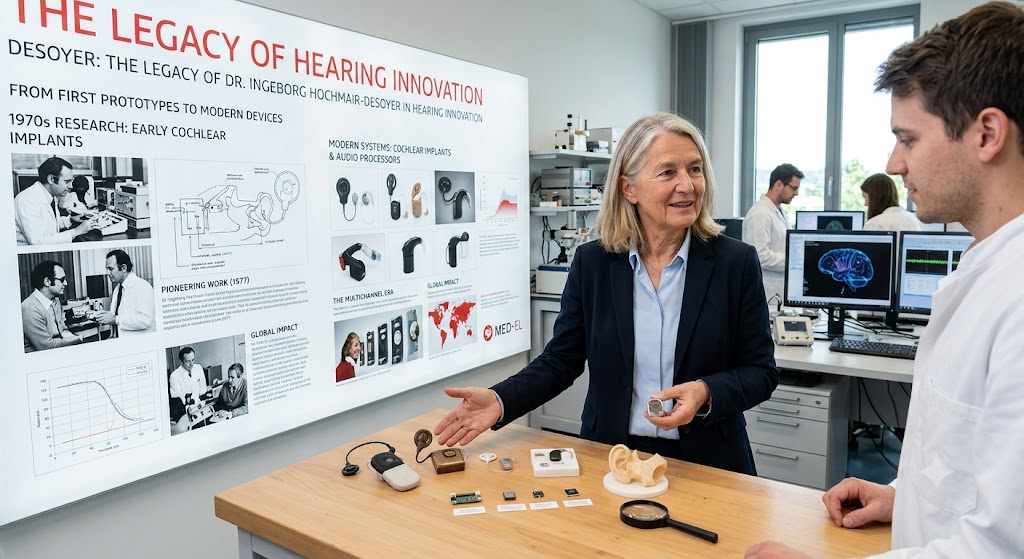
When people search for desoyer, they are most often looking for information about Dr Ingeborg Hochmair-Desoyer, an Austrian electrical engineer whose work transformed the lives of millions of people with severe hearing loss. As the co-founder, Chief Executive Officer (CEO), and Chief Technology Officer (CTO) of MED-EL, she helped develop the world’s first micro-electronic multi-channel cochlear implant in 1977 alongside her husband, Professor Erwin Hochmair.
Her achievements extend far beyond engineering. Dr Hochmair-Desoyer combined scientific research, medical innovation, and entrepreneurial leadership to establish one of the world’s leading hearing implant companies. Today, MED-EL products are used in more than 130 countries, helping children and adults regain access to sound through advanced hearing technology.
Who Is Dr Ingeborg Hochmair-Desoyer?
Dr Ingeborg Hochmair-Desoyer is widely recognised as one of the pioneers of modern cochlear implant technology. Born in Austria, she studied electrical engineering at the Vienna University of Technology before pursuing advanced research in biomedical engineering.
Rather than following a conventional engineering career, she focused on solving one of medicine’s most difficult challenges—restoring hearing for people with profound deafness.
Working alongside her husband, Prof Erwin Hochmair, she developed a revolutionary solution that would eventually become the world’s first successful multi-channel cochlear implant.
This innovation represented a major step forward compared with earlier single-channel devices, which provided limited sound perception.
The Development of the First Multi-Channel Cochlear Implant
In 1977, the Hochmairs introduced the first micro-electronic multi-channel cochlear implant.
Instead of amplifying sound like a traditional hearing aid, the implant bypassed damaged parts of the inner ear and directly stimulated the auditory nerve using electrical signals.
This breakthrough significantly improved speech recognition and communication for many people with profound hearing loss.
The invention combined expertise from multiple disciplines, including:
| Field | Contribution |
| Electrical Engineering | Implant electronics and signal processing |
| Biomedical Engineering | Device design and safety |
| Audiology | Hearing assessment and rehabilitation |
| Surgery | Implant placement procedures |
The interdisciplinary nature of the project helped establish cochlear implants as a practical medical technology rather than an experimental concept.
Founding MED-EL
Following their research success, Dr Hochmair-Desoyer and Prof Hochmair co-founded MED-EL, an Austrian medical technology company dedicated to hearing implants.
The company’s mission has remained focused on improving hearing through continuous innovation.
Today, MED-EL develops several hearing solutions, including:
- Cochlear implants
- Bone conduction systems
- Middle ear implants
- Audio processors
- Hearing rehabilitation technologies
Its products support patients across different age groups and hearing conditions.
Why the Multi-Channel Implant Was Revolutionary
Before multi-channel implants, hearing restoration options were limited for individuals with profound sensorineural hearing loss.
Single-channel devices could provide awareness of environmental sounds but often struggled to deliver understandable speech.
The multi-channel design improved sound quality by stimulating different areas of the cochlea separately.
This advancement enabled users to distinguish speech more effectively while improving communication in everyday environments.
The innovation also created a foundation for future generations of cochlear implant technology.
The Impact on Global Healthcare
The work associated with desoyer has influenced hearing healthcare worldwide.
Thousands of hospitals now perform cochlear implant procedures using technologies that evolved from early research conducted by the Hochmairs.
Children born with severe hearing impairment often receive implants at an early age, allowing many to develop spoken language skills alongside their hearing peers.
Adults who lose hearing later in life also benefit from improved communication, social participation, education, and employment opportunities.
The long-term impact extends beyond medicine by improving quality of life for individuals and their families.
Leadership Beyond Engineering
Dr Hochmair-Desoyer is not only an accomplished engineer but also an experienced technology entrepreneur.
Leading MED-EL required balancing scientific research with manufacturing, regulatory compliance, international expansion, and long-term product development.
Her leadership demonstrates how technical expertise and business strategy can work together to bring life-changing medical innovations to patients around the world.
The company continues investing heavily in research while collaborating with surgeons, audiologists, universities, and rehabilitation specialists.
Challenges in Hearing Implant Development
Although cochlear implant technology has advanced considerably, several challenges remain.
Access to specialised surgery varies across countries, making treatment less available in some regions.
Rehabilitation also plays a crucial role after implantation. Patients often require months of auditory training to maximise hearing outcomes.
Additionally, no implant can fully replicate natural hearing, meaning continued research remains essential for improving future devices.
The Future of Hearing Technology
Looking towards 2027 and beyond, cochlear implant technology is expected to continue evolving.
Researchers are exploring:
- Artificial intelligence for personalised sound processing
- Improved wireless connectivity
- Smaller external processors
- Better battery performance
- Enhanced speech recognition in noisy environments
Future developments may also integrate machine learning to automatically adjust listening settings according to different environments.
While these innovations remain under development, they reflect the continuing influence of pioneers like Dr Hochmair-Desoyer.
Key Takeaways
- Dr Ingeborg Hochmair-Desoyer is a pioneering Austrian electrical engineer.
- She co-developed the world’s first micro-electronic multi-channel cochlear implant in 1977.
- She co-founded MED-EL, now one of the world’s leading hearing implant companies.
- Her work transformed treatment options for people with profound hearing loss.
- Modern cochlear implant technology continues to build upon her groundbreaking research.
Conclusion
The name desoyer is closely connected with one of the most important advances in modern hearing technology. Through determination, scientific excellence, and entrepreneurial leadership, Dr Ingeborg Hochmair-Desoyer helped reshape the future of hearing restoration. Her invention of the first multi-channel cochlear implant created new opportunities for millions of people who previously had limited options for communication.
Her contributions continue to influence biomedical engineering, audiology, and medical technology today. As MED-EL expands its research and hearing solutions worldwide, the legacy of Dr Hochmair-Desoyer remains evident in every new generation of cochlear implant technology. Her career serves as an inspiring example of how engineering innovation can directly improve human lives, making her one of the most influential figures in the history of hearing healthcare.