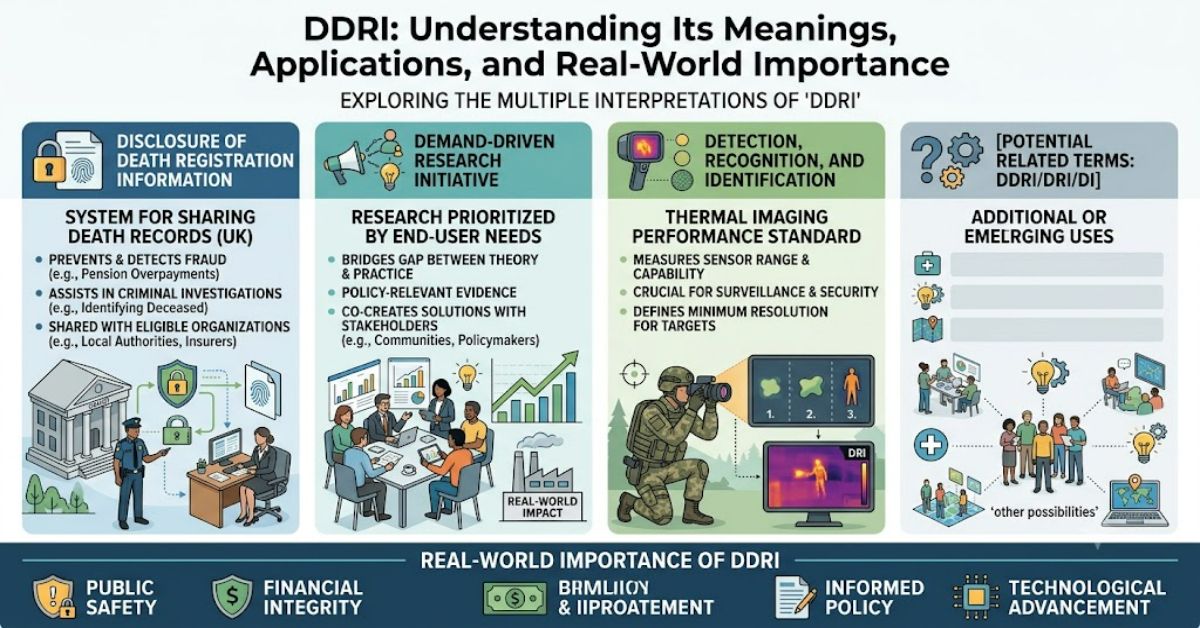
The term DDRI does not have a single universal meaning. Instead, it is an acronym used across several professional disciplines, each representing a different organisation, research method, or scientific concept. Depending on where you encounter the abbreviation, DDRI may refer to the Digestive Diseases Research Institute at Tehran University of Medical Sciences, DNA Damage Response Inhibitors in oncology, a Dialogue and Dispute Resolution Institute, or Data-Driven Retrospective Interviewing in user experience research.
Because these meanings span medicine, healthcare, legal conflict resolution, and technology, readers often struggle to determine which definition applies. The surrounding context usually provides the answer.
This guide explains the most common meanings of DDRI, their objectives, practical applications, and why they matter in today’s research and professional environments.
Digestive Diseases Research Institute (DDRI)
One of the best-known meanings of DDRI is the Digestive Diseases Research Institute based at Tehran University of Medical Sciences (TUMS) in Iran.
The institute focuses on understanding, preventing, and treating diseases affecting the digestive system. Its work supports healthcare professionals through scientific research, clinical trials, education, and international collaboration.
Main Areas of Research
The institute conducts studies on:
- Liver diseases
- Stomach disorders
- Colorectal cancer
- Pancreatic diseases
- Inflammatory bowel disease (IBD)
- Hepatitis
- Gastrointestinal infections
- Nutrition and digestive health
Researchers combine laboratory science with patient care to develop improved diagnostic methods and treatment strategies.
DNA Damage Response Inhibitors (DDRI)
Another important meaning of DDRI appears in cancer biology, where it stands for DNA Damage Response Inhibitors.
Every human cell contains mechanisms that detect and repair damaged DNA. These protective systems are known as the DNA Damage Response (DDR).
Cancer cells often rely heavily on these repair mechanisms because they divide rapidly and accumulate genetic mutations. Scientists have developed DDR inhibitors to block these repair pathways, making cancer cells more vulnerable to treatment.
How DDR Inhibitors Work
These drugs:
- Prevent cancer cells from repairing damaged DNA.
- Increase the effectiveness of chemotherapy.
- Enhance radiation therapy.
- Trigger cancer cell death while attempting to minimise damage to healthy tissue.
Several pharmaceutical companies are actively researching new DDR inhibitors for different types of cancer.
Comparison of Major DDRI Meanings
| Meaning | Industry | Purpose |
| Digestive Diseases Research Institute | Healthcare | Research digestive diseases and improve patient care |
| DNA Damage Response Inhibitors | Oncology | Improve cancer treatment by blocking DNA repair |
| Dialogue and Dispute Resolution Institute | Legal Services | Resolve conflicts through mediation and negotiation |
| Data-Driven Retrospective Interviewing | User Research | Improve product design through behavioural analysis |
Dialogue and Dispute Resolution Institute
In legal and organisational settings, DDRI may represent a Dialogue and Dispute Resolution Institute.
These organisations help individuals, businesses, and governments resolve disagreements without lengthy court proceedings.
Their services often include:
- Mediation
- Arbitration
- Workplace conflict resolution
- Family dispute resolution
- Community engagement
- Professional negotiation training
Alternative dispute resolution has become increasingly valuable because it saves time, reduces legal costs, and encourages cooperative solutions.
Data-Driven Retrospective Interviewing (DDRI)
Within user experience (UX) research and behavioural science, DDRI can refer to Data-Driven Retrospective Interviewing.
Researchers first observe how users interact with software or websites using recorded behavioural data. Afterwards, participants review their actions while answering interview questions.
This process helps researchers understand not only what users did but why they made certain decisions.
Benefits
- More accurate user feedback
- Better product design
- Reduced recall bias
- Improved customer experience
- Higher quality usability research
Technology companies increasingly rely on these methods to improve digital products.
Why Context Matters
Because DDRI has multiple meanings, understanding the surrounding context is essential.
For example:
- A medical journal discussing liver disease almost certainly refers to the Digestive Diseases Research Institute.
- A scientific oncology paper likely discusses DNA Damage Response Inhibitors.
- A legal conference mentioning mediation probably refers to a Dialogue and Dispute Resolution Institute.
- A UX research article discussing customer behaviour may mean Data-Driven Retrospective Interviewing.
Recognising these distinctions prevents misunderstandings and ensures accurate interpretation.
Real-World Impact
Each interpretation of DDRI contributes to its respective field.
Healthcare researchers use the Digestive Diseases Research Institute to improve diagnosis and treatment for millions of patients affected by gastrointestinal diseases.
Cancer specialists continue investigating DNA Damage Response inhibitors as part of personalised medicine, seeking therapies that target cancer cells more precisely while reducing side effects.
Conflict resolution professionals promote peaceful negotiation techniques that can strengthen workplaces, communities, and legal systems.
Meanwhile, technology companies employ Data-Driven Retrospective Interviewing to design software that better meets user needs, improving digital experiences across industries.
The Future of DDRI in 2027
By 2027, each area associated with DDRI is expected to continue evolving.
Medical research institutes are likely to adopt more artificial intelligence tools for analysing patient data and accelerating discoveries in digestive health.
DNA Damage Response inhibitors may become part of broader personalised cancer treatment strategies as clinical research identifies new combinations with immunotherapy and targeted therapies.
Dispute resolution organisations are expected to expand online mediation services, making conflict resolution more accessible across borders.
User research methods such as Data-Driven Retrospective Interviewing will probably become increasingly integrated with AI-powered behavioural analytics, helping companies create more intuitive digital products.
Key Takeaways
- DDRI has multiple recognised meanings across different industries.
- Context determines which definition applies.
- The Digestive Diseases Research Institute advances digestive healthcare research.
- DNA Damage Response inhibitors are an important area of cancer treatment research.
- Dialogue and Dispute Resolution Institutes promote peaceful conflict management.
- Data-Driven Retrospective Interviewing improves user research and product development.
Conclusion
DDRI is a versatile acronym representing important concepts in medicine, scientific research, legal services, and technology. While the Digestive Diseases Research Institute and DNA Damage Response Inhibitors are the most widely recognised meanings, the acronym also appears in dispute resolution and user experience research. Understanding the context in which DDRI is used helps readers interpret information accurately and appreciate its significance within each discipline. As research and innovation continue to advance, the various applications of DDRI are expected to play increasingly important roles in improving healthcare, supporting scientific discoveries, enhancing conflict resolution, and creating better digital experiences.
Frequently Asked Questions
What does DDRI stand for?
DDRI commonly stands for Digestive Diseases Research Institute, DNA Damage Response Inhibitors, Dialogue and Dispute Resolution Institute, or Data-Driven Retrospective Interviewing.
Which meaning of DDRI is the most common?
In healthcare and academic research, the Digestive Diseases Research Institute and DNA Damage Response Inhibitors are the most widely recognised meanings.
Are DNA Damage Response inhibitors currently used in cancer treatment?
Several DDR inhibitors are being researched, with some already approved for specific cancers and others undergoing clinical trials.
Why is the Digestive Diseases Research Institute important?
It advances research into digestive disorders, develops better treatments, and supports medical education and international collaboration.
Why does DDRI have multiple meanings?
Many professional fields independently create acronyms, leading to identical abbreviations representing different concepts depending on the context.