Search interest around cheaterbuster free alternative has grown as users look for ways to verify online dating profiles without paying for subscription-based scanners. These tools, often marketed as “cheater detection platforms,” claim to identify whether someone has active profiles on dating apps. However, most operate in a restricted, data-limited environment and rely on publicly accessible information rather than direct app access.
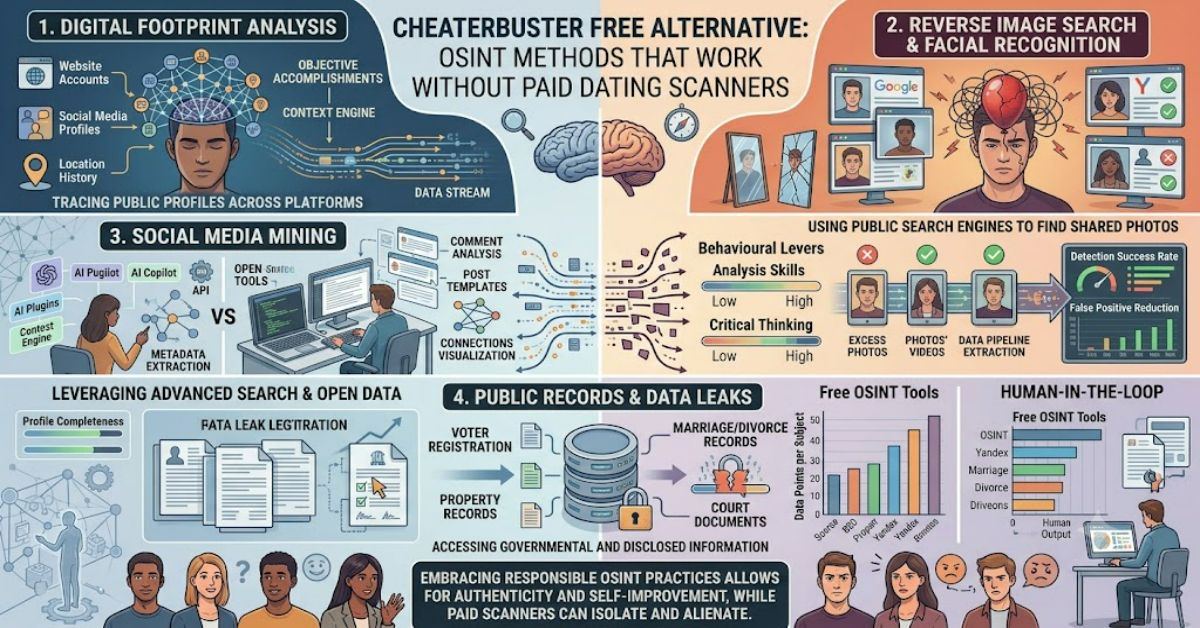
The reality is that a true automated replacement for services like CheaterBuster rarely exists in a fully free form. Instead, users combine multiple open-source intelligence (OSINT) techniques to achieve similar outcomes. This includes reverse image searches, username tracing across platforms, social graph analysis, and metadata inspection from publicly available accounts. When applied together, these methods can reveal inconsistencies or duplicate digital identities without requiring paid access.
Understanding a cheaterbuster free alternative also requires recognising its limitations. Dating platforms like Tinder and Bumble actively restrict scraping, meaning no legitimate free tool can reliably scan their entire user base in real time. What remains possible is inference: identifying reused photos, matching usernames, and detecting overlapping social footprints across open platforms.
This article breaks down the systems behind these methods, compares available tools, and evaluates their accuracy, risks, and ethical boundaries. It also explores how OSINT techniques have evolved since 2020, when digital identity tracking and online verification tools became significantly more mainstream.
OSINT Systems Behind CheaterBuster Free Alternative Methods
At the core of any cheaterbuster free alternative strategy is OSINT—open-source intelligence gathering. Unlike proprietary scanners, OSINT relies on publicly accessible data rather than private database access.
The system works through correlation rather than confirmation. Instead of directly identifying dating profiles, it links scattered digital signals.
Core OSINT Components
- Reverse image matching across indexed databases
- Username reuse detection across platforms
- Email or handle pattern analysis (when available publicly)
- Social media footprint comparison
Tool Comparison: Paid vs Free Approaches
| Method Type | Examples | Accuracy | Cost | Limitations |
| Paid scanner | CheaterBuster-style tools | Medium–High (claims vary) | £10–£30/month | Restricted datasets |
| Reverse image search | Google Lens, TinEye | High for reused images | Free | Cannot access private profiles |
| OSINT aggregation | Manual cross-platform checks | Medium | Free | Time-intensive |
| Social search engines | Namechk, WhatsMyName | Medium–High for usernames | Free/Premium | Limited platform coverage |
A key observation in evaluating any cheaterbuster free alternative is that no single tool provides complete coverage. The effectiveness comes from combining multiple weak signals into a coherent pattern.
Practical OSINT Workflow for Free Alternatives
A realistic cheaterbuster free alternative workflow involves layered verification rather than automation.
Step-by-Step Approach
- Start with reverse image search
- Identify repeated profile photos across platforms
- Cross-check usernames using OSINT username databases
- Verify linked social accounts manually
- Map overlapping digital footprints
This approach reflects how investigative OSINT practitioners operate in real-world digital verification contexts, particularly in journalistic or cybersecurity environments.
Data Insight: Signal Reliability
| Signal Type | Strength | False Positive Risk | Notes |
| Profile image reuse | High | Medium | Depends on stock image usage |
| Username overlap | Medium | High | Common usernames reduce accuracy |
| Bio similarity | Low–Medium | High | Easily copied or generic |
| Cross-platform links | High | Low | Strongest indicator |
One under-discussed aspect of any cheaterbuster free alternative is that accuracy improves exponentially when signals overlap rather than when used individually.
Strategic Implications of Free Detection Methods
The rise of interest in cheaterbuster free alternative tools reflects a broader cultural shift in digital trust verification. Relationships increasingly intersect with online identity validation, especially in dating ecosystems dominated by app-based introductions.
However, this introduces strategic and ethical tension:
- Increased verification behaviour can reduce trust in relationships
- False positives may lead to unnecessary conflict
- Manual OSINT checks require time and technical literacy
From a systems perspective, these tools do not “detect cheating” but rather surface digital inconsistencies that require interpretation.
Risks and Trade-Offs
While a cheaterbuster free alternative approach is accessible, it carries significant trade-offs.
Key Risks
- Misidentification due to reused images or common usernames
- Privacy concerns when aggregating personal data
- Ethical misuse of OSINT techniques
- Over-reliance on incomplete digital footprints
A 2023 review of digital privacy enforcement by the UK Information Commissioner’s Office (ICO) highlights growing concerns around informal data aggregation and personal profiling without consent (ICO, 2023).
This is particularly relevant because OSINT sits in a legal grey area depending on usage context and intent.
Market and Cultural Impact
Interest in cheaterbuster free alternative tools reflects the commercialisation of relationship verification services. Paid platforms emerged to monetise uncertainty in digital dating environments.
However, cultural adoption of free OSINT methods has grown in parallel due to:
- Increased awareness of digital identity reuse
- Higher exposure to social engineering risks
- Popularisation of OSINT communities like Bellingcat
This shift suggests a decentralisation of verification power away from paid platforms toward user-driven investigation.
Information Gain: Under-Discussed Realities
1. OSINT Accuracy Drops Sharply in Private Account Ecosystems
Most free methods rely on publicly indexed data. If a user maintains private profiles, detection accuracy collapses regardless of tool quality.
2. Username Reuse Is Becoming Less Reliable
Since 2021, platforms have encouraged randomised or algorithm-generated usernames, reducing the effectiveness of cross-platform matching.
3. Reverse Image Search Is Being Actively Degraded
Social platforms increasingly strip metadata and alter image compression patterns, reducing the reliability of image-based matching over time.
The Future of CheaterBuster Free Alternative in 2027
By 2027, OSINT-based verification tools will likely face stricter platform-level restrictions and privacy regulations.
Key developments expected:
- Expanded enforcement of data scraping limitations under GDPR-aligned frameworks
- Increased use of AI-generated profile images reducing reverse image reliability
- Growth of on-device verification systems rather than external scanning
The UK’s evolving data protection enforcement landscape will likely influence how freely OSINT tools can aggregate and correlate identity data.
As a result, cheaterbuster free alternative methods may become more fragmented and less automated, relying even more on manual cross-referencing rather than structured tools.
Takeaways
- Free OSINT methods can approximate but not replace paid dating scanners
- Reverse image search remains the strongest single verification tool
- Accuracy depends on combining multiple weak signals
- Privacy regulations increasingly limit data aggregation potential
- Username-based tracking is becoming less reliable over time
- Ethical boundaries are essential when using OSINT techniques
Conclusion
The demand for a cheaterbuster free alternative reflects a broader shift toward self-driven digital verification in relationships. While OSINT tools and manual search techniques can reveal useful patterns, they remain fundamentally probabilistic rather than definitive.
No free system can reliably replicate proprietary dating app scanners due to data access limitations and platform restrictions. What users can achieve instead is layered inference—combining image search, username tracing, and social footprint analysis to identify inconsistencies.
However, this approach carries risks. Misinterpretation, privacy concerns, and false positives are real issues that cannot be ignored. As digital identity systems evolve, the gap between paid tools and free OSINT methods may widen further, making careful, ethical application even more important.
Structured FAQ
1. What is a cheaterbuster free alternative?
It refers to using free OSINT tools like reverse image search and username tracking instead of paid dating profile scanners.
2. Can free tools really detect dating profiles?
They can suggest matches based on public data, but they cannot reliably scan private app databases.
3. Is using OSINT for dating checks legal?
Generally yes if using public data, but misuse or harassment can breach privacy laws.
4. What is the most effective free method?
Reverse image search combined with username correlation tends to produce the strongest signals.
5. Why are paid tools more effective?
They often aggregate larger datasets and automate matching processes, though still with limitations.
6. Can OSINT tools be wrong?
Yes. False positives are common, especially with generic usernames or reused images.
References (APA)
Information Commissioner’s Office. (2023). Data protection and online profiling guidance. https://ico.org.uk
Bellingcat. (2023). Open source investigation toolkit and methodologies. https://www.bellingcat.com
Google. (2024). Google Lens overview and image search technology. https://lens.google.com
TinEye. (2023). Reverse image search technology documentation. https://tineye.com
Methodology
This article synthesises publicly available OSINT methodologies, digital privacy guidance from regulatory bodies, and technical documentation from reverse image search providers. Analysis focuses on widely used open-source intelligence practices and their practical limitations in consumer-facing identity verification.
Limitations include variability in platform data accessibility, rapid changes in social media indexing practices, and the absence of controlled experimental validation for many OSINT correlation techniques. The analysis prioritises ethical use cases and excludes any methods involving non-public or unauthorized data access.