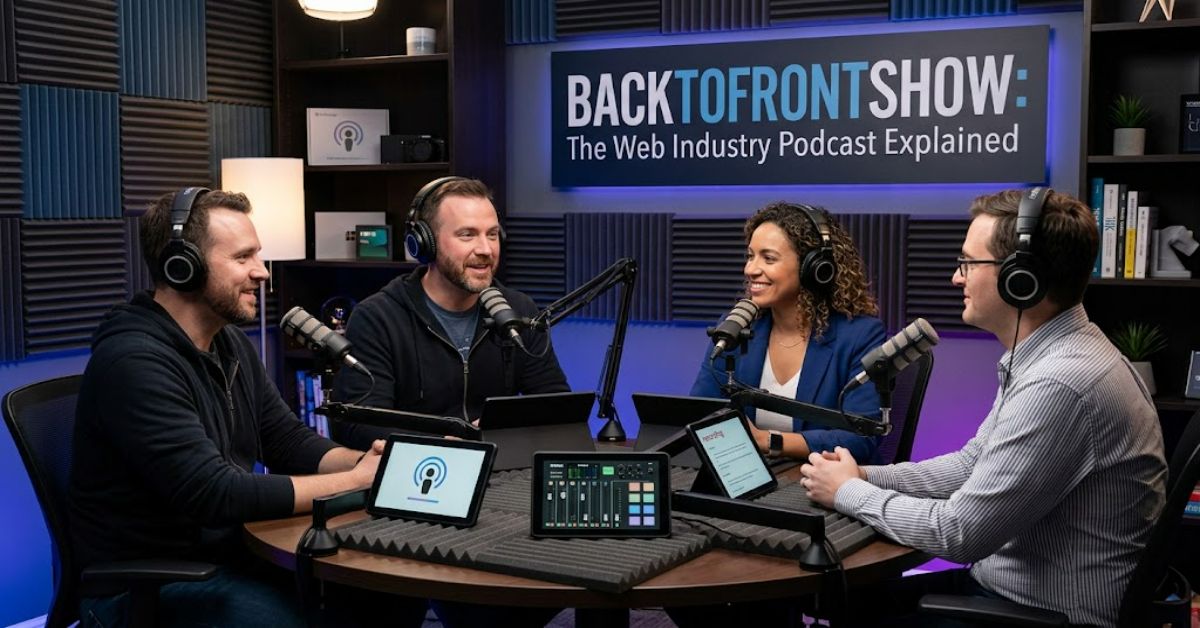
Backtofrontshow is commonly used to refer to The Back to Front Show, a podcast hosted by web industry veterans Keir Whitaker and Kieran Masterton. The programme focused on web development, design, technology, startups and digital content, combining professional knowledge with informal conversation.
The podcast began in January 2013 and developed a distinctive identity around discussions between its two regular hosts. Rather than functioning as a traditional technology news programme, it explored subjects from the perspective of people working within the web industry. Episodes covered topics such as digital publishing, content platforms, design changes, advertising, coding, startups and online business.
The show is particularly interesting today because many of the subjects it discussed have continued to shape the technology industry. Questions about free online content, platform dependence, changing design practices and the future of digital publishing remain relevant even though the tools and platforms have changed.
The Back to Front Show is now best understood as an archive rather than a regularly updated technology podcast. Historical podcast listings record more than 100 episodes, while the archive contains discussions from different periods of the web industry’s development.
For readers searching for backtofrontshow, the main value lies in understanding what the podcast was, who created it, what it covered and why its archive remains useful to people interested in technology and digital culture.
Who Hosted Backtofrontshow?
The Back to Front Show was hosted by Keir Whitaker and Kieran Masterton. Both had professional experience in the web industry, giving the programme a practitioner-led perspective.
Whitaker has worked across ecommerce, digital products and technology partnerships, while Masterton was also involved in web development and digital projects. Their professional backgrounds helped create conversations that moved comfortably between technical subjects and broader industry issues.
The hosts were not simply presenting technology news. Their discussions often included opinions, professional experiences and observations about how the internet was changing the way people worked.
That conversational approach became one of the show’s defining features.
What Did the Podcast Cover?
The subject matter was broad enough to interest developers, designers, entrepreneurs and digital-content professionals.
Common themes included:
- Web development
- Web design
- Startups
- Digital publishing
- Content platforms
- Online advertising
- Technology trends
- Professional development
- Social media
- Internet culture
Some episodes focused on a particular company or platform, while others discussed wider changes affecting people working online.
For example, archived episodes examined questions surrounding Medium, paid digital content and advertising. Other discussions touched on design changes, startups and the changing responsibilities of people working in web development.
This mixture made the programme different from highly specialised programming podcasts. A listener could encounter technical discussion in one episode and a broader conversation about digital business or culture in another.
Backtofrontshow Compared With Other Technology Podcasts
| Feature | The Back to Front Show | Specialist Developer Podcast | Technology News Podcast |
| Main format | Host conversation | Technical discussion | News analysis |
| Regular hosts | Two | Varies | Usually several |
| Technical depth | Moderate | High | Moderate |
| Industry commentary | High | Moderate | High |
| Cultural discussion | High | Lower | Moderate |
| Historical value | High | Varies | Depends on topic |
| Primary audience | Web professionals | Developers | General technology audience |
The show’s main strength was its balance.
It did not require listeners to be expert programmers, but it also avoided treating technology as a simple consumer subject. The hosts discussed the professional realities behind websites, platforms and digital products.
Why the Informal Style Worked
One distinctive feature of the programme was its informal production style.
The show was associated with remote recording and relatively simple podcast equipment. References to microphones, Skype connections and home recording environments reflected the production culture of early specialist podcasts.
Today, technology podcasts are often produced with professional studios, video cameras, multiple microphones and edited clips for social media.
The Back to Front Show belonged to an earlier period when audio alone could be enough to build a specialist audience.
That makes its format historically interesting. It demonstrates that niche technology media did not always require a large production operation. Strong subject knowledge and chemistry between presenters could be enough.
The Podcast as a Record of Web Culture
One of the most valuable aspects of backtofrontshow is its historical perspective.
Technology changes quickly, but industry problems often move more slowly.
Discussions about free content, advertising, online publishing and platform economics continue today. The specific companies may change, but the underlying questions remain.
For researchers and technology enthusiasts, old podcast episodes can therefore provide context that current news coverage cannot.
An article written today tells readers what is happening now. An archived conversation shows how professionals understood a problem when it was developing.
That difference gives specialist podcasts lasting value.
Key Archive Information
| Archive Detail | Information |
| Podcast name | The Back to Front Show |
| Common search term | backtofrontshow |
| Hosts | Keir Whitaker and Kieran Masterton |
| Launch period | January 2013 |
| Main subject | Web and technology industry |
| Format | Informal host discussion |
| Core themes | Design, development, startups and digital content |
| Historical episode listings | More than 100 episodes |
| Main archive value | Technology and web-industry history |
Podcast directories can contain different episode counts because episodes may be removed, duplicated or indexed differently. For that reason, individual directory figures should be treated as historical catalogue information rather than audited statistics.
Three Important Insights
The archive is more valuable for context than current technical advice
Older episodes can explain how web professionals viewed emerging trends, but technical recommendations should not automatically be followed today. Development frameworks, browser standards, security practices and hosting technologies have changed substantially.
The informal production style was part of the appeal
The relatively simple recording approach reflected an era when specialist podcasts could succeed without highly polished video production. The hosts’ knowledge and conversational chemistry were central to the experience.
The topics remain surprisingly relevant
Digital publishing, advertising, platform dependence and online business remain major technology issues. The terminology has changed, but many of the underlying questions remain.
Risks and Limitations
Historical technology podcasts need to be approached carefully.
The biggest limitation is age. A discussion about a web platform from 2014 or 2016 may contain assumptions that are no longer accurate. Companies change ownership, products are discontinued and technical standards evolve.
There is also a risk of confusing commentary with established fact. Podcasts are conversational formats, so opinions expressed by hosts should be understood as perspectives rather than automatically treated as authoritative research.
Finally, podcast archives can be fragmented across hosting platforms. Some episodes may be easier to find on one service than another.
These limitations do not reduce the archive’s value. They simply mean listeners should distinguish historical insight from current technical guidance.
The Future of Backtofrontshow in 2027
By 2027, the most realistic value of backtofrontshow is likely to remain archival.
Podcasting itself continues to expand across audio and video platforms. Modern audiences increasingly discover programmes through multiple services, search engines and social clips.
For an older technology podcast, preservation therefore matters.
Stable episode archives, searchable descriptions and accurate metadata can help older programmes remain discoverable. Transcripts would make archived conversations even more useful because they would allow researchers to search discussions by topic rather than listening to entire episodes.
The Back to Front Show does not need to become a current weekly programme to remain relevant. Its historical material can continue to provide insight into the development of the web industry.
Key Takeaways
- Backtofrontshow refers to The Back to Front Show.
- Keir Whitaker and Kieran Masterton were its principal hosts.
- The programme focused on web development, design, startups and digital culture.
- Its informal format reflected the early professional podcasting environment.
- Archived episodes provide useful historical context for modern technology discussions.
- Older technical recommendations should be checked against current documentation.
- The archive’s long-term value depends on accessibility and preservation.
Conclusion
Backtofrontshow represents an important type of specialist technology media: a practitioner-led podcast built around conversation rather than formal reporting.
Hosted by Keir Whitaker and Kieran Masterton, The Back to Front Show explored the practical and cultural issues affecting people working in the web industry. Its discussions covered development, design, startups, digital publishing and technology trends.
Although the programme should not be treated as a source of current technical instructions, its archive remains useful. It captures the concerns of web professionals during a period when mobile design, online publishing, social platforms and digital business models were changing rapidly.
The show’s informal style is also part of its historical significance. It demonstrates how specialist communities could create valuable media without the elaborate production systems common in modern podcasting.
For anyone researching web-industry history or looking for thoughtful discussions about the internet’s development, the Back to Front Show remains a worthwhile archive to explore.
Frequently Asked Questions
What is backtofrontshow?
Backtofrontshow is commonly associated with The Back to Front Show, a podcast about web development, design, technology, startups and digital content.
Who hosted the Back to Front Show?
The programme was hosted by web industry professionals Keir Whitaker and Kieran Masterton.
What topics did backtofrontshow cover?
Episodes covered web development, design, digital publishing, startups, online advertising, technology platforms and wider internet culture.
Is the Back to Front Show still active?
The original programme is best treated as an archive rather than a consistently active current podcast. Historical listings contain episodes from its earlier publishing period.
Where can old episodes be found?
Archived episodes have been available through podcast hosting and directory platforms, including SoundCloud and podcast-indexing services. Availability can vary because older podcast archives are sometimes reorganised.
Is the podcast useful for web developers?
Yes, particularly for developers interested in industry history, professional culture and broader technology discussions. However, older technical advice should be checked against current documentation.
Methodology
This article was prepared from publicly available information about The Back to Front Show, its hosts and its archived episodes. Podcast directories, the show’s historical material and professional profiles were used to establish the programme’s identity, themes and timeline.
No claim is made that the writer personally attended a recording or conducted a new interview with either host. The article therefore relies on documented archive evidence and attributed professional information rather than invented firsthand experience.
Because podcast directories can contain different episode counts and dates, catalogue figures are presented cautiously. Historical podcast content should also be separated from current technical guidance because web technologies and industry practices change over time.
Editorial Disclosure: This article was drafted with AI assistance and should be reviewed and verified by the editorial team at RubbleMagazine.co.uk before publication. All dates, named claims and references should be independently checked against their original sources.
References
Back to Front Show. (n.d.). The Back to Front Show episode archive.
Listen Notes. (n.d.). Back to Front Show: Keir Whitaker and Kieran Masterton.
Shopify. (2016). Web design podcasts and industry recommendations. Shopify Partners.
SoundCloud. (n.d.). The Back to Front Show.
Ofcom. (2026). Audio listening in the UK. Office of Communications.