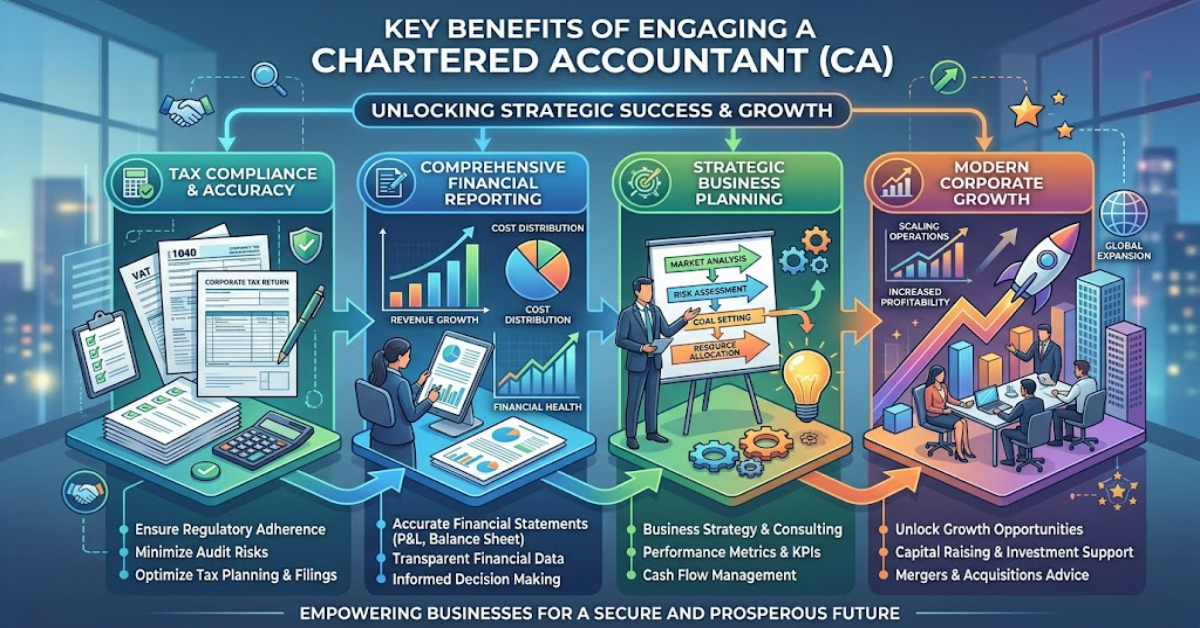
The chartered accountants benefits businesses receive can go well beyond preparing annual accounts. A suitably qualified and regulated Chartered Accountant can help with tax compliance, financial reporting, cash-flow planning, business structure and strategic financial decisions.
This distinction matters because accounting services vary considerably. In the UK, not every person offering accountancy or taxation services is necessarily a Chartered Accountant or regulated by a professional body. The Institute of Chartered Accountants in England and Wales (ICAEW) specifically advises clients to check qualifications, practising certificates, professional indemnity insurance, relevant experience and whether the firm is authorised for specialist services.
The need for accurate financial management is also increasing. HM Revenue & Customs (HMRC) reported that it dealt with approximately 5.7 million businesses during 2025–26 and collected £966.4 billion in tax revenue. It also delivered more than £50 billion in compliance yield during that period.
For business owners, that environment makes financial accuracy more than an administrative concern. Errors can affect tax liabilities, cash flow, reporting and decision-making.
A Chartered Accountant can therefore act as both a compliance specialist and a financial adviser. However, the benefits depend on choosing the right professional and matching the service to the complexity of the business.
What Does a Chartered Accountant Do?
A Chartered Accountant is a professionally qualified accountant with specialist training and, depending on the professional body and services offered, may work across accounting, audit, taxation, corporate finance and business advisory.
ICAEW describes Chartered Accountants as professionals who combine technical knowledge, ethical standards and financial expertise to help organisations and individuals achieve financial and strategic objectives.
Typical services include:
- Preparing and reviewing financial statements
- Corporation Tax and other tax work
- Management accounts
- Cash-flow forecasting
- Budgeting and financial planning
- Business structuring
- Audit and assurance where appropriately authorised
- Financial analysis
- Business growth advice
The precise service depends on the firm. A small business may primarily need tax and accounts support, while a growing company may require management reporting, forecasting and transaction advice.
Key Chartered Accountants Benefits for Businesses
1. Stronger Tax Compliance
One of the clearest advantages is professional support with tax compliance.
HMRC explains that accounting profits provide the practical starting point for calculating taxable trading profits, after which relevant tax adjustments may need to be made.
A Chartered Accountant can help identify the information needed for tax calculations, organise records and ensure submissions are prepared appropriately.
This does not remove the business owner’s responsibilities. Directors and business owners remain responsible for the accuracy of their company’s affairs, even when an accountant acts as an agent.
2. Better Financial Visibility
Accurate accounts do more than satisfy reporting requirements. They show how a company is actually performing.
Regular management accounts can help identify changes in:
- Gross margin
- Operating costs
- Debtor balances
- Cash flow
- Profitability
- Working capital
This allows management to respond before a financial problem becomes severe.
For businesses using technology to manage financial information, forecasting can also become more efficient. RubbleMagazine’s guide to financial forecasting for SaaS companies explores how centralised financial data and automated reporting can support better forecasting.
3. Support With Regulatory Responsibilities
Limited companies have legal accounting and record-keeping responsibilities. GOV.UK states that companies must maintain financial and accounting records and keep company finances separate from those of owners and directors.
Professional support can reduce the administrative burden associated with these responsibilities.
The regulatory environment is also changing. From 1 April 2026, businesses filing Company Tax Returns with HMRC generally need to use commercial software because the previous HMRC online filing service closed on 31 March 2026.
This is a practical example of why professional financial support can be useful: compliance is not static.
4. Strategic Business Advice
A good accountant should not simply report what happened last year.
Financial information can be used to assess whether a company can afford new employees, equipment, premises or expansion.
A Chartered Accountant may help management compare scenarios, evaluate costs and understand the financial implications of different decisions.
This becomes particularly valuable during periods of growth, acquisition or restructuring.
Chartered Accountant vs General Accountant
Not every business needs a Chartered Accountant. The appropriate choice depends on the services required.
| Factor | General Accountant | Chartered Accountant |
| Bookkeeping | Common | Common |
| Basic accounts preparation | Common | Common |
| Tax support | Often available | Often available |
| Strategic advice | Depends on provider | Commonly available |
| Specialist expertise | Varies | Professional qualification provides a stronger formal framework |
| Audit | Requires appropriate authorisation | Requires appropriate authorisation |
| Business planning | Depends on experience | Often available |
| Professional-body oversight | Varies | Depends on membership and regulatory status |
The important point is that the word “chartered” should not replace proper due diligence. ICAEW advises prospective clients to check whether an accountant has a practising certificate, professional indemnity insurance and the relevant authorisations.
When Is Hiring a Chartered Accountant Most Valuable?
The benefits tend to become more significant as financial complexity increases.
| Business situation | Potential value |
| New limited company | Structure and compliance guidance |
| Rapid revenue growth | Forecasting and financial controls |
| Multiple employees | Payroll and reporting support |
| Complex tax position | Specialist tax planning and compliance |
| Business expansion | Financial modelling and budgeting |
| Investment or acquisition | Due diligence and financial analysis |
| Regulatory complexity | Stronger compliance processes |
A microbusiness with simple finances may only need limited annual support. A company with multiple revenue streams, employees, assets and financing arrangements is likely to gain more from continuous professional advice.
Risks and Trade-Offs
Professional accountancy has a cost, so the decision should be based on value rather than the assumption that every company requires the same level of service.
Fees can vary according to turnover, transaction volume, complexity and the services included.
There is also a risk of over-reliance. Hiring an accountant does not mean directors can stop understanding their own financial position. Management should still review accounts, cash flow and tax obligations.
Another important consideration is scope. Not every accountant is authorised to provide every regulated service. ICAEW recommends checking whether the professional has the necessary authorisation for audit, investment business or insolvency work.
A Practical Selection Checklist
Before appointing a Chartered Accountant, businesses should check:
- Professional qualification and membership.
- Practising certificate where relevant.
- Professional indemnity insurance.
- Experience in the company’s industry.
- Services included within the fee.
- Tax and accounting software compatibility.
- Communication arrangements.
- Availability during important reporting periods.
- Relevant specialist authorisations.
- Clear engagement terms.
HMRC guidance also makes clear that an accountant’s responsibilities should be defined through an engagement arrangement. The exact work undertaken depends on the agreement between accountant and client.
The Future of Chartered Accountants in 2027
The profession is moving towards a combination of traditional accounting expertise and digital financial management.
HMRC’s 2025–26 annual report highlights Making Tax Digital developments and the government’s work towards e-invoicing. HMRC also reported that artificial intelligence and advanced analytics helped protect and recover £10 billion in tax during 2025–26.
ICAEW has similarly updated its ACA qualification to reflect technology, sustainability, ethics and changing professional skills.
This suggests that the future accountant will spend less time on repetitive data processing and more time interpreting financial information, advising clients and managing risk.
The qualification itself will not replace technology. Its value will increasingly lie in professional judgement, technical knowledge, ethical standards and the ability to translate financial data into sound business decisions.
Key Takeaways
- Chartered Accountants Benefits can provide support across accounting, taxation, compliance and strategic planning.
- Their expertise can become particularly valuable as a company grows more complex.
- Financial records provide important management information, not simply compliance documentation.
- Businesses should check professional qualifications and authorisations before appointment.
- Digital tax administration is increasing the importance of suitable accounting software.
- Directors remain responsible for their company’s financial and legal obligations.
- The strongest accountant-client relationship combines technical expertise with clear communication.
Conclusion
The main value of a Chartered Accountants Benefits lies in combining technical financial knowledge with professional judgement. Businesses can benefit from support with tax compliance, financial reporting, forecasting, business planning and regulatory responsibilities.
That value is particularly apparent when a company is growing or dealing with complex financial decisions. However, appointing a professional does not transfer every responsibility away from directors or business owners. Management still needs to understand its finances and make informed decisions.
The right choice also depends on the business. A small company with straightforward transactions may require limited services, while a growing organisation could benefit from regular management accounts, forecasting and strategic advice.
Professional status should therefore be one part of the selection process rather than the only criterion. Experience, authorisation, insurance, communication and industry knowledge also matter.
As UK tax administration becomes increasingly digital, the role of the Chartered Accountant is likely to become more analytical. The strongest professionals will combine compliance expertise with technology and commercially useful financial insight.
Frequently Asked Questions
What are the main benefits of hiring a Chartered Accountant?
The main benefits include professional support with accounting, tax compliance, financial reporting, forecasting and business planning. The exact value depends on the business’s size and complexity.
Are Chartered Accountants better than ordinary accountants?
Not necessarily for every situation. A Chartered Accountant has a recognised professional qualification, but businesses should still assess experience, services, authorisation and cost before choosing a provider.
Can a Chartered Accountant help with tax planning?
Yes, Chartered Accountants commonly provide tax-related services. However, the exact scope varies between firms, and specialist or regulated work may require additional authorisation.
Do small businesses need a Chartered Accountant?
Not always. A small business with straightforward finances may only need limited accounting support. More complex tax, payroll, growth or financial reporting requirements can make professional assistance more valuable.
How do I choose a Chartered Accountant?
Check professional qualifications, practising certificates, insurance, relevant experience, services, fees and authorisations. ICAEW specifically recommends asking these questions before appointing an accountant.
Can an accountant guarantee tax compliance?
No. An accountant can prepare or advise on tax matters, but the business remains responsible for its legal and financial obligations. HMRC can still conduct compliance checks.
Methodology
This article Chartered Accountants Benefits was researched using current UK primary and professional sources, principally GOV.UK, HMRC and ICAEW. Regulatory and compliance claims were checked against current government guidance, while professional-status information was checked against ICAEW’s published guidance.
No firsthand testing, private client interview or fabricated practitioner quotation has been used. The documented evidence comes from current institutional guidance and published professional standards. This is important because the benefits of accountancy services vary according to the provider, client circumstances and engagement scope.
The analysis of Chartered Accountants Benefits also considers the counterargument that not every business requires a Chartered Accountant. Cost, business complexity and the specific services required should determine whether the additional professional expertise represents good value.
Editorial disclosure: This article was drafted with AI assistance and should be independently reviewed by a human editor before publication. All financial, regulatory and professional claims should be checked against the original sources at publication.
References
Institute of Chartered Accountants in England and Wales. (2026). The benefits of using a regulated Chartered Accountant. ICAEW.
Institute of Chartered Accountants in England and Wales. (2026). What is chartered accountancy? ICAEW.
Institute of Chartered Accountants in England and Wales. (2026). What is a Chartered Accountant? ICAEW Business Advice Service.
HM Revenue & Customs. (2026). HMRC annual report and accounts 2025 to 2026: Executive summary. GOV.UK.
HM Revenue & Customs. (2026). Company and accounting records. GOV.UK.
HM Revenue & Customs. (2026). Filing company accounts and tax returns if you previously used the HMRC online service. GOV.UK.
HM Revenue & Customs. (2026). Tax compliance checks. GOV.UK.
HM Revenue & Customs. (2026). Check if you meet HMRC’s conditions to register as a tax adviser. GOV.UK.